

Why RCS Messaging Is the Future

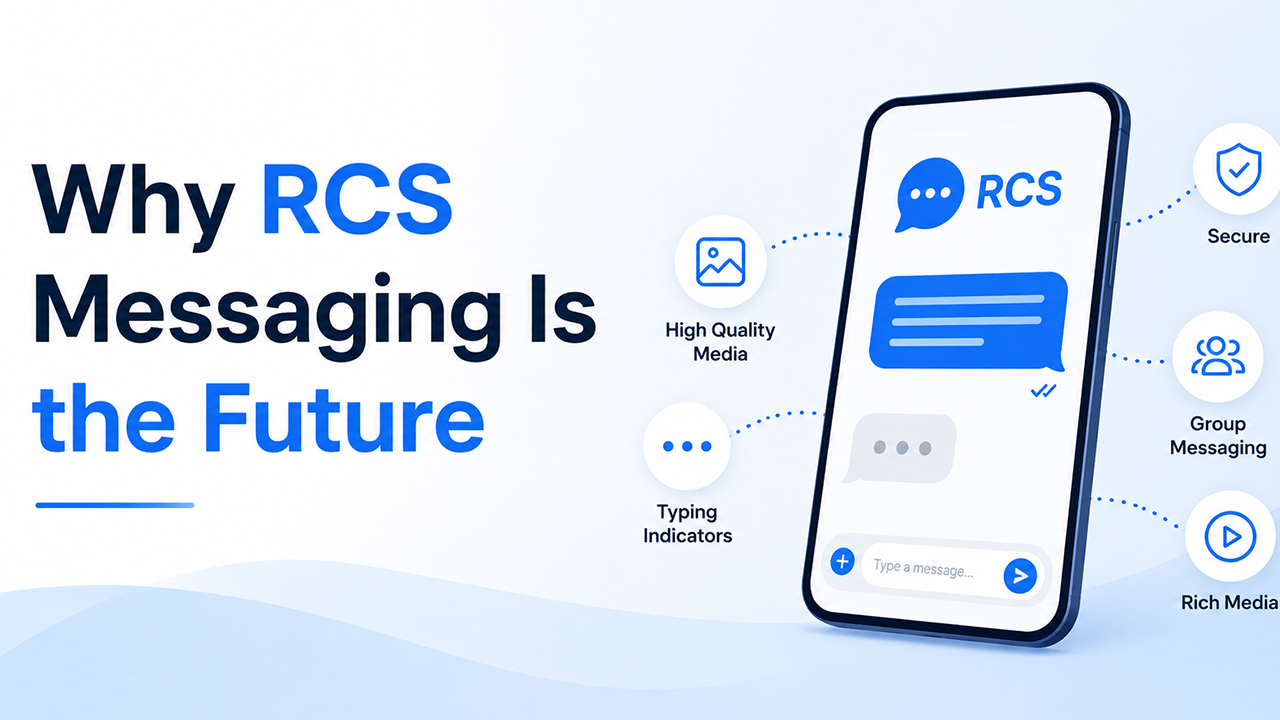
SMS was revolutionary for its time. A 160-character window into your customer's pocket felt like magic in 1992. But customers today live in a world of rich media, instant verification, and seamless digital experiences — and plain text simply cannot keep pace. Enter RCS: Rich Communication Services, the messaging standard quietly rewriting the rules of how businesses and consumers connect. This isn't a modest upgrade. It's a generational leap, and the brands that recognize it early will own the next era of mobile engagement.
This piece makes the full case for RCS — from its strategic positioning as a premium channel, to the hard data on engagement, to the growing momentum that makes right now the inflection point for adoption.
The Strategic Case for RCS: A Premium Messaging Channel
RCS sits at a rare intersection: the reach of SMS with the richness of a native app. It runs in the device's default messaging app — no download required — and supports branded sender profiles, verified business IDs, high-resolution images, video, carousels, and interactive reply buttons. For marketers, this means a channel that feels premium without the friction of asking users to install yet another app.
Unlike email, which battles inbox clutter, or push notifications, which are increasingly muted by users, RCS lands where attention already lives — the messages screen — with a visual identity that immediately signals trust. Verified sender badges replace anonymous strings of digits, telling customers exactly who is writing before they even read the first word.
How RCS Drives Better Customer Engagement
3×Higher click-through vs SMS
85%Open rate on RCS messages
2×Conversion lift in retail pilots
The engagement numbers tell a consistent story. When a promotional message includes a tappable product carousel, a one-touch "Shop Now" button, and a branded header image, customers don't just read — they act. Rich content reduces the cognitive distance between intent and purchase, collapsing what used to be a multi-step journey (read text → open browser → search → navigate) into a single, frictionless tap.
"The best customer experience is one that requires the least effort. RCS removes steps — and every removed step is a conversion that wasn't lost."
Building Loyalty and Trust With RCS Marketing
Trust is the scarcest currency in digital marketing. Phishing, spam, and impersonation have taught consumers to be suspicious of unexpected messages. RCS addresses this structurally: business sender verification is baked into the protocol. Customers see a verified checkmark alongside your brand name and logo — the equivalent of the padlock icon in a browser, but for messaging.
This matters beyond aesthetics. When customers know a message is genuinely from their bank, retailer, or airline, engagement quality rises. They respond, they click, they trust the link. Brands that deploy RCS early benefit from a halo of credibility that undifferentiated SMS senders simply cannot project.
RCS for End-to-End Customer Journeys
Where RCS truly separates itself is in orchestrating entire journeys — not just single-message blasts. Consider a retail example: a customer receives a personalized product recommendation with an image carousel. They tap to browse, select a size, and confirm purchase — all within the conversation thread. A shipping confirmation with real-time tracking follows. After delivery, a satisfaction survey with quick-tap ratings completes the loop.
No app switch. No browser redirect. No friction. The entire post-purchase journey lives inside one thread, in the app the customer already trusts. This kind of conversational commerce, once the exclusive province of costly custom apps, is now accessible to any brand with an RCS integration.
The Growing RCS Ecosystem and Industry Momentum
For years, RCS adoption was hampered by one conspicuous holdout: Apple. That changed. With iOS 18 bringing RCS support to iPhone, the last major barrier to universal reach collapsed. Today, RCS-capable devices account for the overwhelming majority of smartphones in circulation across North America, Europe, and rapidly expanding markets in Asia and Latin America.
Google has invested heavily in the Android ecosystem's RCS infrastructure, while major carriers globally have committed to the standard. Messaging platforms, CPaaS providers, and marketing clouds are racing to build RCS into their core offerings. The infrastructure, in short, is no longer speculative — it is here, it is scaled, and it is accelerating.
Why Now Is the Right Time for RCS Adoption
First-mover advantage in messaging channels is real and measurable. Brands that adopted SMS marketing early captured audience opt-in lists at scale before saturation. Those that moved into push notifications ahead of the curve enjoyed open rates that look impossible today. RCS is at that same early-majority tipping point right now — consumer awareness is growing, but brand adoption is still nascent. The window to build familiarity, refine messaging, and accumulate opt-in audiences at favorable cost-per-acquisition will not stay open indefinitely.
Beyond competitive positioning, the economics make sense. RCS messages cost more than basic SMS per send, but the sharply higher conversion rates mean cost-per-acquisition typically falls. For campaigns where a single conversion justifies dozens of sends, the ROI math is straightforward.
Step Into the Future With RCS
The case for RCS is not merely technical — it is strategic, economic, and cultural. Customers are conditioned by apps like WhatsApp, Instagram, and iMessage to expect rich, interactive conversations. When a brand's messaging finally matches that expectation, engagement doesn't just improve; the entire relationship between brand and consumer is reframed. You stop being a sender of alerts and become a participant in a conversation.
RCS is that reframing, built into the default messaging layer of virtually every modern smartphone on earth. The technology is ready. The ecosystem is mature. The competitive window is open — but it won't be forever. The brands bold enough to move now won't just be communicating with their customers more effectively. They'll be setting the standard that everyone else scrambles to follow.
The future of messaging isn't a new app. It's already in your customer's pocket. Time to show up there like you mean it.