

Why Google Seems To Favor Big Brands & Low-Quality Content

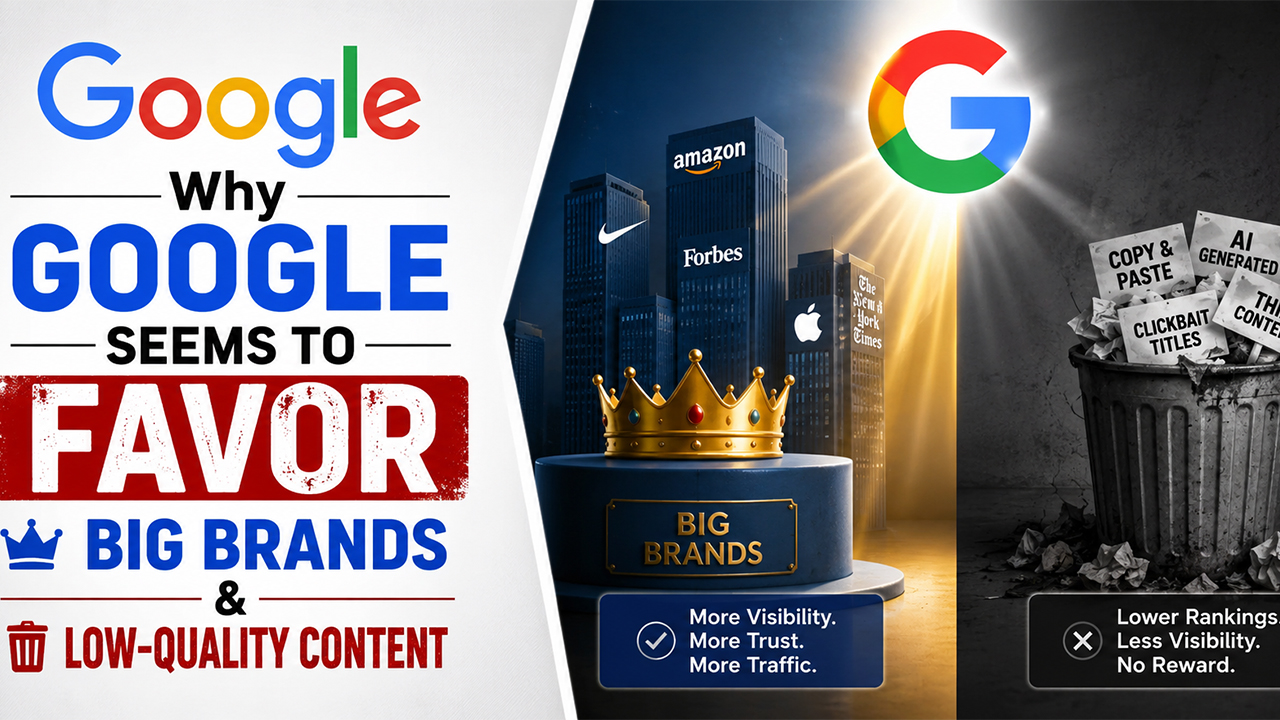
Open any Google search result page today and something feels off. The blue links you once trusted have given way to a strange hierarchy: household brand names clustered at the top, Reddit threads surfaced as authoritative sources, and a creeping layer of AI-generated summaries that confidently paraphrase content you'll never actually read. Meanwhile, the independent publisher who spent three months researching a definitive guide sits somewhere on page four, invisible.
This isn't paranoia. It's a pattern that SEO professionals, content creators, and everyday searchers have been documenting with growing frustration. The question worth asking is no longer "does Google show the best content?" but rather: has Google structurally shifted toward rewarding authority, brand signals, and engagement volume over the actual quality of information it serves?
260KSearch results analyzed
~68%Clicks going to top 3 results
4×Brand CTR vs. unknown sites
Google's Complicated History with Fairness
Google Has Always Had Favorites
This isn't the first time Google has been accused of bending its own rules. Over the past decade, the company has faced regulatory scrutiny in the EU, antitrust investigations in the US, and a steady drumbeat of credible allegations that its search results favor its own products — Google Shopping, Google Hotels, Google Flights — over third-party competitors who play by the same rules the algorithm supposedly enforces neutrally.
Former insiders have described internal pressure to keep major advertisers happy. Leaked documents and court proceedings have revealed that the "quality" signals Google publicly champions — E-E-A-T (Experience, Expertise, Authoritativeness, Trustworthiness) — don't always translate cleanly into what actually ranks. Brand recognition and domain authority, accumulated through years of marketing spend rather than editorial merit, often do the heavy lifting.
"A well-funded brand publishing mediocre content at scale consistently outranks a solo expert publishing once a month — and Google's algorithm, intentionally or not, is the engine making that happen."
The Content Quality Paradox
Big Brands and the Low-Quality Advantage
Here's the uncomfortable reality that a recent analysis of 260,000 search results surfaces: Google's evaluation of content quality is far more correlated with domain-level authority signals than with what's actually written on the page. A 400-word thin answer published by a major media outlet frequently outranks a deeply researched, well-cited 3,000-word piece from an independent expert — not because the former is better, but because the domain it lives on has more backlinks, more traffic history, and more brand searches.
The phenomenon has a name in SEO circles: "SERP fluffyfication." It describes the gradual replacement of original, substantive content with keyword-optimized filler — content that is engineered to look like a quality answer to Google's crawlers while offering the human reader remarkably little. Large content farms and even blue-chip publishers have mastered this format. They produce at volume, optimize aggressively, and their existing authority acts as a multiplier that carries weak content to positions it has no editorial right to occupy.
The rise of AI-generated content has accelerated this trend. When producing 500 articles costs the same as producing five, the economics of scale favor whoever can publish most. The sites that benefit most are those that already have the authority moat. New entrants with genuinely original research find the door increasingly difficult to open.
Why the Algorithm Breaks This Way
Explanations for a Broken SERP
Google's core ranking systems were designed around a fundamental proxy: if many trusted sites link to a page, that page is probably good. This worked reasonably well in 2005. In 2026, the web's link graph is a product of marketing budgets, PR campaigns, and network effects as much as it is a reflection of actual quality. The proxy has been gamed so thoroughly that it now often measures brand investment rather than informational value.
There's also a user-behavior loop at play. People click on recognizable brand names because they trust them — not necessarily because those pages deliver better answers. Google interprets those clicks as quality signals and ranks the brands higher, which generates more clicks, which reinforces the ranking. The algorithm, in effect, learns the preferences of a user population that has been trained by years of exposure to those same brands dominating the top results. It's a closed loop that independent creators have very little power to break.
SERP pixel data research makes this disturbingly concrete: a significant portion of users never scroll past the first visible screen. If your brand doesn't appear in that precious above-the-fold real estate — which is increasingly occupied by featured snippets, AI overviews, paid ads, and big-brand organic results — you may as well not exist for most searchers.
Beyond Google
AI Search, Reddit, and the Shifting Landscape
Ironically, the emergence of AI-powered search may represent both the biggest threat to traditional SEO and the most meaningful opportunity for quality content to regain ground. AI citation engines — the systems that power tools like Perplexity, ChatGPT search, and Google's AI Overviews — tend to favor content that is specific, well-structured, and demonstrably authoritative in tone. Reddit threads, for all their informality, are being cited heavily because they represent real human experience — exactly the signal that algorithmically generated fluff cannot replicate.
Multi-location businesses and publishers who optimize for AI citation — by producing content with clear, citable claims, named experts, verifiable data, and structured formatting — are finding visibility in AI search that has largely eluded them in traditional Google results. This doesn't mean abandoning Google. It means expanding the definition of "being visible" beyond a single ranking system that may, structurally, no longer be optimizable by quality alone.
Conclusion: Authority Has Won — For Now
The evidence, taken together, points to an uncomfortable conclusion: Google is currently rewarding authority over quality, and it is doing so in ways that are not entirely accidental. The feedback loops built into its ranking systems, the dominance of brand signals, and the economics of AI-generated content at scale have created a search environment where being well-known is a more reliable path to the top than being genuinely useful.
That doesn't mean quality content has no future. It means the strategy must evolve. Stop optimizing exclusively for Google, and start optimizing for visibility — across AI search, community platforms, direct brand recognition, and the kind of originality that citation engines actively seek out. The SERP, as we've known it, may already be broken. The question is whether your content strategy has caught up to that reality.