

Why Businesses Without AI Will Fall Behind

Introduction
A decade ago, the internet separated companies that adapted from those that didn't. Blockbuster ignored streaming and vanished; Netflix embraced it and became a household name. Today, a similar shift is underway, and artificial intelligence is the dividing line. AI is no longer a futuristic add-on reserved for tech giants — it has become a practical, everyday tool that shapes how companies serve customers, manage operations, and make decisions. Businesses that fail to adopt AI aren't just missing out on a trend; they're gradually losing ground to competitors who move faster, work smarter, and understand their customers better. This shift isn't happening in some distant future — it's happening right now, and the gap between AI-enabled businesses and those without is widening every quarter.
The Speed of Change Is Accelerating
One of the biggest misconceptions about AI adoption is that businesses have time to "wait and see." In reality, the pace of AI development and adoption has compressed what used to be a decade-long technology cycle into just a few years. Cloud computing took roughly ten years to become mainstream business infrastructure. Generative AI tools have achieved comparable adoption in a fraction of that time. Companies that delay integration aren't simply pausing — they're falling further behind competitors who are already using AI to automate processes, generate insights, and reduce costs.
This acceleration means the cost of inaction compounds. A business that waited two years to adopt cloud computing lost some efficiency but could usually catch up. A business waiting two years on AI adoption today risks losing customer relationships, market share, and institutional knowledge about how to use these tools effectively — knowledge that competitors are building daily.
Efficiency and Cost Advantages
AI's most immediate impact on business is operational efficiency. Tasks that once required hours of manual work — data entry, customer support responses, scheduling, basic content drafting, and financial reporting — can now be automated or significantly accelerated. This isn't about replacing employees wholesale; it's about freeing human talent from repetitive work so they can focus on strategy, creativity, and relationship-building.
Consider customer service. AI-powered chatbots and support systems can now handle a significant share of routine inquiries instantly, any time of day, without the wait times that frustrate customers. Businesses without these tools are stuck paying for larger support teams while still delivering slower response times. Over time, this translates directly into higher operating costs and lower customer satisfaction scores compared to AI-equipped competitors.
The same pattern holds in manufacturing, logistics, marketing, and finance. Predictive maintenance reduces equipment downtime. AI-driven inventory forecasting reduces waste and stockouts. Automated marketing tools personalize campaigns at a scale no human team could match manually. Each of these represents real, measurable cost savings that compound over months and years — savings that businesses without AI simply cannot access.
Better Decision-Making Through Data
Modern businesses generate enormous amounts of data, but data alone isn't valuable — the ability to interpret it quickly and accurately is. AI excels at identifying patterns, trends, and anomalies across massive datasets that would take human analysts weeks to process, if they could process them at all.
Companies using AI-driven analytics can spot shifting customer preferences before they become obvious, identify supply chain risks before they cause disruptions, and adjust pricing strategies in near real-time based on market conditions. This isn't a hypothetical advantage — it's a practical one that shows up in inventory decisions, marketing spend, hiring plans, and product development.
Businesses relying solely on gut instinct or delayed quarterly reports are, in effect, making decisions with outdated information while their AI-equipped competitors are adjusting in real time. In competitive markets, this lag can mean the difference between capturing a trend early and missing it entirely.
The Customer Experience Gap
Customer expectations have shifted dramatically. People are accustomed to personalized recommendations, instant responses, and seamless digital experiences — largely because AI-powered companies have set that standard. When a business fails to meet these expectations, customers notice, and they have no shortage of alternatives.
AI enables hyper-personalization at scale: recommending products based on browsing behavior, tailoring email content to individual preferences, and predicting what a customer might need before they ask. Businesses without these capabilities often default to generic, one-size-fits-all approaches that feel outdated compared to competitors offering tailored experiences. Over time, this erodes customer loyalty and makes it harder to compete on anything other than price.
Talent and Workplace Considerations
There's also a talent dimension to this shift. Skilled employees increasingly expect to work with modern tools that make their jobs more efficient and less tedious. Businesses that don't invest in AI risk becoming less attractive employers, particularly to younger professionals who have grown up with AI-assisted tools in school and previous jobs. Meanwhile, employees at AI-adopting companies gain experience that makes them more valuable and more likely to seek advancement elsewhere if their current employer falls behind.
This creates a talent gap that mirrors the technology gap: AI-forward companies attract and retain better talent, which in turn strengthens their AI capabilities further, creating a reinforcing cycle that latecomers struggle to break into.
It's Not Too Late — But the Window Is Narrowing
None of this means businesses without AI are doomed. Adoption doesn't require a massive overhaul overnight. Many companies start small — automating a single workflow, piloting an AI tool in customer service, or using AI for data analysis in one department — before expanding gradually. The key is starting now rather than waiting for a "perfect" moment that will likely never arrive.
Businesses that treat AI adoption as optional, rather than essential, are making a strategic miscalculation. The technology has moved past the experimental phase and into the realm of basic competitive infrastructure, much like websites and smartphones did in earlier decades. Waiting doesn't just mean missing an opportunity; it means actively losing ground to competitors who are already several steps ahead.
Conclusion
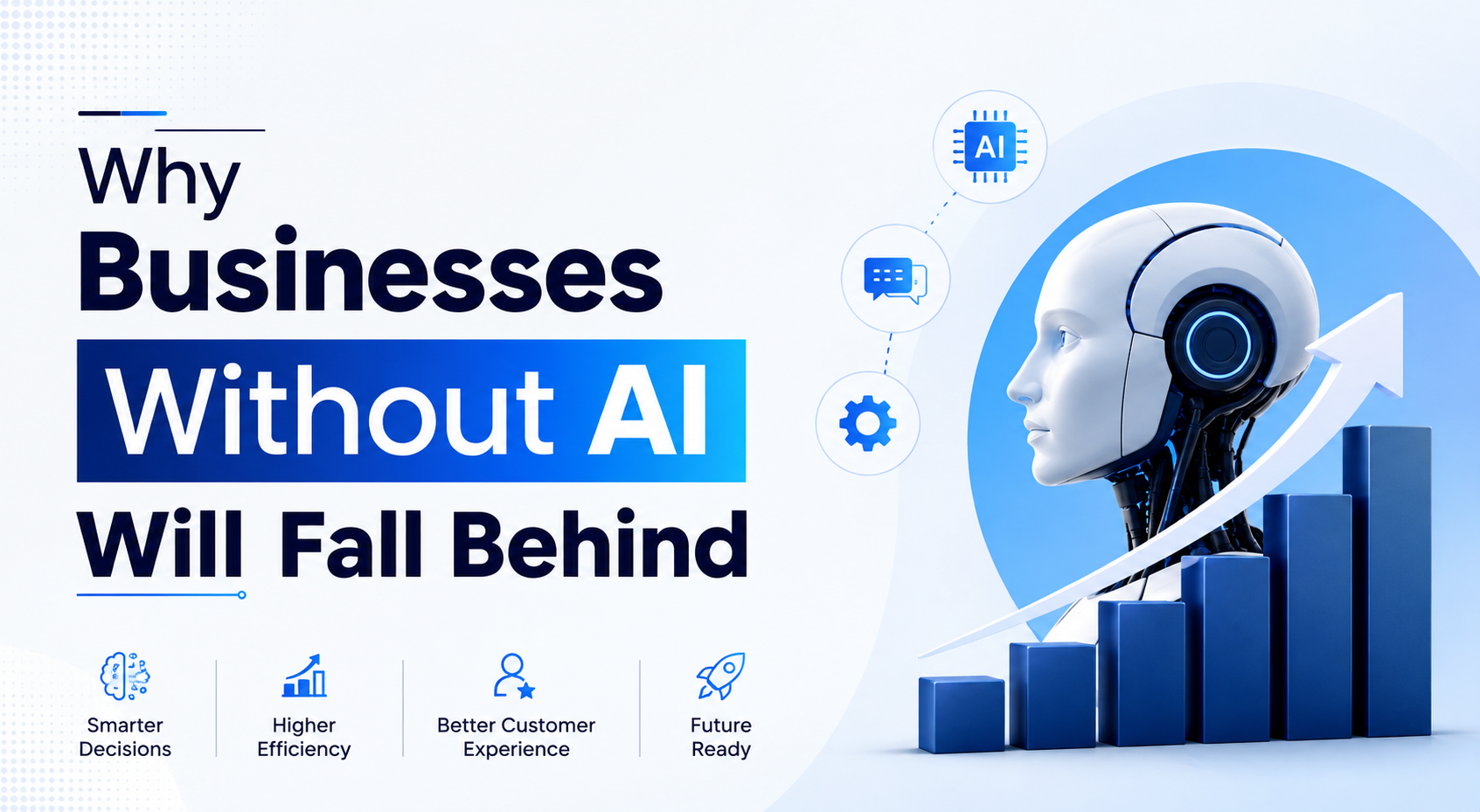
The businesses that will thrive in the coming years are not necessarily those with the most resources, but those willing to adapt and integrate new tools into how they operate. AI offers measurable advantages in efficiency, decision-making, customer experience, and talent retention — advantages that compound over time and become increasingly difficult to close once a gap forms. Companies that continue to operate without AI aren't standing still; relative to their competitors, they're moving backward. The good news is that adoption doesn't require perfection or massive investment to begin — it simply requires a willingness to start. Those who act now will find themselves better positioned for the years ahead, while those who wait may discover the gap has become too wide to close.