

WhatsApp OTP vs SMS OTP in India: Reach, Cost, Security and the Best Way to Combine Them

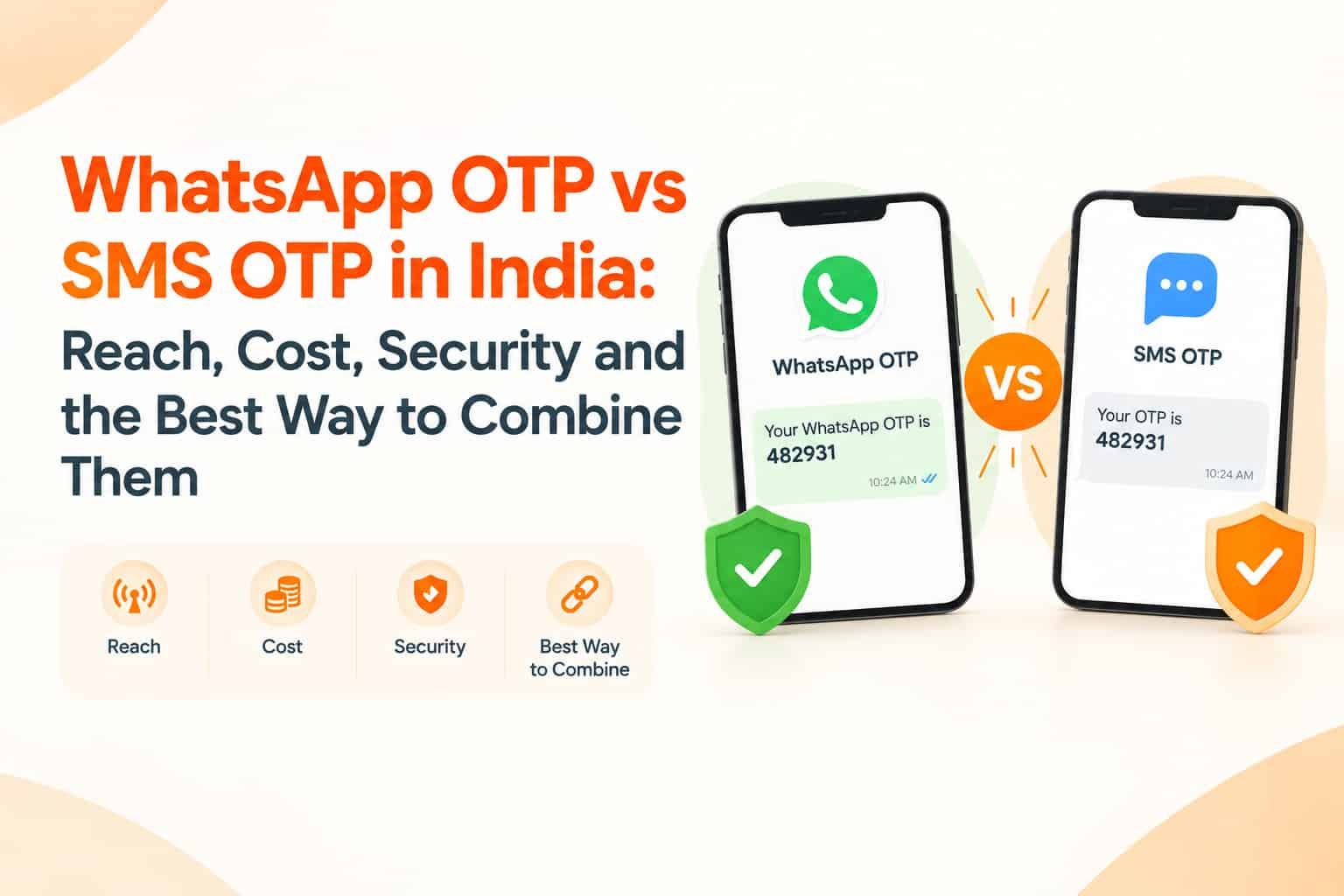
For over a decade, the OTP in India has meant an SMS. Customers wait for a text, read six digits and type them in. Now businesses are asking whether the same code can arrive on WhatsApp instead. The idea is attractive: most customers already live in the app, delivery can feel faster and the experience can be smoother. But SMS is still the universal fallback, and each channel has strengths, costs and risks. This guide compares WhatsApp OTP and SMS OTP in India so you can choose, or combine, with confidence.
How WhatsApp OTP works
On the WhatsApp Business Platform, one-time passcodes are sent as authentication templates, a special category of message with a fixed structure. The message contains the code and usually a short security notice, along with a button. Meta describes several experiences. A copy-code button lets the customer copy the code with one tap. One-tap autofill, available on supported Android setups, can fill the code into your app after the customer taps a button. Zero-tap options on Android can complete verification without the customer doing anything, under conditions defined in Meta's documentation. Authentication templates are pre-approved, and you pay per message under Meta's authentication pricing category, which varies by country. Always check the current rate card and feature availability, because they change.
How SMS OTP works
SMS OTP travels over the telecom network. In India, senders must register their entity, sender ID and message templates on the DLT platform, and the message text must match an approved template. SMS works on every phone, with no app or data connection needed, and reaches customers who do not use WhatsApp. Delivery speed and success vary by operator, route quality and congestion.
Reach and coverage
WhatsApp is widely used across India, but not by everyone, and a customer must have the app installed, be online and have a WhatsApp account on that number. SMS reaches all mobile numbers with network coverage, including basic phones and people with limited data. For a business serving a broad population, such as banks, government services or utilities, SMS remains the safest base. For app-first, urban customer groups, WhatsApp can offer a better experience.
Speed and reliability
Both channels can deliver within seconds when everything works. SMS depends on operator routes, and delays happen during congestion. WhatsApp depends on the customer's internet connection and app status. If a customer is offline, a WhatsApp message waits until they reconnect, while an SMS may arrive without data. Time-sensitive OTPs need fallback plans for both.
Cost comparison
Costs depend on volume, route, template category and provider. SMS is usually charged per message at a rate negotiated with the provider, with additional charges for failed or long messages. WhatsApp authentication messages are charged according to Meta's rate for the category and destination, plus any provider platform fees. Compare real costs for your volume, including fallback messages and the cost of failed logins that frustrate customers. Do not assume one is cheaper without checking current quotes.
User experience
WhatsApp OTP can feel smoother, because customers do not leave the app they already use, and copy or autofill buttons remove manual typing. SMS autofill also exists on many phones, using automatic reading of codes under platform rules, which gives a similar convenience on supported devices. The best experience depends on your app, the customer's device and how you implement the flow. Test on real phones across brands, since behaviour differs.
Security considerations
Neither channel is immune to attack. SMS OTPs can be vulnerable to SIM swap fraud, interception by malware and phishing in which the customer is tricked into sharing the code. WhatsApp OTPs can face account takeover risks if a customer's WhatsApp is compromised, and phishing remains a problem. Both channels can be abused by bots that trigger floods of OTP requests, so protect the trigger with rate limits, bot defence and spending alerts. Make each code single-use and short-lived, tie it to a session or transaction, and teach customers never to share OTPs with anyone.
Compliance and rules
SMS OTP traffic in India must follow telecom rules, including DLT registration and template matching. WhatsApp OTP must follow Meta's business messaging policies and use approved authentication templates. Customers should have opted in to receive WhatsApp messages from your business, and authentication use cases have specific policy requirements. Do not mix promotional content into OTP messages on either channel. For regulated sectors such as banking and payments, check whether regulations specify allowed authentication methods for particular transactions, since some require additional factors beyond a simple OTP.
Which should you choose?
Use SMS as your foundation if you serve a broad, mixed audience, need maximum reach or must support users without data. Use WhatsApp OTP as the primary channel if your customers are app-heavy, you want a smoother flow and you have a reliable WhatsApp Business Platform setup. The strongest design combines them: send via WhatsApp when the customer is reachable there, and fall back to SMS if the message is not delivered within a few seconds or the customer chooses SMS. Add voice OTP for accessibility, and offer authenticator apps or passkeys for higher-risk actions.
Implementation tips
Ask your provider whether it supports authentication templates, autofill options and automatic fallback. Set the validity period to a few minutes, limit retries and show a clear resend timer. Track delivery rate, time to delivery, verification success rate and cost per successful verification for each channel, because the real metric is the number of customers who log in or complete a purchase. Monitor for sudden spikes in requests. Make the customer's choice visible and let them switch channels if one fails.
Common mistakes
Common errors include relying on one channel only, ignoring fallback, forgetting template approvals, letting codes live too long, allowing unlimited resends, sending OTPs to numbers that never opted in on WhatsApp and failing to test autofill on different phones.
Frequently asked questions
Is WhatsApp OTP cheaper than SMS?
It depends on current rates, volumes and providers. Compare real quotes.
Can I use WhatsApp OTP without the Business API?
No. Authentication templates are part of the WhatsApp Business Platform.
Should I stop using SMS OTP?
Not usually. SMS remains the universal fallback.
Build a reliable verification flow
OM Enterprises provides SMS and WhatsApp OTP delivery with automatic fallback and monitoring. Talk to our messaging team.