

WhatsApp Business Platform in 2026: The Features Actually Worth Using for Customer Engagement

A customer has a question about an order. They could open your app, hunt for a support email, or call a helpline and wait on hold — or they could just message the WhatsApp thread that's already sitting in their recent chats, the same place they message their family. Most people pick the third option, which is exactly why WhatsApp has quietly become the default customer service channel for a huge share of Indian businesses, not because of a marketing campaign, but because of habit.
WhatsApp is not one feature — it's three
Businesses that get the most value treat WhatsApp Business Platform as three distinct message categories, each with a different job:
- Marketing templates — promotions, offers, re-engagement. These need explicit opt-in and are the most heavily scrutinized by Meta for quality and relevance.
- Utility templates — order confirmations, delivery updates, appointment reminders. These are expected, low-friction, and typically see the highest read rates of any message type a business sends.
- Authentication templates — OTPs and login verification, formatted specifically for speed and minimal friction.
The businesses that struggle with WhatsApp are almost always the ones using marketing templates for everything, including messages that should have been utility notifications — which burns through opt-in goodwill fast.
Features worth actually building around
Catalogs and in-chat commerce
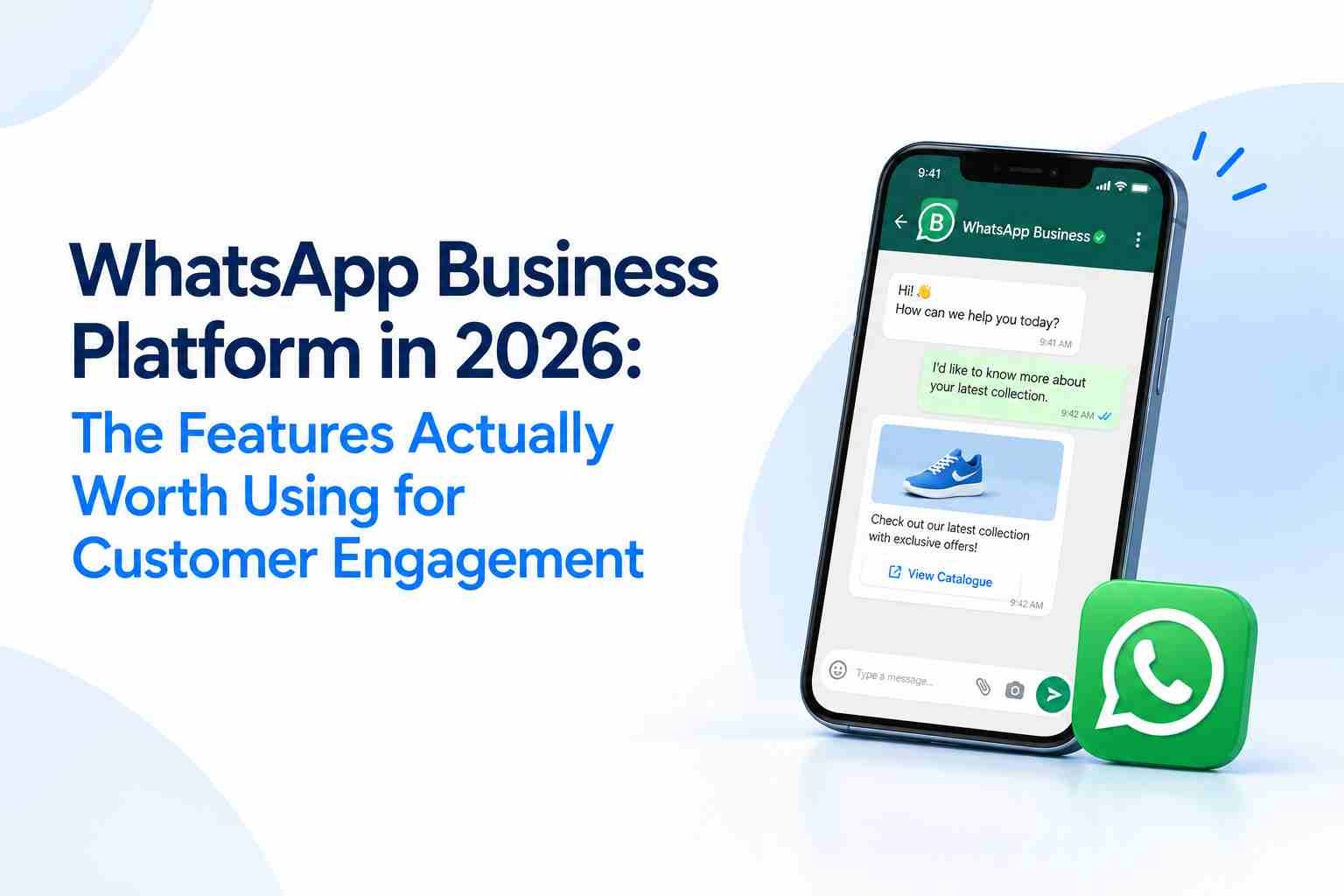
A product catalog attached to your WhatsApp Business profile lets a customer browse and add items to a cart without ever leaving the chat. For D2C and retail businesses, this collapses the distance between "I saw your ad" and "I bought it" into a single conversation.
Interactive list and reply-button messages
Instead of asking a customer to type a free-text reply (which is hard to route automatically), structured buttons and list messages let them tap a choice — "Track my order," "Talk to support," "Browse new arrivals" — which your automation can act on instantly and unambiguously.
Automation that hands off cleanly to a human
The best-performing setups use a simple chatbot for routing and FAQs, then hand off to a live agent the moment a query gets specific or a customer sounds frustrated. Automation that never escalates is the single most common complaint customers have about business messaging.
Where businesses get it wrong
Two recurring mistakes: sending marketing messages at a frequency that gets a number blocked or rated poorly on Meta's quality signals, and never segmenting a contact list — sending the same broadcast to a first-time browser and a five-year repeat customer. Segmentation by purchase history or engagement stage consistently outperforms broadcast-everything strategies.
FAQ
Is WhatsApp marketing still effective if RCS is growing?
Yes — the two aren't in direct competition for most Indian audiences yet. WhatsApp has near-universal adoption and habitual daily use; RCS is growing but still depends on device and carrier support. Many businesses run both, using each for what it does best.
Do small businesses need a BSP (Business Solution Provider), or can they use the app directly?
The free WhatsApp Business app suits a single-location business handling manageable message volumes. Once you need automation, multiple team logins, catalog sync with inventory, or API-based sending at scale, a Meta-verified BSP becomes worth the cost.
What's the biggest compliance risk?
Messaging contacts who never explicitly opted in. Meta enforces this through message quality ratings, and a poor rating can throttle or block a business number entirely — opt-in hygiene matters more than clever copywriting.
Conclusion
WhatsApp's advantage was never really its feature list — it's that customers are already there, already comfortable, and already checking it several times an hour. Businesses that respect that by separating marketing from utility messages, structuring conversations with buttons instead of guesswork, and letting automation hand off to a human when it matters, turn that habit into genuine retention rather than one more channel customers learn to mute.