

WhatsApp Business App vs API: Cost & Features (India 2026)

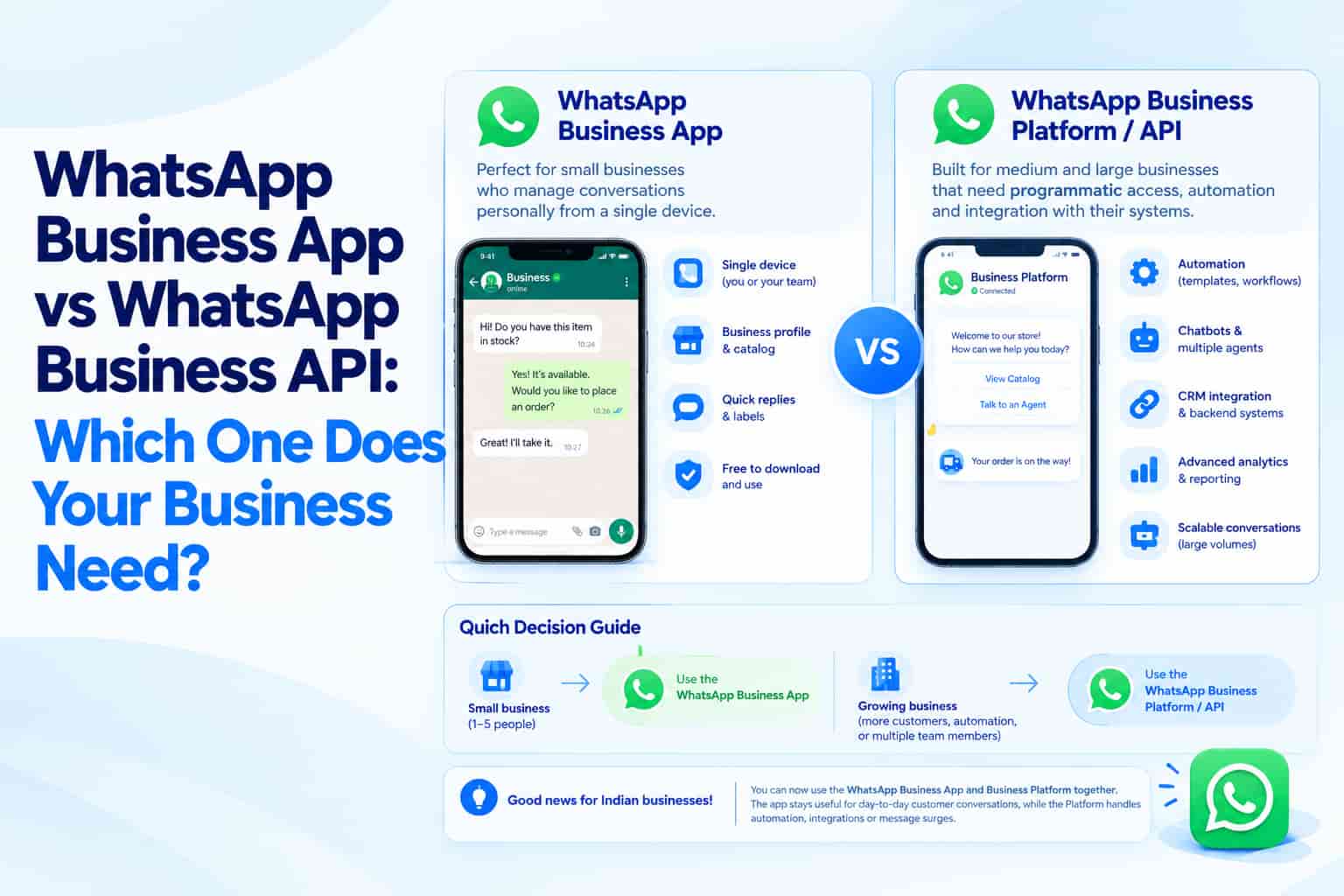
Many Indian businesses start on the free WhatsApp Business app and later ask the same question: should we move to the WhatsApp Business API? The answer depends on your message volume, team size, automation needs and budget. This guide compares the WhatsApp Business app vs API in plain language, explains how WhatsApp API pricing in India works in 2026 and helps you decide which setup fits your business.
What Is the WhatsApp Business App?
The WhatsApp Business app is a free app for a single phone, built for owners and very small teams. It adds business features to ordinary WhatsApp:
- A business profile with address, hours, website and description
- A product catalogue and shareable links
- Quick replies, greeting and away messages
- Labels to organise customers and conversations
- Limited broadcast lists that only reach people who saved your number
It works well for a home baker, a freelancer or a single-branch clinic with a manageable number of chats each day.
What Is the WhatsApp Business API?
The WhatsApp Business API (officially the WhatsApp Business Platform) is designed for growing and larger businesses. You access it through a Business Solution Provider (BSP) rather than a phone app. It offers:
- A shared inbox where many agents answer from one number
- Approved message templates for notifications and campaigns, sent only to opted-in customers
- Chatbots, automated flows and integration with your CRM, store or booking system
- Click-to-WhatsApp ad support and richer analytics
- The ability to send OTPs, order updates and reminders automatically
WhatsApp Business App vs API: Side-by-Side Comparison
| Feature | Business App | Business API |
|---|---|---|
| Cost to start | Free | Provider fee plus Meta message charges |
| Team access | Very limited devices | Many agents on one number |
| Automation | Basic auto-replies | Chatbots, flows, CRM integration |
| Bulk campaigns | Limited broadcast lists | Template-based campaigns to opted-in users |
| Verification and branding | Basic profile | Official business account options |
WhatsApp API Pricing in India (2026)
Meta moved from conversation-based billing to per-message pricing on 1 July 2025. You pay for each delivered template message based on its category. Published India rates, which providers quote before GST and their own platform fees, are approximately:
- Marketing messages: about ₹0.86 per delivered message
- Utility messages (order updates, reminders, receipts): about ₹0.115, and free inside an open customer service window under current documentation
- Authentication messages (OTPs): about ₹0.115
- Service replies: free-form replies have been free inside the 24-hour window, but several providers report that from 1 October 2026 replies beyond a monthly free allowance per number become billable
Rates and rules change, so always confirm the latest figures on Meta's rate card or with your provider. Your total cost is Meta's message charges plus your BSP's platform or subscription fee. As a rough example, 10,000 marketing and 20,000 utility messages a month would cost about ₹8,600 plus ₹2,300 in Meta charges before GST and provider fees.
When to Stay on the WhatsApp Business App
- One person handles all chats
- You send under a few dozen messages a day
- You do not need automation or integrations
- You want zero monthly cost
When to Move to the WhatsApp Business API
- Several team members must reply from the same number
- You want automated order updates, appointment reminders or OTPs
- Leads arrive from ads and need instant replies
- You want chats and leads recorded in a CRM
- You plan permission-based marketing campaigns at scale
Before You Switch: A Short Checklist
- Plan your opt-in process so you only message people who agreed.
- Prepare message templates for utility, authentication and marketing use cases.
- Decide bot-to-human handover rules.
- Check number migration steps with your provider, since a number moved to the API usually cannot be used in the regular app at the same time.
- Compare BSPs on platform fees, support, reporting and template approval help.
If you are comparing channels, our guide on RCS business messaging shows how it complements WhatsApp and SMS.
Frequently Asked Questions
Can I keep my existing WhatsApp number on the API?
Usually yes, but the number must be migrated, and the migration may disable the regular app on that number. Ask your provider before starting.
Is the WhatsApp Business API only for big companies?
No. Growing small businesses often adopt it once chat volume, team size or automation needs outgrow the app.
Is the WhatsApp Business API free?
Meta charges no licence fee, but you pay per delivered template message, plus any platform fee from your provider.
Conclusion
The WhatsApp Business app is a great starting point for small teams, while the WhatsApp Business API unlocks automation, shared inboxes and scalable campaigns. Choose based on volume, team size and goals, and budget for per-message costs as you grow. A clear opt-in strategy and well-designed templates matter as much as the platform you pick.
OM Enterprises helps businesses choose, set up and automate WhatsApp for customer communication. Talk to our WhatsApp team for a plan that fits your business.