

What's the Difference Between Traditional and Generative AI?

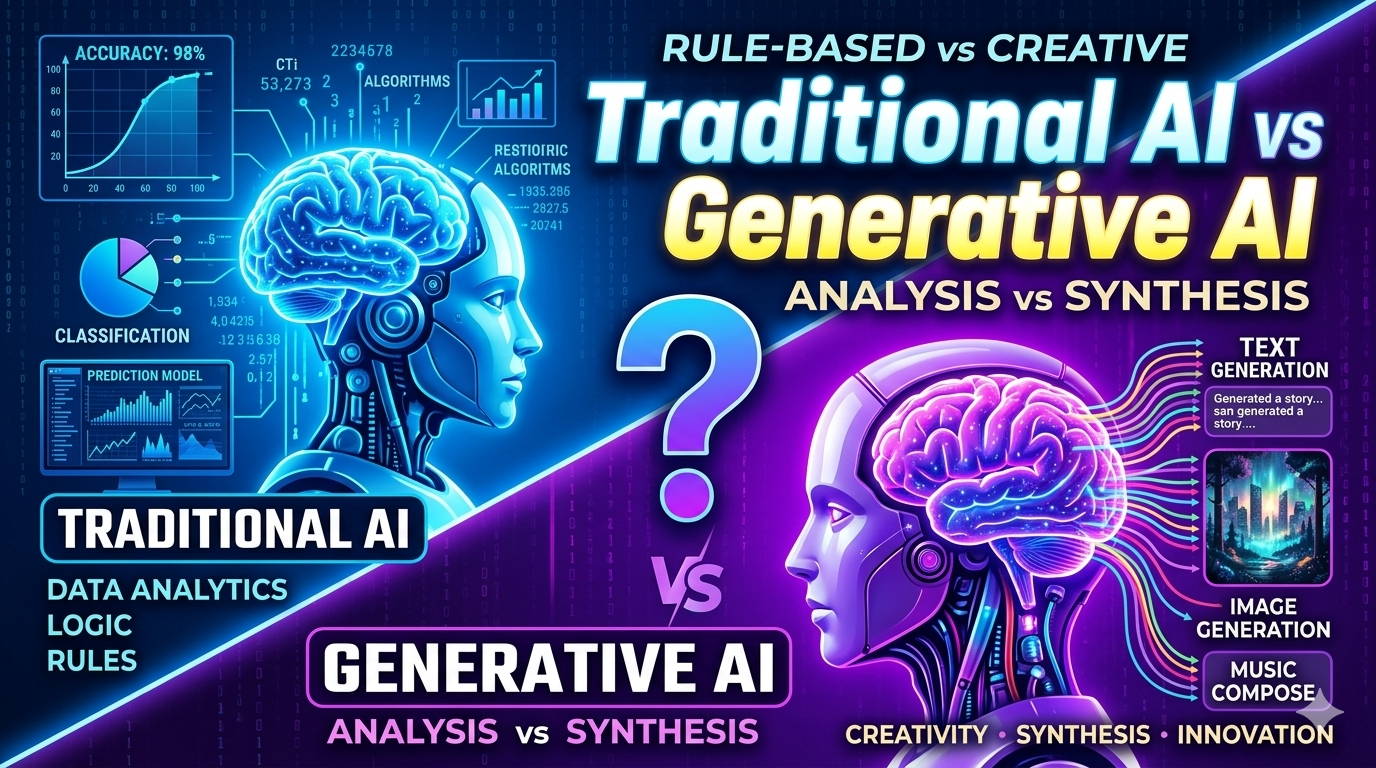
What's the Difference Between Traditional and Generative AI?
Artificial intelligence is no longer a futuristic concept — it's embedded in how businesses operate today. But not all AI is created equal. Understanding the distinction between traditional AI and generative AI is the first step toward making smart, strategic technology decisions for your business.
What is traditional AI?
Traditional AI, often called narrow or rule-based AI, is designed to perform specific, well-defined tasks. These systems are trained on historical data and programmed to recognize patterns, make predictions, or automate repetitive processes. Think of spam filters in your email inbox, product recommendation engines on e-commerce platforms, or fraud detection systems in banking — these are all examples of traditional AI doing exactly what they were built to do.
The defining characteristic of traditional AI is that it operates within strict boundaries. It doesn't create; it classifies, predicts, or optimizes.
How does traditional AI work?
Traditional AI systems are built on machine learning algorithms that are trained using labeled datasets. The model learns to recognize patterns in that data and applies those learned rules to new inputs. For example, a credit-scoring model is trained on thousands of loan applications with known outcomes, then uses that learning to predict the likelihood of future applicants repaying a loan.
Key types include supervised learning, unsupervised learning, and reinforcement learning — each suited to different problem types, but all anchored in the idea of optimizing a specific outcome.
What is generative AI?
Generative AI is a newer category that goes beyond prediction and classification — it creates. Using large language models (LLMs) and neural networks trained on vast amounts of text, image, audio, and video data, generative AI systems like ChatGPT, Claude, and Midjourney can produce original content: drafting emails, writing code, generating images, synthesizing reports, and holding natural conversations.
Rather than being told the "right answer," generative models learn the underlying structure of language or images and generate new outputs that are statistically coherent and contextually relevant. This makes them incredibly versatile — but also less predictable than their traditional counterparts.
Business use cases: traditional vs. generative AI
Traditional AI
Structured, repetitive tasks
Predictive analytics, demand forecasting, fraud detection, quality control, customer churn prediction, and automated sorting or classification workflows.
Generative AI
Creative and conversational tasks
Content creation, customer support chatbots, code generation, document summarization, marketing copy, and personalized communications at scale.
Many businesses find the most value in combining both — using traditional AI for data-driven decisions and generative AI for communication, creativity, and knowledge work.
Risks and limitations of generative AI tools
Generative AI comes with genuine trade-offs that businesses must understand before adopting it. The most well-known risk is hallucination — the tendency of large language models to generate confident-sounding but factually incorrect information. This makes human oversight essential, especially in legal, medical, or financial contexts.
Other considerations include data privacy (what happens to the information you share with AI tools?), intellectual property ambiguity, potential for bias inherited from training data, and the risk of over-reliance on generated content without proper review. Regulatory frameworks around AI are also evolving rapidly, meaning compliance requirements may shift.
A practical rule: treat generative AI output as a capable first draft, not a final answer. Human judgment remains irreplaceable for high-stakes decisions.
Which type of AI is right for your business?
The right choice depends on your goals, your data, and the nature of the problem you're solving. If you need to automate a well-defined, data-rich process — like predicting inventory needs or detecting anomalies — traditional AI is likely a better fit. It's more reliable, auditable, and purpose-built for structured tasks.
If your challenge is more open-ended — producing content faster, answering customer questions around the clock, or enabling your team to draft and iterate more efficiently — generative AI can offer substantial leverage. Most growing businesses will eventually use both in different parts of their operations.
How to get started with AI in your small business
Start with the problem, not the technology. Identify one or two bottlenecks in your operations where automation or intelligence could save meaningful time or money. Then explore whether an off-the-shelf AI tool addresses that need before investing in custom development.
For generative AI, tools like Claude, ChatGPT, or Jasper can be adopted quickly with minimal technical overhead. For traditional AI use cases, platforms like Google Cloud AutoML or Microsoft Azure AI provide accessible entry points. In both cases, prioritize data quality, set clear success metrics, and involve your team early to build confidence in the new workflow.
Conclusion
Traditional and generative AI are not competitors — they're complementary tools built for different jobs. Traditional AI excels at structured, repeatable, data-driven tasks where accuracy and consistency matter most. Generative AI opens up new possibilities for creativity, communication, and knowledge work at scale. For business owners, the question isn't which type of AI will "win" — it's which problems you most need to solve, and which tools give you the clearest path there. Start small, stay curious, and build from real results.