

What Are Entities & Why Do They Matter for SEO

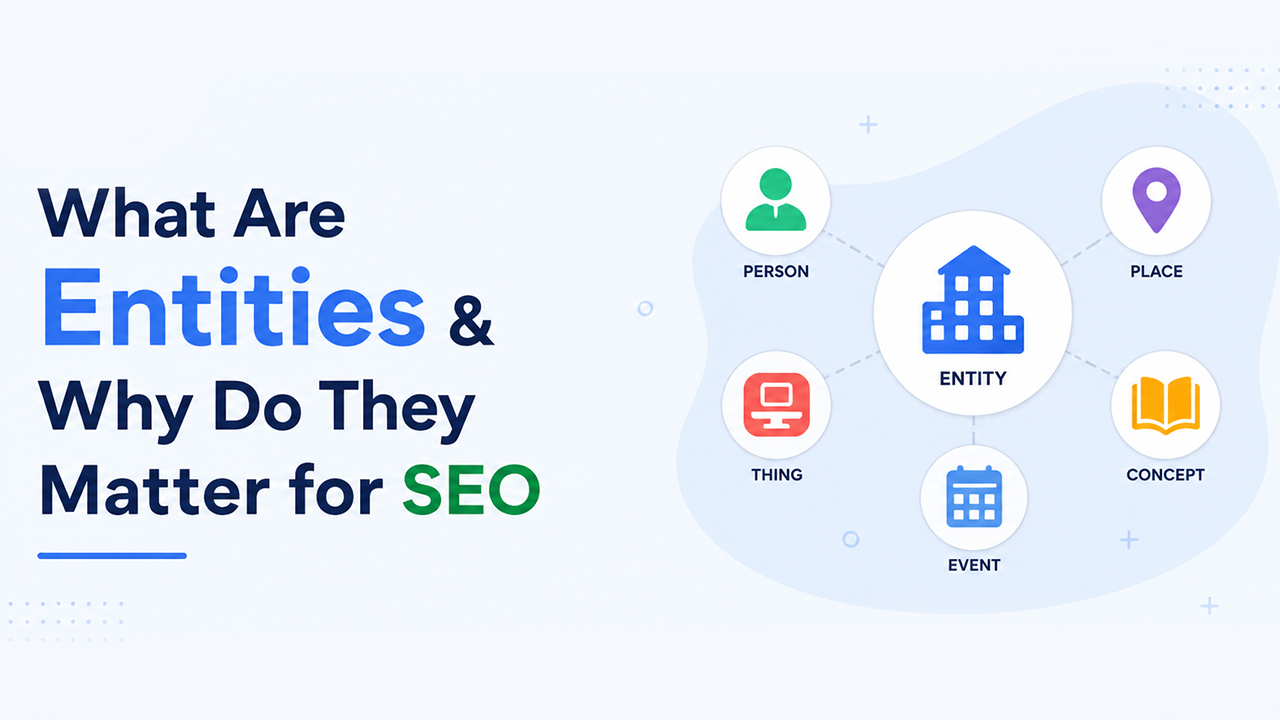
Search engines no longer just match words — they understand meaning. If you're still optimizing purely for keywords, you're missing the bigger picture. Entities are reshaping how Google and AI-powered search tools interpret content, and mastering them could be the edge your site needs.
What Is an Entity?
In SEO, an entity is any distinct, clearly defined concept that can be uniquely identified — a person, place, organization, product, event, or idea. Unlike a keyword, which is simply a string of text, an entity carries meaning independent of the words used to describe it.
Google's Knowledge Graph is built entirely around entities. When you search for "Apple," Google doesn't just look for pages with that word — it determines which Apple you mean (the company, the fruit, the record label) based on context, relationships, and signals across the web. That disambiguation is entity-based search in action.
Think of an entity as a node in a vast knowledge network. Its value comes not just from what it is, but from how it connects to everything around it.
Why Are Entities Important in SEO & AI Search?
Google's Hummingbird update (2013) and subsequent advances — BERT, MUM, and the Knowledge Graph — shifted the engine from keyword matching toward semantic understanding. Today, Google evaluates content by identifying the entities it covers and how authoritatively it covers them.
AI-powered search tools like Google's Search Generative Experience (SGE) and Bing's Copilot amplify this further. These systems generate answers by pulling from sources they consider topically authoritative. If your site isn't recognized as an entity-rich, trustworthy source within your niche, it gets left out of AI-generated summaries — regardless of how well-keyworded your pages are.
Entity optimization is also the foundation of E-E-A-T (Experience, Expertise, Authoritativeness, Trustworthiness). When Google can clearly identify who you are, what you cover, and how you relate to established entities in your field, your content gets a credibility boost that keywords alone can't deliver.
What's the Difference Between Entities and Keywords?
Keywords are search terms. Entities are the underlying concepts those terms refer to. They're related but not interchangeable — and treating them as the same thing is one of the most common SEO mistakes.
Keywords
Text strings typed by users
Context-dependent meaning
Optimized through placement & density
Can be ambiguous ("bank," "apple")
Declining as a lone ranking signal
Entities
Unique, identifiable concepts
Meaning is intrinsic & stable
Optimized through context & structure
Unambiguous with unique identifiers
Growing role in modern search ranking
The goal isn't to abandon keywords — it's to use them as signals that point toward the entities your content covers. Think of keywords as the map and entities as the territory.
How to Optimize for Entities
1
Map Out Your Core Entities and Start Using Them
Identify the primary entities your site, brand, and content represent. Use Google's Knowledge Graph Search API or tools like InLinks to surface related entities in your niche. Then make sure these entities appear clearly and consistently across your pages — in titles, headings, body copy, and metadata.
2
Build Out Topic Clusters
Search engines assess topical authority by looking at how thoroughly a site covers a subject area. Create pillar pages for your core entities and connect them with supporting content that explores related entities, subtopics, and relationships. The goal is to build a dense, interconnected web of meaning around your core subject matter.
3
Add Schema Markup
Structured data (Schema.org markup) gives search engines explicit signals about the entities on your pages. Use relevant schema types — Article, Person, Organization, Product, FAQ — to help Google understand who you are and what your content covers. This is particularly important for establishing your own brand as a recognized entity.
4
Run an Entity Analysis
Use tools like Semrush, Surfer SEO, or entity-specific platforms to analyze the top-ranking pages for your target topics. Identify which entities they cover that you don't. These gaps represent opportunities to strengthen your semantic coverage and signal broader topical expertise to search engines.
5
Avoid Common Pitfalls
Don't stuff entity names without context — search engines evaluate relationships, not just presence. Avoid thin content that mentions entities superficially. And make sure your About page, author bios, and business information clearly establish your brand entity with consistent NAP data (Name, Address, Phone) and references from trusted external sources.
Entity SEO in Action: End-to-End Example
Let's say you run a nutrition coaching business. Your primary entity is your brand, but related entities include "nutritionist," "meal planning," "macronutrients," and perhaps influential figures in your field like recognized dietitians or health organizations.
Worked example — Nutrition Coaching Brand
Step 1: Add Organization schema to your homepage identifying your brand, location, and services.
Step 2: Create a pillar page on "evidence-based nutrition" and cluster articles around related entities: macronutrients, gut health, metabolic rate, caloric deficit.
Step 3: Add Person schema to your team pages linking your credentials to recognized organizations (e.g., the Academy of Nutrition and Dietetics).
Step 4: Earn mentions from recognized health entities — medical journals, established wellness publications, authority directories. These external signals anchor your entity in Google's knowledge graph.
Result: Google begins to understand not just that you write about nutrition, but that your brand is a nutrition authority — increasing your chances of appearing in AI-generated answers, knowledge panels, and featured snippets.
Common Mistakes to Avoid in Entity SEO
Treating entities like keywords and overusing them without contextual support.
Neglecting schema markup — structured data is how you speak directly to search engine crawlers.
Inconsistent brand information across the web, which weakens your entity identity.
Creating isolated content that doesn't link to or support broader topic clusters.
Ignoring Wikipedia, Wikidata, or Google's Knowledge Panel — these platforms are major trust signals for entity recognition.
Focusing only on your content entities while neglecting author and brand entity signals.
The Future of Entity-Based SEO and AI Search
As large language models become embedded in search — through Google SGE, Perplexity, ChatGPT search, and others — entity optimization becomes even more critical. These systems don't just rank pages; they synthesize answers from sources they trust. Trust, in this context, is largely built on entity authority: how well-defined your brand is, how consistently you're mentioned alongside relevant entities, and how deeply your content covers the semantic landscape of your niche.
The sites that will win in AI-powered search aren't necessarily those with the most backlinks or the highest keyword density. They'll be the ones that have clearly established who they are, what they cover, and why they're a credible voice — all signals rooted in entity-based optimization.
Start Optimizing for Entities
Entity SEO isn't a replacement for the fundamentals — it's an evolution of them. Keywords, backlinks, and technical SEO still matter. But layering entity optimization on top of these foundations gives search engines the semantic clarity they need to confidently surface your content in an increasingly AI-driven landscape. Start by mapping your core entities, building your topic clusters, and implementing structured data. The brands that invest in entity authority today are the ones search engines — and AI systems — will reach for tomorrow.