

Website SEO Mistakes That Are Quietly Costing Indian Businesses Traffic in 2026

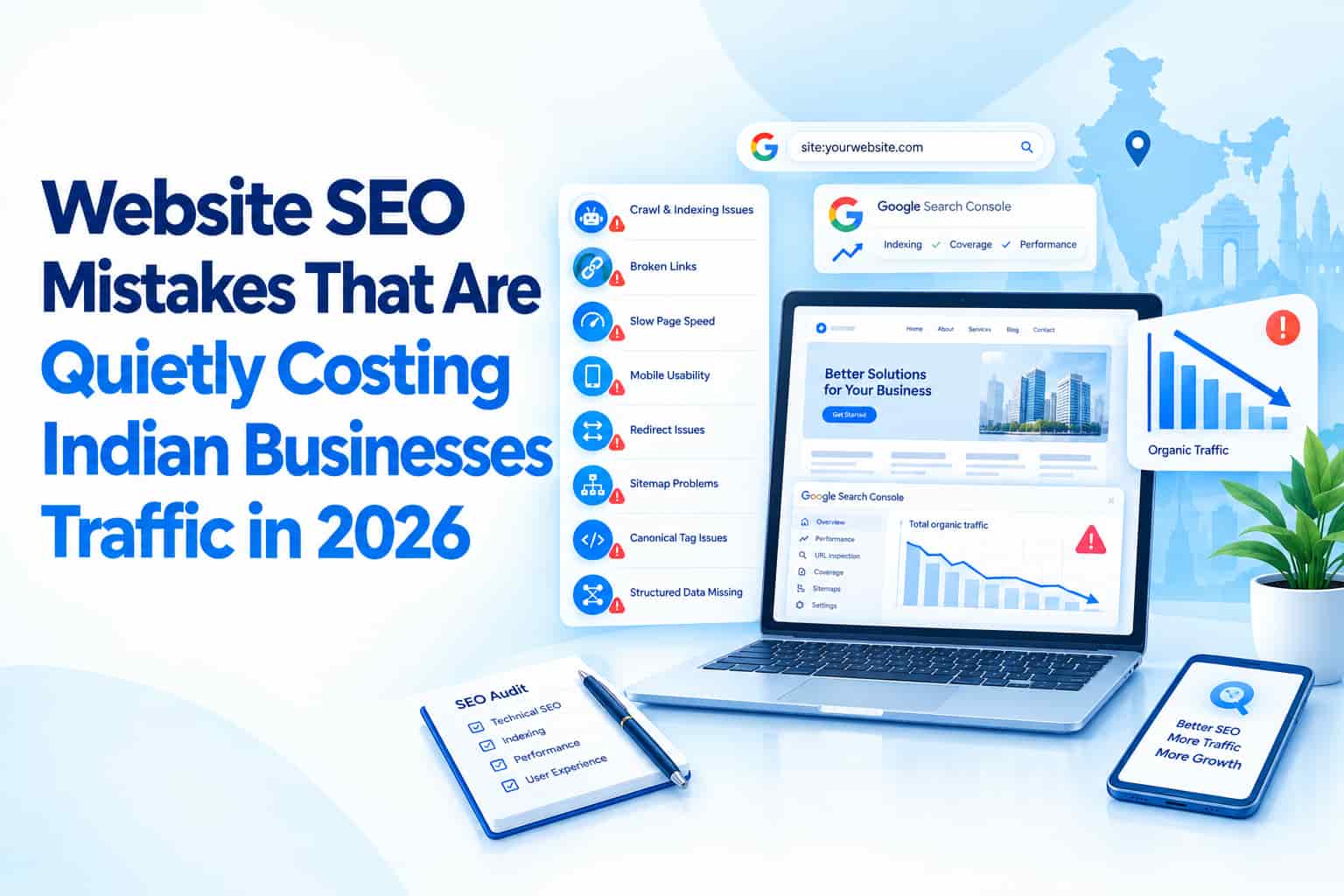
Most website SEO damage isn't dramatic — nobody gets hit with a visible Google penalty banner. It's quiet: a redirect chain added six months ago during a site update, a canonical tag pointing to the wrong URL, a handful of orphan pages nobody remembers publishing. None of it looks urgent, and all of it adds up. Sites that skip ongoing monitoring see an estimated 12% average organic traffic decline per quarter purely from accumulating small issues like these.
Mistake 1: Treating a Technical Audit as a One-Time Project
A single technical SEO cleanup fixes the problems that exist on the day of the audit — it does nothing for the issues introduced afterward by routine site updates, plugin changes, or a developer's well-intentioned "quick fix." Quarterly monitoring catches these before they compound into the kind of traffic decline that's hard to trace back to a single cause months later.
Mistake 2: Conflicting Canonical Signals
When the canonical URL set in a page's HTML doesn't match the one set in HTTP headers, search engines get mixed signals about which version of a page should actually rank — often splitting ranking authority across duplicate URLs instead of consolidating it into one strong page. This is common after site migrations or CMS changes and rarely gets checked afterward.
Mistake 3: Leaving Orphan Pages With No Internal Links
Pages with zero internal links pointing to them are, in effect, invisible to both users navigating the site and search engines crawling it — some studies suggest this affects 40–60% of websites in some form. A genuinely useful page that nothing else on the site links to is functionally wasted content.
Mistake 4: Ignoring Core Web Vitals on Mobile
With most Indian website traffic on mobile, a slow Largest Contentful Paint doesn't just hurt rankings — it directly costs conversions before a visitor even finishes loading the page. Pages in the top LCP quartile (under 2.5 seconds) see roughly 24% higher organic click-through rates than pages that fail this threshold.
Mistake 5: Skipping Schema Markup Entirely
Rich results — star ratings, FAQ dropdowns, pricing shown directly in search — can lift click-through rates by 20–30%, yet only around 17% of the top 10 million websites globally implement any schema markup. This remains one of the most under-used, low-effort SEO improvements available.
Mistake 6: Over-Optimized, Repetitive Anchor Text
Internal links using the exact same keyword-stuffed anchor text repeatedly ("best digital marketing agency," "best digital marketing agency," "best digital marketing agency") look manipulative to search engines and reduce the natural effectiveness of internal linking, which works better with varied, descriptive anchor text.
Mistake 7: Not Reading Google Search Console Properly
Search Console reports specific indexation statuses — "crawled, currently not indexed," "duplicate without user-selected canonical," "discovered, currently not indexed" — and each one points to a different underlying fix. Many businesses check Search Console for a general health score and miss the specific, actionable diagnosis sitting in the indexation report.
Mistake 8: Deploying Site Changes Without a Pre-Launch Crawl
New site changes — a redesign, a new page template, an updated navigation menu — can introduce silent regressions (broken internal links, accidentally noindexed pages, missing meta tags) that go unnoticed until traffic has already dropped. A crawl before and after any significant deployment catches these immediately instead of weeks later.
A Practical Quarterly Habit
- Run a full site crawl and compare indexation status against the previous quarter
- Check Core Web Vitals for the highest-traffic pages specifically, not just the homepage
- Review canonical consistency after any CMS or platform update
- Identify and fix newly created orphan pages
- Confirm schema markup is still validating correctly after any template changes
Frequently Asked Questions
How would a business know if these mistakes are already happening on their site?
A technical SEO crawl tool or an audit will surface most of these issues directly — orphan pages, canonical conflicts, and Core Web Vitals failures all show up in standard crawl reports.
Can fixing these issues alone improve rankings without new content?
Often yes, at least partially — technical fixes frequently unlock ranking potential that existing content already had but couldn't realize due to crawlability or speed issues.
How often should these checks be repeated?
At minimum quarterly, and immediately after any site redesign, migration, or major content restructuring.
Fixing What's Quietly Leaking
None of these mistakes are dramatic individually, which is exactly why they go unnoticed for months while traffic slowly erodes. OM Enterprises runs technical SEO audits for Indian businesses that catch exactly these accumulating issues before they compound into a real traffic problem.