

TRAI's 1600 Number Series Explained: What Banks, NBFCs and Customers Need to Know

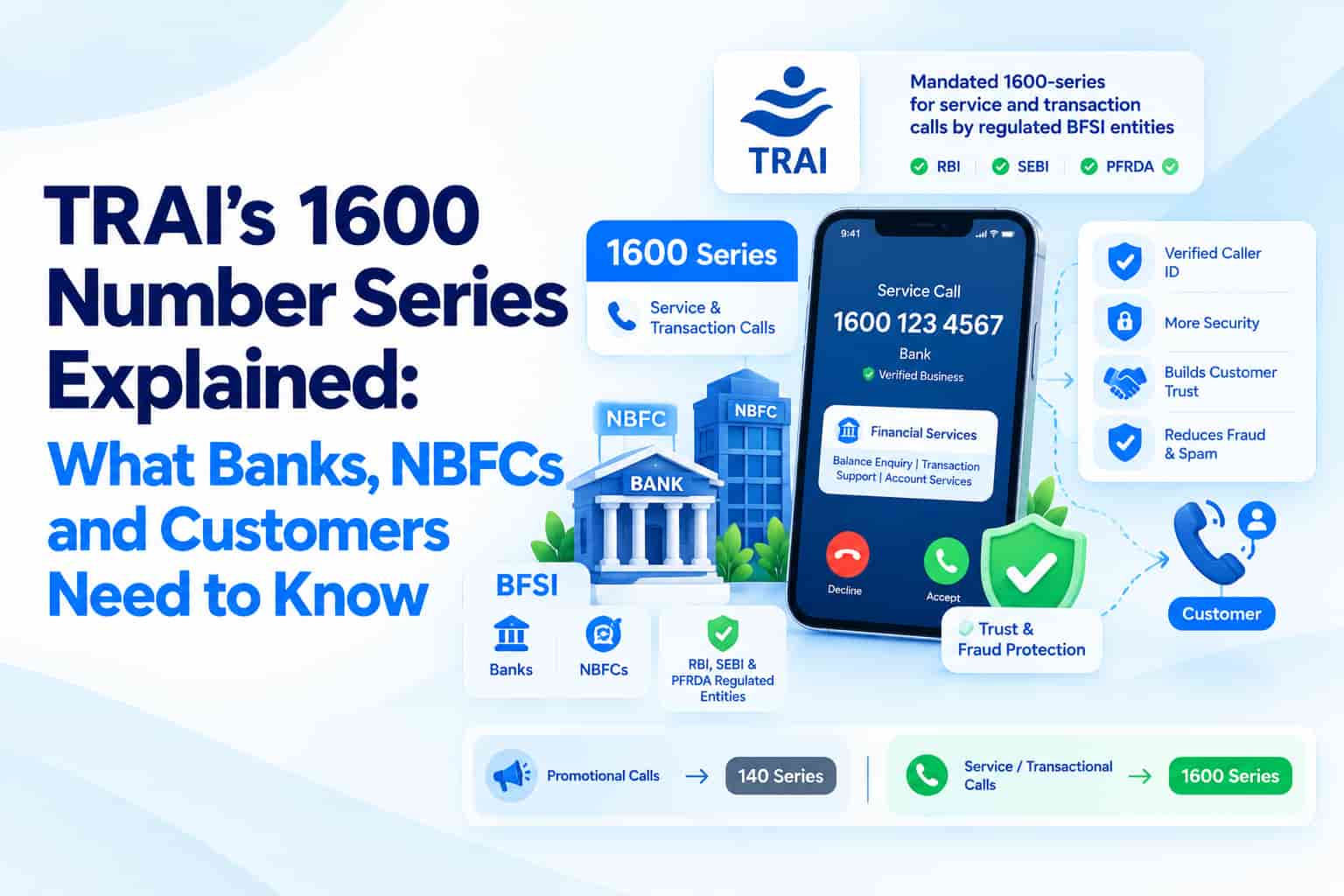
"Hello sir, I'm calling from your bank. Your KYC is pending..." Most Indians have received a call like this, and many have no reliable way to tell whether it's genuine. Fraudsters have exploited that uncertainty for years by calling from ordinary 10-digit mobile numbers that look exactly like a bank relationship manager's.
The 1600 number series is the regulator's answer. It gives customers a simple visual cue: legitimate service and transactional calls from regulated financial institutions should come from a number starting with 1600.
What is the 1600 number series?
The Department of Telecommunications assigned the 1600 numbering series to distinguish service and transactional voice calls made by entities in banking, financial services and insurance (BFSI), as well as government bodies. In late 2025, TRAI issued a direction setting time-bound, phased deadlines for regulated entities to move these calls off standard 10-digit numbers and onto 1600-series numbers.
SEBI separately directed its regulated and registered entities to use the 1600 series exclusively for service and transactional calls to existing customers.
Who had to migrate, and by when
| Entity type | Deadline |
|---|---|
| Commercial banks (public sector, private and foreign banks) | 1 January 2026 |
| Large NBFCs (asset size above ₹5,000 crore), payments banks, small finance banks | 1 February 2026 |
| Mutual funds and asset management companies | 15 February 2026 |
| Remaining NBFCs, co-operative banks, regional rural banks | 1 March 2026 |
| Qualified stockbrokers | 15 March 2026 |
At the time of the direction, timelines for insurance companies were being discussed with IRDAI. All of the listed deadlines have now passed, so these institutions are expected to be calling from 1600 numbers for service and transactional purposes.
1600 vs 140: two different jobs
India now uses distinct number ranges to help people recognise the purpose of a call:
- 1600 series – service and transactional calls from regulated BFSI entities (account updates, loan servicing, transaction confirmations, KYC follow-ups).
- 140 series – promotional and telemarketing calls from registered telemarketers.
A call about a "pre-approved loan offer" is promotional. A call about your existing EMI is service. They should arrive from different kinds of numbers.
What this means for customers
- A caller claiming to be from a bank on a regular 10-digit mobile number deserves extra suspicion.
- A 1600 number signals a legitimate institution's official line — but you should still never share OTPs, PINs or passwords on any call.
- Suspected fraud can be reported through the Department of Telecommunications' Chakshu facility on the Sanchar Saathi portal, and unwanted commercial calls through the DND options on your operator's app or by calling or texting 1909.
What this means for businesses
If you're a BFSI entity
- Confirm every outbound team — branches, collections, call centres, outsourced agencies — is using 1600 numbers for service and transactional calls.
- Update customer communications (website, app, SMS, statements) to tell customers which number to expect.
- Align CRM and dialler systems so that agents can't fall back to personal mobiles for official calls.
- Keep promotional calling separate and compliant with telemarketing rules.
If you're outside BFSI
The mandate doesn't directly apply, but the trend is clear: regulators are moving toward verified, identifiable business communication across every channel. You can see the same direction in DLT-registered SMS headers, verified WhatsApp Business accounts and branded RCS sender profiles.
Businesses that already make it easy for customers to recognise official communication — consistent sender IDs, verified profiles, a published list of official numbers — build trust faster and suffer less from impersonation.
Combining channels for trusted communication
Voice is only one touchpoint. A practical, fraud-resistant setup for a financial services brand might look like:
- SMS from a DLT-registered header for OTPs and transaction alerts
- RCS with a verified brand profile and logo for rich statements and reminders
- WhatsApp Business API with a verified account for service conversations
- 1600-series voice for service calls that need a human
When every channel looks official and consistent, customers learn to spot what doesn't.
Frequently asked questions
Is the 1600 series mandatory for all banks?
TRAI's direction set phased, mandatory deadlines for RBI, SEBI and PFRDA-regulated entities to use 1600 numbers for service and transactional calls. Commercial banks were first, from 1 January 2026.
Can banks still make promotional calls?
Promotional calls follow separate telemarketing rules and are associated with the 140 series, not 1600.
If a call comes from 1600, is it always safe?
It indicates an official line, but never share OTPs, PINs or passwords on any phone call, regardless of the number.
Does this apply to SMS?
No. The 1600 series covers voice calls. SMS from businesses is governed by TRAI's DLT framework with registered headers and templates.
Build trusted, compliant customer communication
OM Enterprises provides DLT-compliant SMS, verified RCS, WhatsApp Business API and voice solutions that help financial and consumer brands communicate in ways customers recognise and trust. Contact our team to review your communication stack.