

The Best Content Formats for Search Channel Optimization

Introduction
For years, marketers treated Google as the only doorway to discovery. Rank on page one, and the traffic would follow. But the way people search has quietly changed. Shoppers scroll TikTok for product reviews, ask YouTube how something works, browse Amazon before they browse Google, and treat Instagram and Pinterest as visual search engines. This shift has given rise to Search Channel Optimization, or SCO — a strategy built on the idea that "search" no longer happens in one place.
Unlike traditional SEO, which focuses almost entirely on ranking web pages in a single search engine, SCO takes a wider view. It treats every platform where users look for answers, products, or entertainment as a search channel in its own right, each with its own algorithm, audience behavior, and content expectations. Winning at SCO means meeting people with the right format, on the right platform, in the way they actually prefer to consume information there.
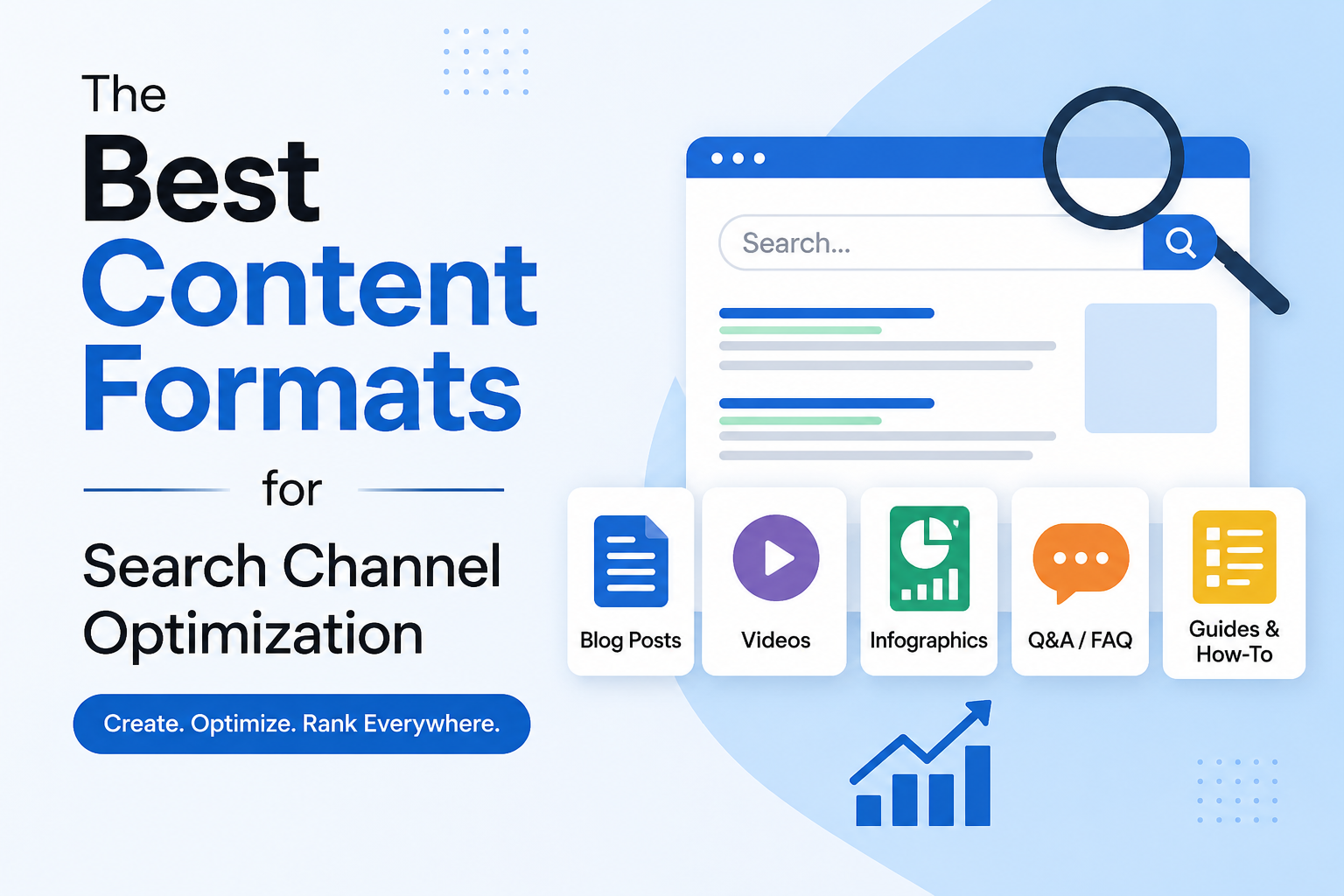
That last part is the key challenge. A blog post that performs beautifully on Google may fall flat if repurposed word-for-word onto YouTube or TikTok. Every channel rewards a different shape of content. This post breaks down the formats that matter most for SCO success and how to use each one effectively.
1. Long-Form Blog Content (Still the Foundation for Google)
Despite the rise of video and social search, well-researched blog content remains essential for ranking in traditional search engines like Google and Bing. In-depth guides, how-to articles, and comparison posts continue to satisfy search intent for people who want detailed, text-based answers. For SCO purposes, blogs also work as the "source material" that gets repurposed into other formats — a single strong article can become a script for a video, a carousel for Instagram, or a thread for LinkedIn.
To perform well, blog content should be structured with clear headings, answer the searcher's question early, and include supporting data or examples. Think of it as the anchor of your content ecosystem rather than the whole strategy.
2. Short-Form Video (YouTube Shorts, Reels, TikTok)
Short videos have become one of the most powerful discovery tools available, especially for younger audiences who increasingly use platforms like TikTok as their first stop for research. A tight 30–60 second video that answers a specific question, demonstrates a product, or breaks down a concept can capture attention far faster than text.
For SCO, short-form video works best when it's built around a single, clear hook — a question, a surprising fact, or a before-and-after result — delivered in the first few seconds. Captions, trending audio, and text overlays help these videos surface in each platform's own search and recommendation systems.
3. Long-Form Video (YouTube Tutorials and Explainers)
While short videos win attention, long-form video builds authority. YouTube functions as the second-largest search engine in the world, and tutorials, product walkthroughs, and explainer videos with strong titles, descriptions, and timestamps rank extremely well there. Long-form video is especially valuable for topics that require demonstration — software walkthroughs, cooking instructions, or step-by-step guides — where text alone can't fully convey the process.
4. Listicles and Comparison Content
"Best of" lists and side-by-side comparisons perform well across nearly every channel, from blogs to Pinterest pins to YouTube videos. This format works because it mirrors how people naturally search when they're deciding between options — "best running shoes for flat feet" or "X vs Y." Comparison content also tends to attract backlinks and social shares, reinforcing visibility across multiple channels at once.
5. Product Listings and Marketplace Content
For e-commerce brands, Amazon and similar marketplaces are search engines in their own right. Optimizing product titles, bullet points, and descriptions with the keywords shoppers actually type in is a core SCO practice. High-quality images, clear specifications, and keyword-rich descriptions directly influence whether a product surfaces in marketplace search results.
6. Visual and Infographic Content (Pinterest, Instagram)
Visual platforms like Pinterest and Instagram function as search engines for inspiration-driven queries — home decor ideas, outfit combinations, recipes, and design references. Infographics, styled photos, and carousel posts optimized with descriptive keywords and alt text tend to perform well here. This format is particularly effective for brands in fashion, food, travel, and design industries, where visual discovery drives a large share of purchase decisions.
7. Community and Forum-Style Content
Platforms like Reddit and Quora have grown into genuine search destinations, particularly for people seeking honest opinions rather than polished marketing copy. Participating authentically in these spaces, or creating content that mirrors the conversational, question-and-answer style popular there, helps brands show up where trust matters most.
8. Voice and Conversational Content
With voice assistants and AI-powered search tools becoming more common, content written in a natural, conversational tone — directly answering common questions in plain language — is gaining importance. FAQ sections and structured question-and-answer content help capture this growing segment of search behavior.
Bringing It All Together
The common thread across all these formats is intent. Every platform has its own version of a "search bar," and the winning content matches the way people naturally look for answers there. A strong SCO strategy doesn't mean creating entirely separate content for every channel from scratch — it means taking your core ideas and reshaping them to fit the tone, length, and expectations of each platform.
Conclusion
Search behavior has moved well beyond a single search box, and brands that only optimize for Google are leaving a large share of their audience undiscovered. Search Channel Optimization asks marketers to think platform by platform — pairing long-form blogs with short-form video, marketplace listings with visual pins, and community engagement with voice-friendly answers. Brands that master this multi-format approach build stronger visibility, deeper engagement, and more resilient traffic that isn't dependent on a single algorithm.
To know more about SCO marketing, visit our website at www.omenterprisesgroup.in