

SMS for Logistics and Delivery Businesses: Cut "Where Is My Order?" Calls and Failed Deliveries

A delivery executive reaches a gated society in Gurugram. The customer is not at home. He calls, but the call goes unanswered because it is from an unknown number. The parcel goes back to the hub, the customer complains on social media that the order "never came", and the business pays for a second attempt or, worse, a return. Multiply that by hundreds of orders a week and the cost becomes significant.
For logistics companies, couriers, distributors and e-commerce businesses running their own deliveries, a large share of avoidable cost comes from communication gaps. Timely, clear messages at each stage of delivery prevent many of these failures and dramatically reduce "where is my order?" calls.
The messages that matter most
The journey starts with a dispatch message. As soon as an order is shipped, customers want the shipment ID, the carrier, a tracking link and an expected delivery date. This single message prevents a large share of "where is my order" enquiries, often called WISMO calls, because customers can check progress themselves.
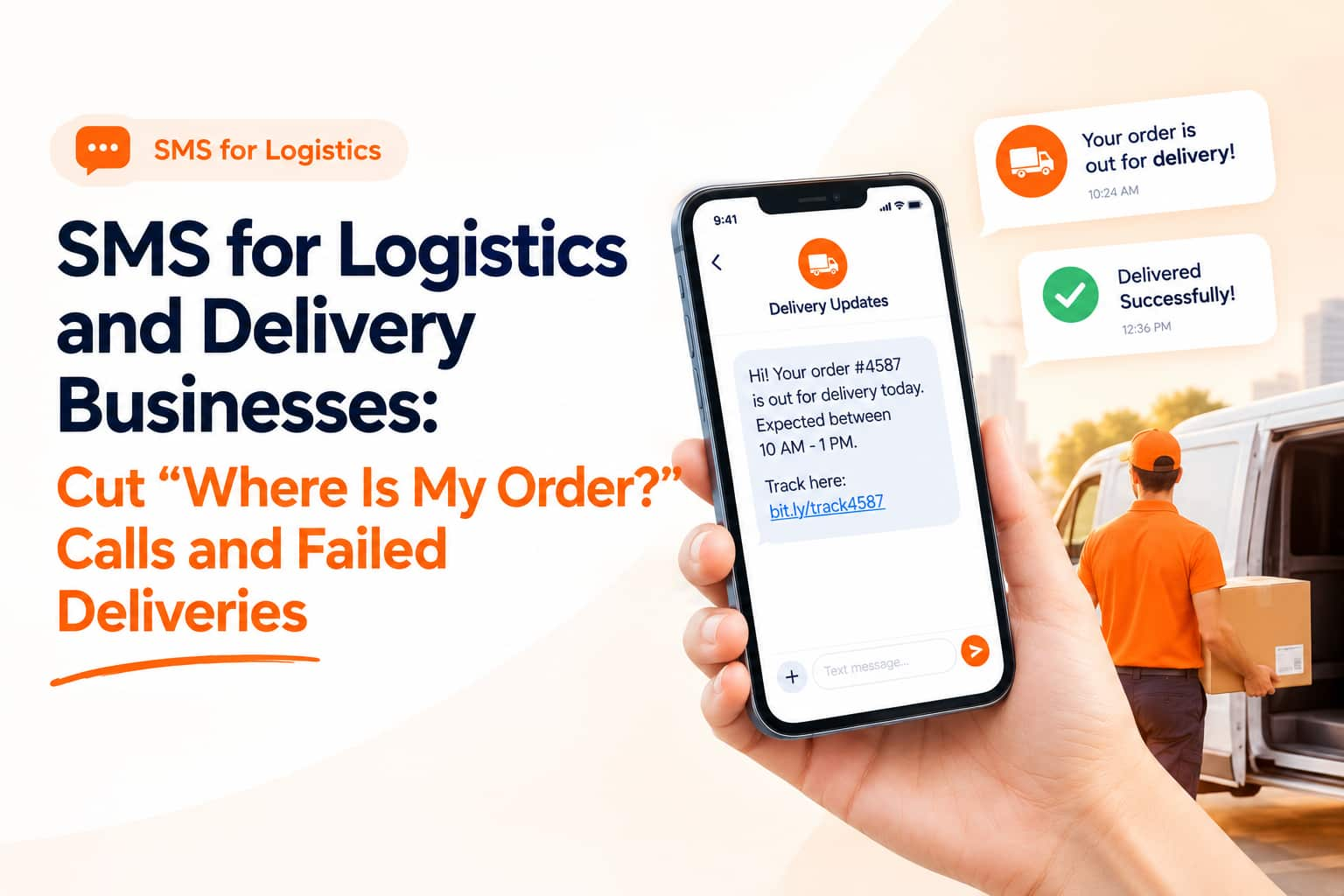
On delivery day, an "out for delivery" message sets expectations. It should include the time window and either the executive's contact or a masked number, so the customer knows to be available and recognises the call when it comes. For many deliveries, a one-time delivery code is also sent, which the customer shares with the executive at handover. This protects both sides against false claims of delivery or non-delivery and reduces fraud.
If an attempt fails, an immediate message explaining what happened and offering options to reschedule or update the address can recover the delivery before the parcel is returned. After successful delivery, a confirmation with a feedback link closes the loop and gives you valuable service data. For cash-on-delivery orders, a reminder of the amount due and accepted payment methods, including UPI, makes handover smoother and faster.
Why SMS remains essential in logistics
SMS reaches every mobile phone, including basic phones and smartphones without data, which matters greatly for deliveries across Tier 2 and Tier 3 cities and rural areas. It is fast and dependable for time-critical information like delivery codes, and it is familiar to customers of every age.
That said, SMS works best as part of a broader setup. RCS Business Messaging can deliver branded, richer updates on supported Android phones, with maps and buttons for rescheduling. WhatsApp is excellent for two-way conversations, such as clarifying an address or arranging a convenient time. Used together, with SMS as the universal fallback, these channels cover nearly every customer.
Reducing failed deliveries
Failed deliveries, often tracked as NDRs or non-delivery reports, are one of the biggest hidden costs in last-mile logistics. Several simple practices help. Confirming availability on the morning of delivery, with a reply option such as "Reply 1 to confirm, 2 to reschedule", catches problems before the executive sets out. Offering a self-service rescheduling link lets customers choose a convenient slot without calling anyone.
Collecting address landmarks is especially important in India, where many addresses are approximate and executives rely on local knowledge. A short message asking for a nearby landmark can save several phone calls. And after a failed attempt, alerting the customer immediately, with clear next steps, gives you the best chance of completing delivery on the next attempt.
Compliance essentials
Delivery messages in India must follow TRAI's commercial communication rules. Register your sender headers and transactional or service templates on the DLT platform. Whitelist the tracking URLs and any callback numbers you include, because messages containing unregistered links or numbers can be blocked. Keep transactional messages free of promotional content; adding an offer to a delivery update can cause rejection and blurs the line between service and marketing. Finally, protect personal data such as addresses and phone numbers, mask numbers where possible, and handle data in line with India's data protection framework.
Example templates
A clear out-for-delivery template might read: "Your order {#var#} from BRAND is out for delivery today between {#var#}. Delivery code: {#var#}. Track: {#var#} - BRAND". A failed-delivery template could say: "We could not deliver order {#var#} today. Reschedule or update your address: {#var#} - BRAND". Both are specific, clearly transactional and use variables only for genuinely changing details.
Automate rather than send manually
Manual messaging does not scale. Connect your order management or transport management system to an SMS API so that messages trigger automatically whenever an order's status changes. Then track delivery rates, response rates and failed-delivery recovery by region, and use the data to refine timing and wording.
Frequently asked questions
Are delivery updates transactional or promotional?
Order and delivery updates are transactional or service messages. Offers must use promotional templates and respect consent.
Should we use WhatsApp instead of SMS?
Use both. WhatsApp suits conversations, while SMS guarantees reach and handles delivery codes reliably.
How quickly should delivery codes arrive?
As close to instantly as possible, using priority transactional routes.
Automate your delivery communication
OM Enterprises provides SMS, RCS and WhatsApp APIs for logistics and e-commerce businesses, with DLT-compliant templates, priority routes and delivery analytics included. Talk to our team.