

SCO vs SEO: What's the Real Difference and Does Your Indian Business Need Both?

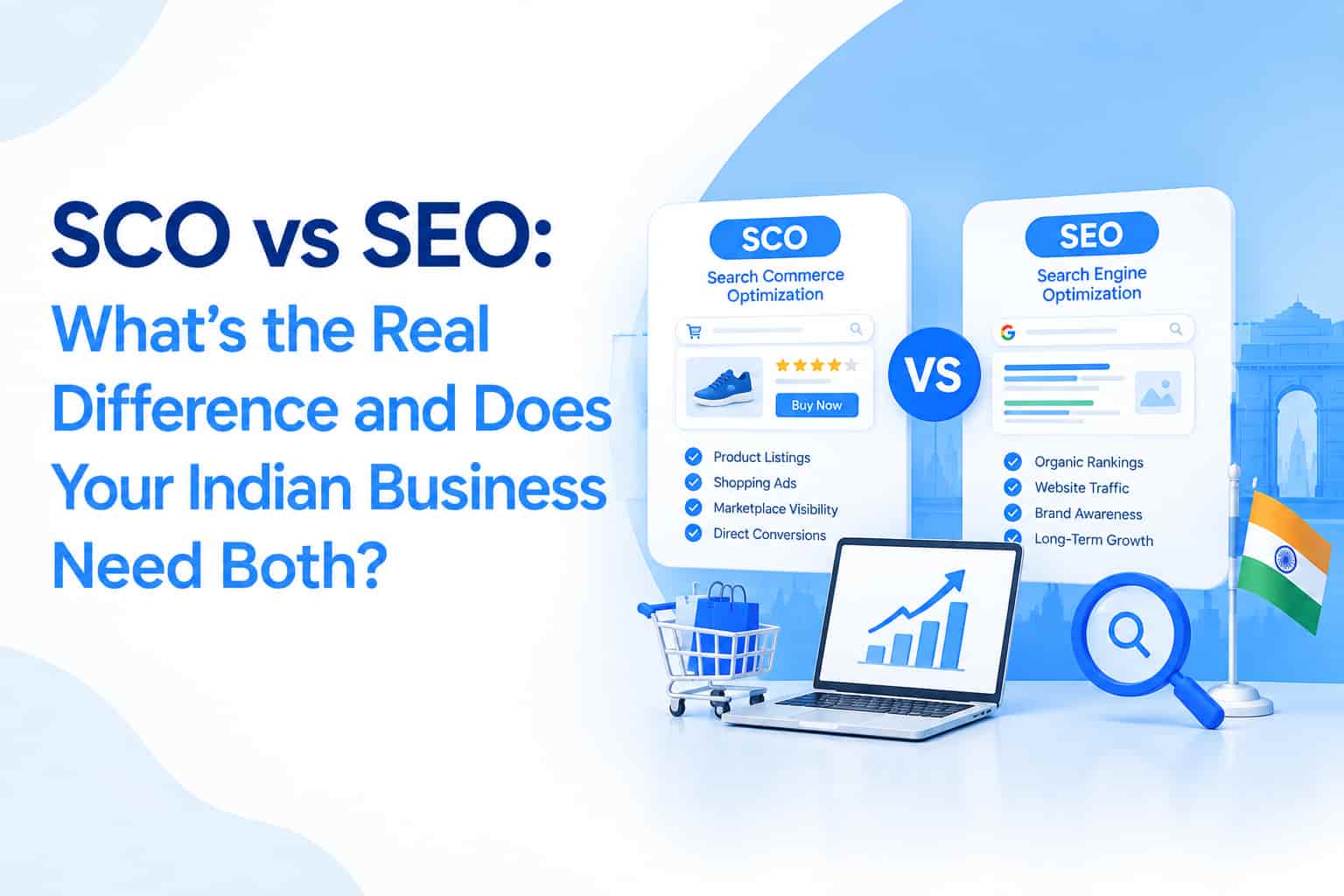
A common question from Indian business owners lately: "We've been doing SEO for two years — do we need SCO now too, or is someone just renaming the same thing to sell a new service?" It's a fair suspicion, and the honest answer is: SCO isn't a replacement for SEO, and anyone claiming it is has probably misunderstood — or is misrepresenting — both terms.
SEO: A Defined, Measurable Discipline
SEO (Search Engine Optimization) has a specific, well-documented scope: improving a website's visibility in organic search engine results, primarily Google. It has known ranking factors (however much Google keeps the exact formula private), established tools for measurement (rankings, organic traffic, click-through rate), and a mature body of practice built over two decades.
SCO: A Broader, Less Standardized Idea
SCO (commonly Search Channel Optimization, though the acronym is used inconsistently across the industry) is a newer, looser concept describing visibility across multiple discovery channels at once — Google Search, YouTube, AI answer engines, social platforms, and local directories — rather than one channel in isolation. It doesn't have Google's documentation, established measurement standards, or years of shared industry practice behind it. Treat any claim of "official SCO ranking factors" with real skepticism — no such official system exists.
The Practical Difference for a Business Owner
| SEO | SCO | |
|---|---|---|
| Scope | Organic Google/Bing search rankings | Search + social + AI answer engines + local discovery, together |
| Measurability | Established metrics: rankings, organic traffic, CTR | Still forming — often self-reported attribution and mixed-channel tracking |
| Maturity | 20+ years of documented practice | Emerging; terminology and methods still settling |
| Primary output | Rank higher for specific search queries | Be consistently discoverable and citable across multiple channels |
Does Your Business Actually Need "SCO" as a Separate Strategy?
For most small and mid-size Indian businesses, the honest answer is: get SEO fundamentals right first — technical health, useful content, local optimization — because these still drive the majority of measurable organic traffic. SCO-style thinking becomes useful once a business notices a specific gap: customers mention finding the brand on Instagram or YouTube but the business has never optimized for either, or competitors are getting cited in ChatGPT/AI Overview answers and the business isn't. At that point, extending the same discoverability discipline SEO already taught the business — clear structure, consistency, genuine usefulness — to those additional channels is a natural next step, not a separate discipline requiring new tools.
A Simple Way to Decide
- If organic Google traffic is still the main gap — invest in SEO fundamentals first: technical health, content depth, backlinks.
- If SEO is solid but customers say they found the business through Instagram, YouTube, or a friend's WhatsApp recommendation — that's a genuine signal to extend the same discoverability thinking to those channels.
- If a vendor pitches "SCO" as a proprietary ranking system with guaranteed results — that's a red flag; no platform publishes an official SCO algorithm.
Frequently Asked Questions
Is SCO going to replace SEO?
No — Google Search remains the single largest organic discovery channel for most businesses, and SEO remains the most measurable, established way to optimize for it. SCO is additive, not a replacement.
Can a small business afford to do both?
Most of what "SCO" describes — consistent NAP data, clear content structure, a presence on YouTube or Instagram — overlaps heavily with good SEO and content practice already, so it's less about a separate budget and more about extending existing discipline to more places.
How do I measure SCO if there's no standard metric?
Track it indirectly for now: ask new leads how they found the business, monitor branded search volume, and watch for citations in AI answer tools — imperfect, but currently the most honest available signals.
Where This Leaves Indian Businesses
SEO and SCO aren't competing strategies — SEO is the proven foundation, and SCO is a useful lens for the gaps that show up once that foundation is solid. OM Enterprises builds SEO strategy first for Indian clients, then extends into broader multi-channel discoverability work only where the data shows it's actually needed.