

What Is SCO (Search Channel Optimization) and Why Indian Businesses Can't Ignore It in 2026

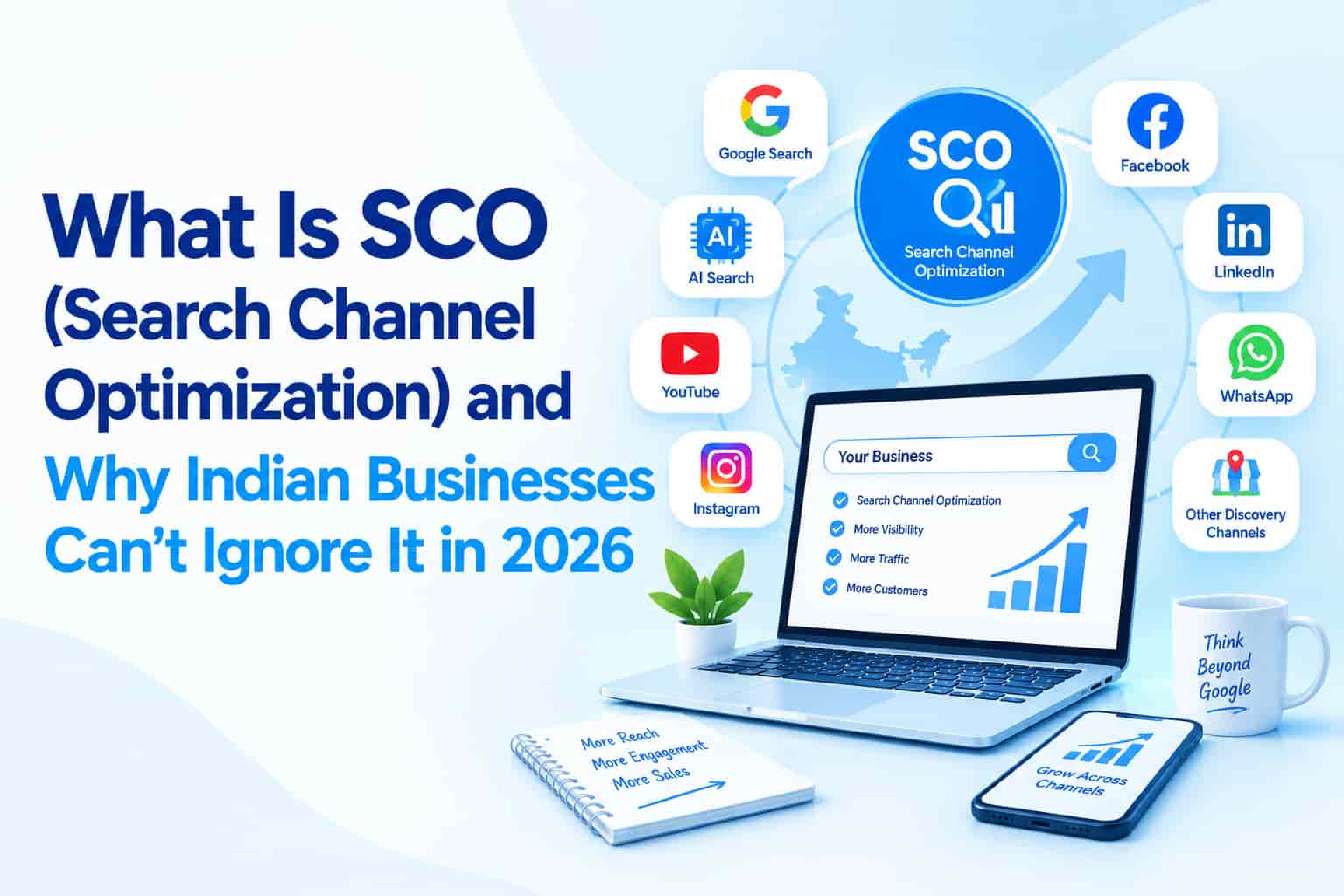
A Jaipur boutique ranks #1 on Google for "designer kurtis Jaipur" and still watches sales slip. The reason usually isn't the website — it's that the customer's actual journey never touched Google in a straight line. She saw the brand on Instagram Reels, searched the brand name on Google to check reviews, asked a friend on WhatsApp if it was legit, and finally bought after seeing it again in a YouTube Short. Ranking #1 on one channel while being invisible everywhere else in that journey is exactly the gap that "SCO" — Search Channel Optimization — tries to describe.
SCO isn't an official Google ranking system, and there's no single industry-agreed definition of it yet — some marketers use it to mean Search Channel Optimization, others use the same acronym loosely for "Social Channel Optimization." What's consistent across most usages is the core idea: optimizing for discoverability across every channel a customer actually searches on, not just Google's organic results.
What SCO Covers Beyond Traditional SEO
Traditional SEO focuses on one channel — organic Google rankings. SCO, as most practitioners now use the term, treats that as one input among several:
- Google Search — still the largest single channel, and the one classic SEO optimizes for.
- AI answer engines — ChatGPT, Perplexity, and Google's own AI Overviews, which increasingly answer questions directly instead of sending a click.
- YouTube — India's second-largest search engine by query volume for many product and how-to categories.
- Instagram and social discovery — where a large share of younger Indian buyers now start their research, especially for fashion, food, and lifestyle categories.
- Local and map-based discovery — Google Business Profile, JustDial, and similar directories for service businesses.
- WhatsApp — not a search engine, but frequently the final trust-check and closing channel in an Indian buyer's journey.
None of this replaces SEO — SEO is still the largest, most measurable piece of the puzzle. SCO is the recognition that a single ranking on a single channel is no longer the same thing as being findable.
Why This Matters More in India Than It Might Elsewhere
India's buyer journeys are unusually fragmented across apps. A customer can move from a short-form video to a search query to a chat app within minutes, often without ever landing back on a brand's own website until the final step. A business that's been optimized purely for Google rankings can be doing everything "right" by SEO standards and still lose the sale at the WhatsApp or Instagram stage simply because nobody prepared for it.
A Practical Way to Start Building an SCO Approach
1. Map the actual customer journey, not the assumed one
Talk to recent customers about how they actually found and vetted the business. Most companies assume a journey that doesn't match reality.
2. Treat Google Business Profile and YouTube as search engines, not social add-ons
Both are frequently searched directly by intent — "near me" queries on Maps, and "how to" or comparison queries on YouTube — and both reward completeness and consistency the same way Google Search does.
3. Keep brand information identical everywhere
Name, address, phone number, pricing claims, and service descriptions should match exactly across the website, Google Business Profile, Instagram bio, and any directory listing. AI answer engines and local search both penalize inconsistency by simply picking a different, more consistent source to cite.
4. Structure content so it can be lifted and quoted
Clear headings and direct answers near the top of a section help both traditional search snippets and AI Overviews extract and cite the content — this is one of the few genuinely measurable overlaps between SEO and SCO.
5. Track where inquiries actually originate
Ask new leads how they found the business, or use platform-level attribution where available. Without this, it's impossible to know which channel in the SCO mix is actually doing the work.
Frequently Asked Questions
Is SCO a real Google ranking factor?
No — SCO is a marketing strategy concept, not an official algorithm or ranking system from Google, Meta, or any platform. Be skeptical of anyone selling it as a guaranteed formula or a secret ranking trick.
Should a small business worry about SCO before fixing basic SEO?
No. SEO fundamentals — a fast, crawlable, well-structured website with genuinely useful content — should come first. SCO thinking is most useful once those fundamentals are in place and the business wants to close the remaining discoverability gaps.
Does SCO replace the need for paid advertising?
No — it's a lens for organic discoverability across channels, not a substitute for paid reach. Most businesses still need both working together.
The Real Takeaway
SCO is less a new technique than a more honest way of looking at how Indian customers actually discover and vet a business today — across search, video, social, and chat, not in the single straight line SEO reporting usually assumes. OM Enterprises helps Indian businesses map that real discovery journey and build search, content, and messaging strategies that show up at every stage of it, not just the Google search bar.