

Schema Markup Beyond Products: FAQ, Review, and Article Schema for Service Businesses

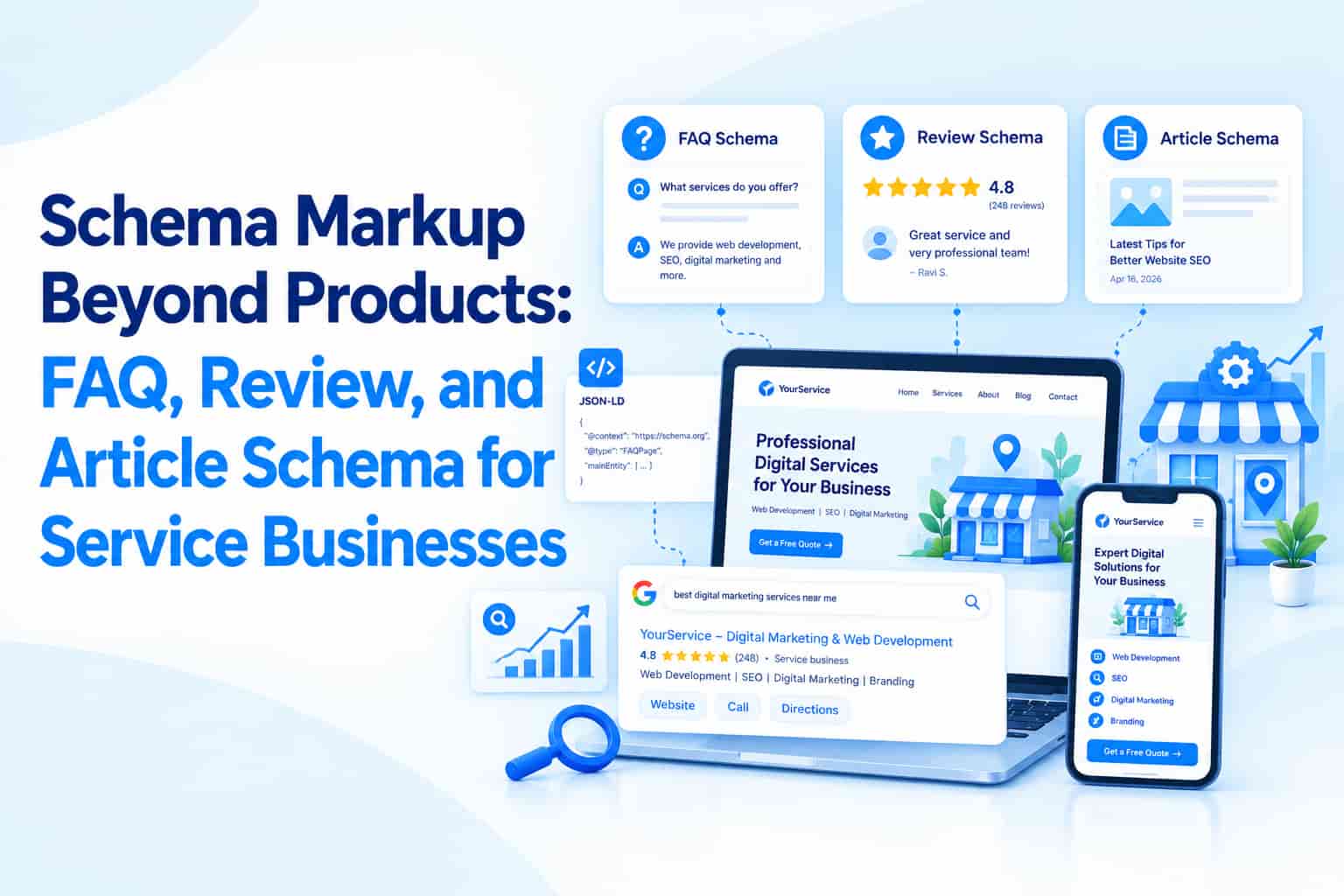
A service business assumes structured data is only relevant to e-commerce sites with products to mark up, skips it entirely, and misses out on rich results — star ratings, FAQ dropdowns, article information — that its retail competitors are already capturing in search results for unrelated reasons. Schema markup has genuinely useful applications well beyond product listings, and most service businesses are leaving it unused simply because it's framed as an e-commerce topic.
FAQ Schema: The Easiest High-Value Addition
FAQ schema marks up genuine question-and-answer content so Google can display it as an expandable dropdown directly within the search result, taking up more visual space on the results page and giving searchers a direct answer before they even click through. This works for any service business with a genuine FAQ section — a clinic, a law firm, a home services company — provided the questions marked up are real, commonly asked questions rather than invented ones stuffed with keywords purely to qualify for the schema.
Review Schema for Trust Signals in Search
Review or aggregate rating schema enables star ratings to display directly in search results for pages with genuine, verifiable review content — a meaningful trust signal that can improve click-through rate even without a ranking change, since searchers comparing several results are visibly drawn to the one showing a strong rating. This requires actual review data on the page (not just a claimed rating), and using it without genuine underlying reviews risks a Google structured data policy violation.
LocalBusiness Schema for Service-Area and Location-Based Businesses
LocalBusiness schema (or its more specific subtypes, such as MedicalClinic, LegalService, or HomeAndConstructionBusiness) helps Google understand a business's name, address, service area, hours, and category with more precision than what's written in prose alone — reinforcing the same information a Google Business Profile provides, from the website's own structured data.
Article Schema for Blog and Resource Content
Article schema on blog posts and resource pages — marking up the headline, author, publish date, and featured image in a machine-readable format — helps these pages appear correctly in Google's various content surfaces (Top Stories, Discover) where applicable, and gives search engines clearer signals about content freshness and authorship, which matters more as content authenticity becomes a bigger factor in how both traditional and AI search systems evaluate a source.
Service Schema for Clearly Defining What's Offered
Service schema, used on individual service pages, explicitly defines what a specific page is about — the service name, the area served, and the business offering it — in a structured format rather than relying entirely on Google inferring this from unstructured page text. For a business offering multiple distinct services across separate pages, this reduces ambiguity about which page should rank for which specific service query.
Implementation Without Breaking Anything
Schema markup should be validated using Google's Rich Results Test before and after implementation — a common, avoidable mistake is a theme or plugin update silently breaking previously working schema, which then goes unnoticed until rich results quietly stop appearing weeks later. Periodic re-validation, not just a one-time setup check, catches this before it costs visibility.
Frequently Asked Questions
Do service businesses without physical products need schema markup?
Yes — FAQ, LocalBusiness, Review, and Service schema all apply meaningfully to service businesses and don't require a product catalog to be useful.
Can review schema be added without genuine customer reviews?
No — this violates Google's structured data guidelines and risks a manual action; review schema should only reflect real, verifiable review data already present on the page.
Making Structured Data Work for Every Business Type
Schema markup's value isn't limited to product listings — for service businesses, FAQ, review, and local business schema can meaningfully improve how a page appears in search. OM Enterprises implements and validates the right schema types for Indian service businesses based on what each page genuinely offers, not a one-size-fits-all e-commerce template.