

Responsive Search Ads: How to Write Headlines and Descriptions That Earn Clicks From the Right People

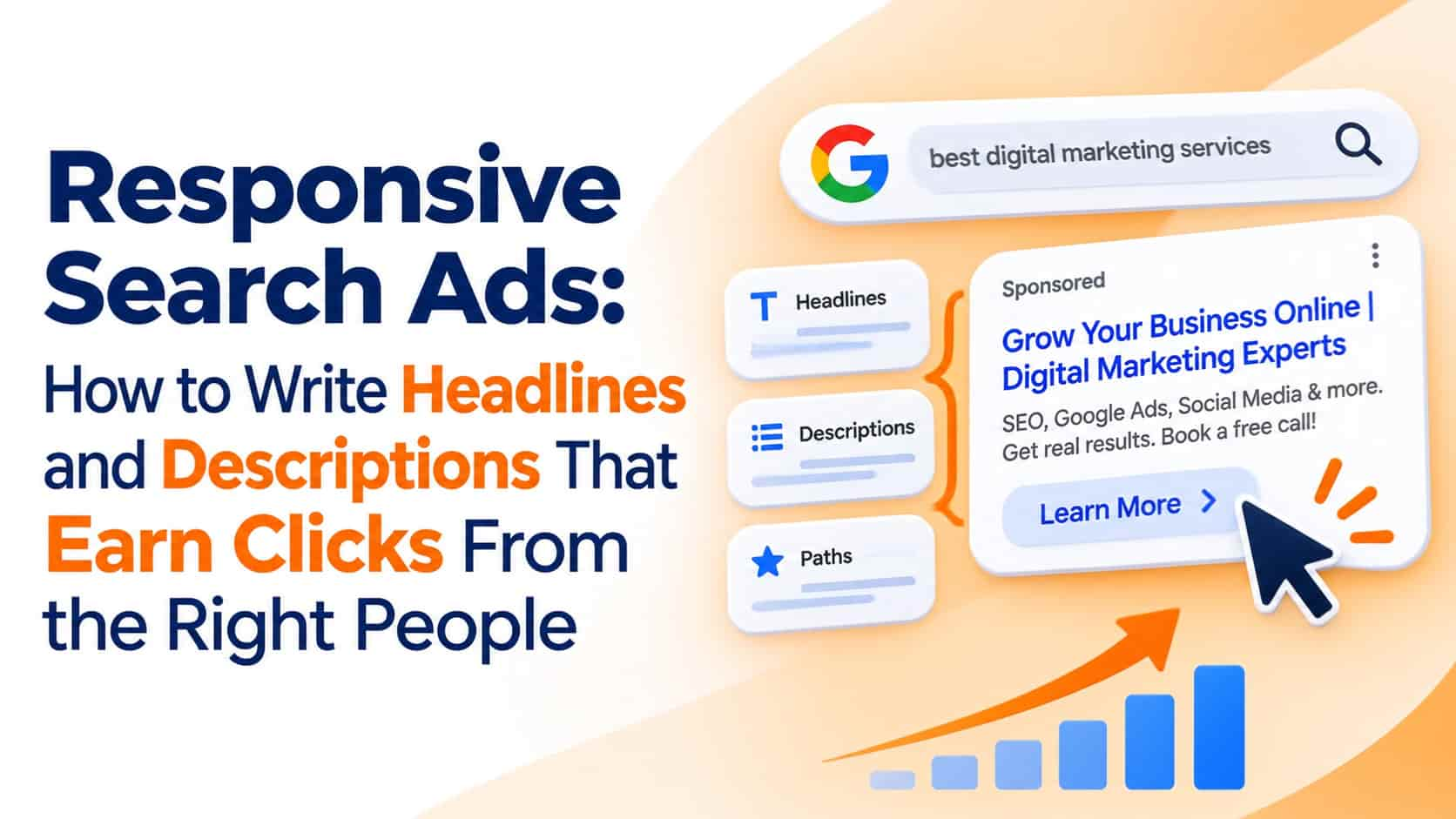
When someone searches on Google, your ad has about two seconds to earn a click. In the old days, advertisers wrote a fixed headline and description and tested one version against another. Today, most Google Search ads are responsive: you supply a pool of headlines and descriptions, and Google assembles combinations that it expects to perform best for each search. This gives you reach and flexibility, but it also changes the craft. The advertiser who supplies fifteen similar headlines will do worse than the one who supplies fifteen carefully different ones. This guide explains how to write responsive search ads that earn clicks from the right people.
How responsive search ads work
You can enter up to fifteen headlines of up to thirty characters each, and up to four descriptions of up to ninety characters each, plus final URL and display path text. Google tests combinations, showing up to three headlines and two descriptions in different arrangements, and learns which perform best for different queries, devices and audiences. You can pin specific headlines or descriptions to fixed positions when something must always appear, such as a legal statement or brand name, but pinning reduces flexibility, so use it sparingly. Ad strength ratings such as poor, average, good and excellent are Google's guide to variety and relevance. They are not a guarantee of results, but low ratings usually mean you have given the system too little to work with.
Start with the searcher, not your product
Great search ads answer the question in the person's head. Study the search terms that trigger your ads, and group them by intent. Someone searching "bulk SMS price per message" is price-sensitive and comparing. Someone searching "DLT registration help" needs a solution to a specific problem. Someone searching for your brand name already knows you. Write ads that reflect these differences. Use separate ad groups for distinct intents, so each set of headlines can speak directly to that need.
Include the keyword naturally
People notice words that match what they typed, and Google highlights matching terms in bold. Include your main keyword in at least a few headlines, but do not repeat it in all of them. Use variations, synonyms and related phrases. Dynamic keyword insertion can place the search term in the headline automatically, but it can produce awkward or inaccurate text, so use it carefully and avoid it for sensitive categories.
Cover different angles in your headlines
A good set of headlines is a menu of distinct messages, not rewrites of the same sentence. Aim to include several types.
Keyword and offer. Clear statement of what you provide, such as "Bulk SMS for Businesses".
Benefits. What the customer gains, such as faster delivery, lower cost or fewer missed calls.
Proof. Years in business, number of customers, ratings, certifications or awards, if they are real and verifiable.
Features and specifics. Details that help qualify a click, such as supported languages, delivery times or integrations.
Price and offers. Starting prices, free trials, discounts or free consultations, where accurate.
Calls to action. "Get a Free Quote", "Book a Demo", "Call Today". Make the next step obvious.
Location and availability. City names, service areas and hours matter for local businesses.
Brand. Your name in at least one headline.
Write descriptions that finish the argument
Headlines get attention, and descriptions persuade. Use them to expand on benefits, address objections and give a clear call to action. Write complete sentences that make sense alongside any headline combination. Include specifics such as what is included, how fast you respond or what happens after the click. Avoid repeating the headline words with no new information. Four descriptions with different focus, such as benefits, proof, process and offer, give the system useful variety.
Make every combination make sense
Because headlines are mixed automatically, each one must work with any other. Avoid headlines that depend on a particular order, contradict each other or repeat the same promise. Do not write a headline that ends with a sentence that continues in the next one. Read several random combinations aloud to check that they still read naturally. Use pinning only for compliance or branding requirements.
Use ad assets and extensions
Add assets, formerly called extensions, to make ads larger and more informative. Sitelinks lead to key pages, callouts highlight selling points like free consultation or same-day setup, structured snippets list types of services, call assets add a phone number, lead form assets collect enquiries directly and location assets show your address. Price and promotion assets display offers. Assets do not guarantee a click but can improve visibility and relevance. Make sure that each one is accurate and leads to a working page.
Match the landing page
An excellent ad followed by a mismatched page wastes money. The headline promise should be visible on the landing page immediately. If the ad mentions a free demo, the page should show how to book one. Align the keyword, ad and page for each ad group, and make sure the page loads quickly on mobile. Google considers landing page experience as part of ad quality.
Follow policy and honesty rules
Google Ads policies restrict misleading claims, unrealistic promises, excessive capitalisation and punctuation, and certain sensitive categories. Do not claim "No. 1" or "best" without evidence. Do not use competitor trademarks in ad text improperly. For regulated areas like health and finance, follow local rules and platform requirements. Disapproved ads waste time, so check policy guidance before launch.
Test and learn
Let ads run long enough to gather impressions and clicks before judging. Review asset performance labels, which indicate how individual headlines and descriptions perform relative to others, though they are guidance and not absolute. Replace consistently weak assets with new angles, and keep strong ones. Test one theme at a time, such as price-led versus benefit-led messaging. Compare conversion rate and cost per conversion, not only click-through rate. A high click-through rate with poor conversions means the ad promises something the page does not deliver.
Common mistakes
Common errors include fifteen near-identical headlines, forgetting a call to action, pinning too many assets, keyword stuffing, weak descriptions, mismatched landing pages, ignoring search terms and chasing ad strength ratings at the cost of clarity.
Frequently asked questions
How many headlines should I write?
Use as many distinct, useful headlines as you can, up to fifteen, but do not pad with repeats.
Should I pin headlines?
Only when necessary for legal or branding reasons.
Does ad strength guarantee performance?
No. It is guidance. Always judge ads by conversions.
Write ads that get the right clicks
OM Enterprises writes and tests Google Search ads aligned with your keywords, landing pages and conversion goals. Request a Google Ads review.