

RCS vs WhatsApp Business Messaging: Which One Should Your Business Actually Use?

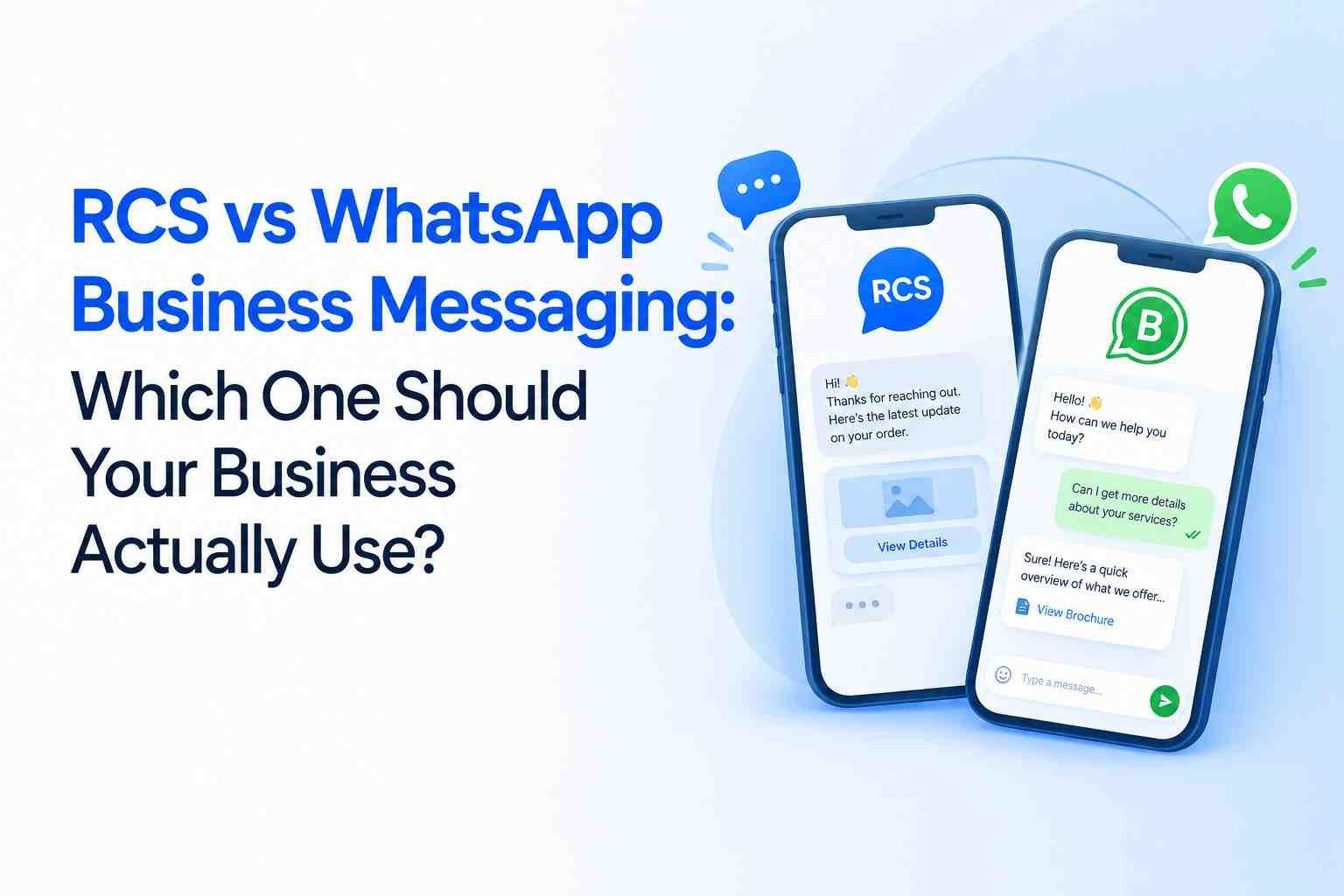
Two customers get the same delivery update. One sees it appear as a rich card with a tracking button inside their default Android messages app, no download required. The other sees an identical rich card inside WhatsApp. Both experiences look almost the same on the surface — which is exactly why so many businesses ask which one they should actually be investing in, rather than running both by default.
The core difference: reach vs. universality
WhatsApp requires the recipient to have the app installed — which, in India, describes the overwhelming majority of smartphone users, making it close to a universal channel already. RCS Business Messaging works through the native messaging app already built into Android phones, meaning no install or download at all, but its rich features depend on the recipient's carrier and device supporting RCS — coverage that has been steadily expanding across major Indian carriers but is not yet as uniformly universal as WhatsApp's installed base.
Where each one wins
RCS tends to win on
- Zero-friction first contact — a customer doesn't need to have added your business or opened an app they don't use daily; the message simply appears in their default texting app, the same place OTPs and transactional SMS already land.
- Carrier-verified sender branding — RCS messages can display a verified business name and logo directly in the conversation, which builds trust for first-time senders in a way a random ten-digit number can't.
WhatsApp tends to win on
- Habitual, repeat engagement — customers already return to WhatsApp multiple times a day for personal messaging, which means a business message sits inside a genuinely active inbox rather than a rarely-opened one.
- In-chat commerce — catalogs, carts, and payments inside the chat are considerably more mature on WhatsApp today than on RCS.
A practical decision framework
Rather than treating this as an either/or choice, map it to the message's purpose:
- OTPs, delivery updates, appointment reminders — either channel works well; RCS often has a cost advantage here since it doesn't require an existing opt-in relationship the way WhatsApp templates do.
- Ongoing customer relationships, support conversations, catalog browsing — WhatsApp's habitual use and commerce features currently give it the edge.
- First-time outreach to a cold or lapsed contact list — RCS's zero-install nature can outperform WhatsApp, since a WhatsApp message to a number that hasn't opted in risks the account's quality rating.
The real answer for most businesses
Larger and mid-size businesses in India increasingly run both channels, routed by message type and audience segment, rather than picking one. The channel fragmentation that made this complex a few years ago has mostly been solved by messaging platforms that let a business manage RCS, WhatsApp, and SMS fallback from a single dashboard — falling back to plain SMS automatically when a recipient's device or carrier doesn't support either rich channel.
FAQ
Is RCS available to all Android users in India now?
Coverage has expanded significantly across major carriers and modern Android devices, but it isn't yet universal the way SMS is — always build in an SMS fallback for messages that must reach everyone.
Does RCS work on iPhone?
Apple has added RCS support to iOS, though the rich business-messaging features available to a brand can still differ by carrier and region — check current support before relying on it for iPhone-heavy audiences.
Which is cheaper to send at scale?
Pricing structures differ by provider and message category (marketing vs. utility vs. authentication) on both channels — get a like-for-like quote from your messaging provider rather than assuming one is categorically cheaper.
Conclusion
RCS and WhatsApp aren't really competing for the same job. RCS shows up uninvited in a native inbox with instant brand trust; WhatsApp lives inside a habitual, high-engagement app your customers already check constantly. The businesses getting the most out of business messaging in 2026 aren't choosing between them — they're matching each message's purpose to the channel built for it, with SMS quietly filling the gaps neither one covers yet.