

RCS vs WhatsApp Business API: Which Should Indian Retailers Choose in 2026

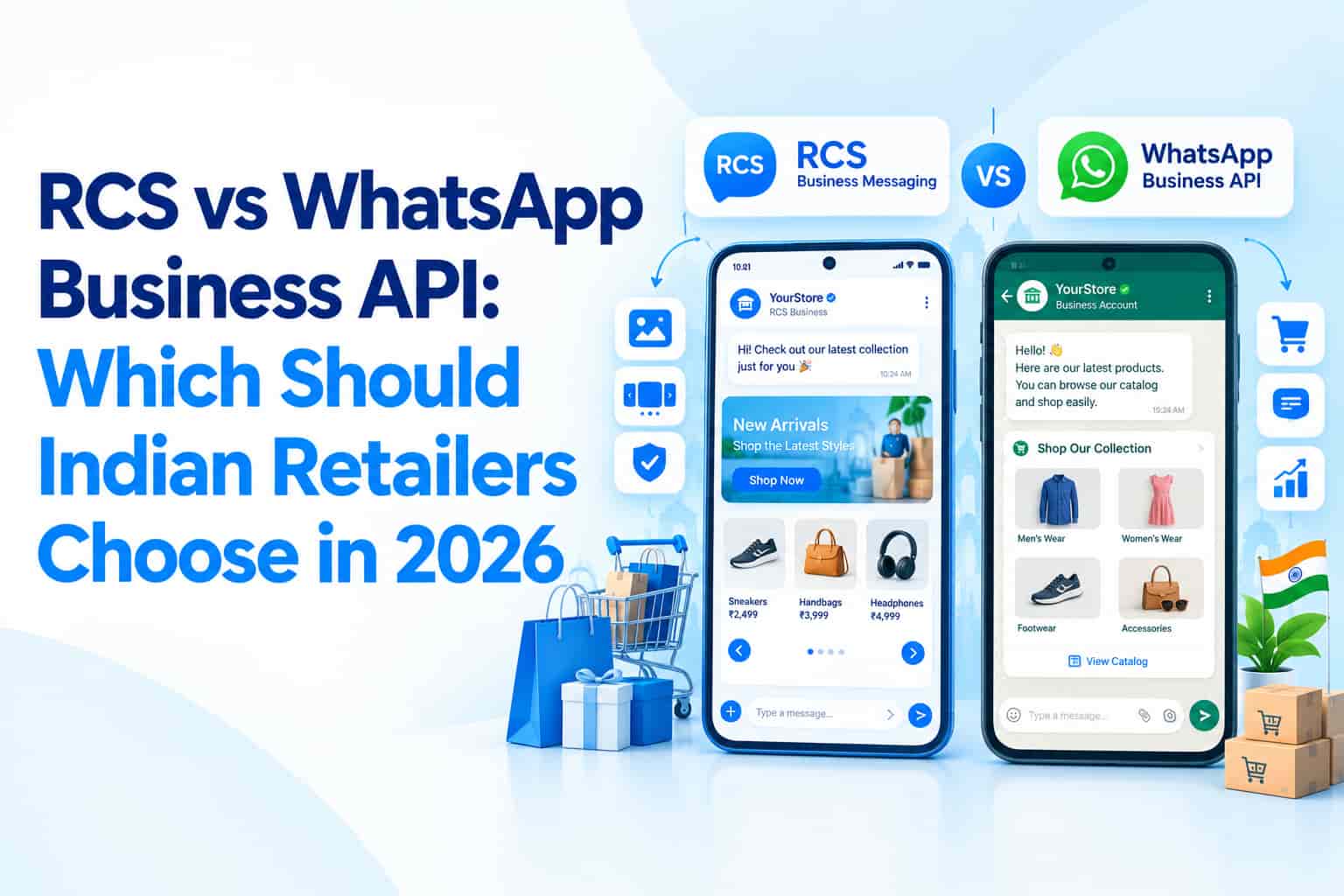
A retailer setting up cart-abandonment recovery for the first time in India will almost always default to WhatsApp — it's the obvious, familiar choice. But since Apple added RCS support with iOS 18, the real question for 2026 isn't "WhatsApp or nothing," it's which of the two rich-messaging channels — or which combination — actually fits the use case.
Where RCS Stands in India Right Now
Jio, Airtel, and Vi all fully support RCS Business Messaging, with BSNL — representing only 7–8% of subscribers — expected to catch up by 2026–2027. Combined with Apple's iOS 18 rollout, RCS now reaches an estimated 70–80 crore addressable devices, or roughly 85–90% of Indian smartphones. Reported performance for well-targeted RCS campaigns: open rates of 82–90% and click-through rates of 8–15%, which is 4–6 times higher than typical SMS click-through rates. Typical use cases include appointment reminders, cart recovery, invoice delivery with embedded payment links, real estate property showcases, and insurance claim updates.
Where WhatsApp Business API Still Leads
WhatsApp's advantage isn't reach data — it's default behavior. It remains the app Indian consumers already have open multiple times a day, with an existing habit of using it for both personal and business conversations, from booking confirmations to customer support. That familiarity matters more than any feature comparison: a message in an app someone checks constantly gets read differently than a message in a native messaging app they open less often.
Head-to-Head: Where Each Channel Actually Wins
| Use Case | Better Fit | Why |
|---|---|---|
| Cart abandonment recovery | Either — test both | RCS often shows higher open rates; WhatsApp benefits from existing customer habit |
| Rich product carousels / catalogs | RCS | Native carousel and suggested-reply UI built into the messaging app, no separate app required |
| Two-way customer support conversations | Customers already default to WhatsApp for ongoing conversations with businesses | |
| Delivery and appointment reminders | Either | Both support rich, branded notification formats reliably |
| Reaching customers without WhatsApp installed | RCS | Works natively through the default messaging app — no app download or opt-in required |
Cost and Compliance Considerations
RCS campaigns in India typically require a minimum commitment (around ₹0.18 per message with a 50,000-message minimum in many carrier packages), which suits mid-size and larger retailers more than very small businesses. WhatsApp's Business Platform has been shifting toward fully per-message, per-category billing, which changes the cost calculation depending on message volume and category (marketing, utility, authentication, or service). Neither channel removes the retailer's obligation to get proper opt-in consent before sending promotional messages — a rule regulators in India enforce closely regardless of which app carries the message.
A Practical Recommendation for Retailers
For most Indian retailers, the pragmatic answer isn't "choose one" — it's sequencing: use RCS where it's supported to reach the full smartphone base with rich, native experiences (especially for catalog and cart-recovery use cases), and fall back to WhatsApp or SMS for customers or carriers where RCS isn't yet available. Larger retailers running both often see better overall reach and lower blended cost per engaged customer than committing entirely to one channel.
Frequently Asked Questions
Do customers need to install an app to receive RCS messages?
No — RCS works through the phone's default messaging app, the same way SMS does, which is one of its main advantages over WhatsApp for reaching customers who haven't opted into a separate app.
Is RCS available to all Indian mobile users yet?
Not universally — coverage now extends to an estimated 85–90% of smartphones following carrier rollouts and Apple's iOS 18 support, but full parity across all devices and carriers isn't complete.
Which channel is cheaper for a small business just starting out?
WhatsApp is often more accessible for smaller message volumes, since many RCS carrier packages require a minimum monthly commitment that suits higher-volume senders better.
Choosing the Right Channel Mix
The retailers getting the best results in 2026 aren't debating RCS versus WhatsApp in the abstract — they're matching each channel to the specific use case where it performs best. OM Enterprises helps Indian retailers set up and manage both RCS and WhatsApp Business messaging, from initial carrier registration to campaign design and compliance.