

RCS vs Push Notifications: Which Channel Drives Better App Engagement in 2026

Why the Push Notification vs RCS Debate Matters in 2026
Every app-first business in India runs on the same question: how do you get a user who has gone quiet to come back? For close to a decade, the default answer has been push notifications. They are free to send, they land instantly, and every mobile OS ships with the infrastructure built in. But mobile marketers running re-engagement campaigns in 2026 are noticing something uncomfortable — open rates on push have been sliding for years, and a growing share of installs never even grant notification permission in the first place. At the same time, RCS business messaging has quietly become one of the fastest-growing channels for customer communication in India, with RCS interactions in the country growing 108% between H1 2025 and H1 2026, according to Infobip's 2026 messaging report. That kind of growth forces a real conversation: is RCS simply a better version of push, or are the two channels solving different problems? This blog breaks down how each channel actually works, where each one wins, and how a combined strategy — rather than a either-or choice — produces the strongest results for app engagement and win-back campaigns.
How Push Notifications Work — and Where They Fall Short
Push notifications are messages sent directly from an app to a user's device through the operating system's notification layer — Firebase Cloud Messaging on Android, Apple Push Notification service on iOS. The mechanics are simple: a user installs the app, grants notification permission when prompted, and the app can then send alerts even when it is closed in the background.
The core limitations businesses run into
- Permission is the first wall. On iOS especially, users must explicitly opt in, and a large share simply tap "Don't Allow." No permission means zero reach, no matter how good the campaign is.
- Install dependency. Push only works for users who already have the app on their device. It cannot reach a prospect, a lapsed user who uninstalled, or someone browsing your website who hasn't downloaded anything yet.
- Notification fatigue. Users who once opted in frequently mute notifications at the OS level or bury the app in a folder, once the volume of promotional alerts starts to feel like noise.
- Limited formatting. A standard push notification is a title, a short body of text, and sometimes a small icon. There is no room for a product carousel, no rich imagery, no suggested-reply buttons inside the alert itself — the user has to tap through into the app to see anything more.
- No verified sender identity. Push notifications inherit whatever trust the app itself has. If a user hasn't opened the app in months, a generic notification with no visual branding is easy to dismiss as spam.
None of this makes push notifications useless — for an actively used app with a loyal base that has already granted permission, push remains a fast and low-cost way to nudge behaviour. The problem is what happens outside that narrow band of "already installed, already opted in, still engaged" users — and that is exactly the segment most re-engagement and win-back campaigns are trying to reach.
How RCS Works — and Why It Changes the Equation
Rich Communication Services (RCS) is the modern successor to SMS, and it now ships as the default messaging protocol on most Android devices in India, with adoption expanding on iOS as well. Instead of living inside a single app, RCS messages arrive directly in the phone's native messaging app — the same place users already check for texts from friends and family.
What makes RCS distinct as a business channel
- No app install required. A business can reach a customer's default messaging app using nothing more than their mobile number, whether or not they have ever downloaded the brand's app.
- No separate opt-in permission screen to fight. As long as a device has RCS-enabled messaging active — which is now the default state for most Android users and a growing share of iOS users — brand messages can be delivered without asking the user to grant a special notification permission the way an app must.
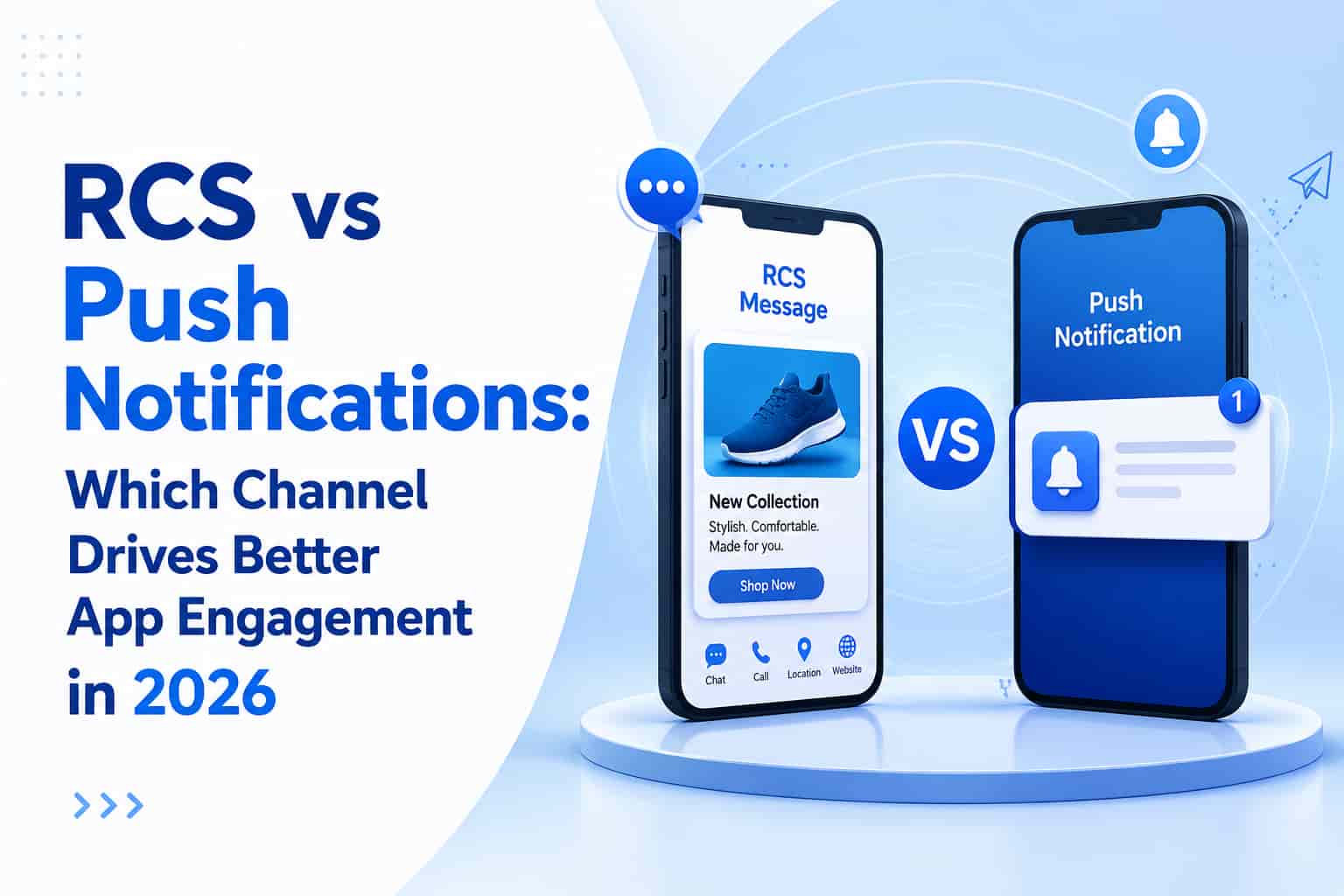
- Rich, interactive formatting. Through our RCS Messaging platform, brands can send full-width images, product carousels, suggested-reply chips, and action buttons — "Track Order," "Reorder Now," "View Offer" — directly inside the message thread, without the user leaving the conversation.
- Verified sender branding. RCS messages from a registered business display the company name, logo, and a verified badge in the chat window, which builds immediate trust compared to an unbranded push alert or an unknown SMS number.
- Two-way conversation. Customers can tap a suggested reply or type a response right in the thread, turning a one-way alert into the start of a real conversation — useful for support, order updates, and lead qualification.
RCS vs Push Notifications: A Side-by-Side Comparison
Reach
Push notifications can only reach users who have installed the app and granted permission. RCS can reach anyone with a mobile number on an RCS-enabled device, making it a stronger channel for re-engaging lapsed users, reaching prospects, and running win-back campaigns for people who uninstalled the app entirely.
Permission friction
Push requires an explicit in-app permission prompt that a meaningful share of users decline. RCS messaging rides on the device's default messaging capability, removing that specific app-level opt-in hurdle for delivery.
Rich media and interactivity
Push is limited to short text and a small icon. RCS supports carousels, large images, video thumbnails, and tappable action buttons directly in the message — closer to a mini landing page than a notification.
Branding and trust
Push inherits the app's existing trust level and has no verified badge of its own. RCS displays verified business identity — name, logo, and badge — which is especially valuable when reaching users who don't yet have a strong relationship with the brand.
Cost
Push notifications are essentially free to send through standard OS infrastructure. RCS messages, similar to SMS and Bulk SMS campaigns, carry a per-message cost, which means campaigns benefit from being targeted and well-timed rather than blasted indiscriminately.
Best-fit use cases
Push suits frequent, low-friction nudges for active, logged-in users — a reminder that a cart item is low in stock, a "your workout is due" alert, a live score update. RCS suits higher-intent, higher-value moments — order confirmations, delivery updates, appointment reminders, win-back offers for dormant users, and campaigns that need visual proof like a product carousel or a rich offer card.
When Push Notifications Still Win
Push remains the right tool when speed and volume matter more than richness — real-time alerts for an already-open session, gaming and content apps with daily active users, or any scenario where the user has recently opted in and is actively engaged with the app. It is also the lowest-cost option when reach outside the installed base isn't the goal.
When RCS Wins
RCS pulls ahead whenever the goal is broader reach, higher trust, or richer storytelling — win-back campaigns targeting users who uninstalled the app, promotional offers that benefit from a visual carousel, order and delivery updates that need to look professional and verified, and any communication where a suggested-reply button can shortcut the customer straight into a purchase or support conversation.
The Smart Approach: Combining Both Channels
The strongest app engagement strategy in 2026 doesn't force a choice between RCS and push — it assigns each channel to the job it does best. Use push notifications for fast, low-cost nudges to your actively engaged, already-opted-in app users. Use RCS business messaging for higher-value moments: reactivating dormant users, running win-back campaigns for people who deleted the app, sending rich order and delivery updates, and any communication where verified branding and interactive buttons meaningfully improve the response rate. Businesses that layer their Digital Marketing strategy this way — push for retention, RCS for reach and re-engagement — consistently see stronger overall engagement than relying on either channel alone, because each one is compensating for exactly what the other lacks.
Frequently Asked Questions
Does RCS replace push notifications completely?
No. Push notifications still make sense for fast, in-app nudges to already-engaged, opted-in users. RCS is better suited to reaching users beyond the installed app base, re-engagement, and richer, higher-trust messaging — the two channels work best as complements, not substitutes.
Do customers need to install anything to receive RCS messages?
No separate app install is required. RCS messages arrive in the phone's default messaging app, which now supports RCS out of the box on most Android devices and an increasing number of iOS devices, so businesses can reach customers using just their mobile number.
Is RCS more expensive than push notifications?
RCS carries a per-message cost, similar to SMS, while push notifications are largely free to send through app infrastructure. The trade-off is reach and richness — RCS is best used for higher-intent moments where the extra cost is justified by stronger response and trust, rather than for high-frequency, low-value alerts.
How can a business start using RCS for re-engagement campaigns?
The first step is registering as a verified business sender and integrating with a reliable RCS provider. Through our RCS Messaging platform, OM Enterprises helps Indian businesses set up verified branding, design rich message templates, and launch targeted re-engagement and win-back campaigns without needing in-house technical infrastructure.