

RCS Messaging in India 2026: Why Adoption Just Surged 108%

If you sent a promotional SMS to your customers last month and quietly wondered why almost nobody clicked on it, you're not alone — and the data suggests you may already be behind.
Rich Communication Services (RCS), the "smart upgrade" to plain-text SMS, just had its biggest year yet in India. Business messaging is having a quiet but massive shift, and 2026 looks like the year RCS stopped being an emerging channel and became a mainstream business tool.
The Headline Number: RCS Interactions in India Grew 108% in One Year
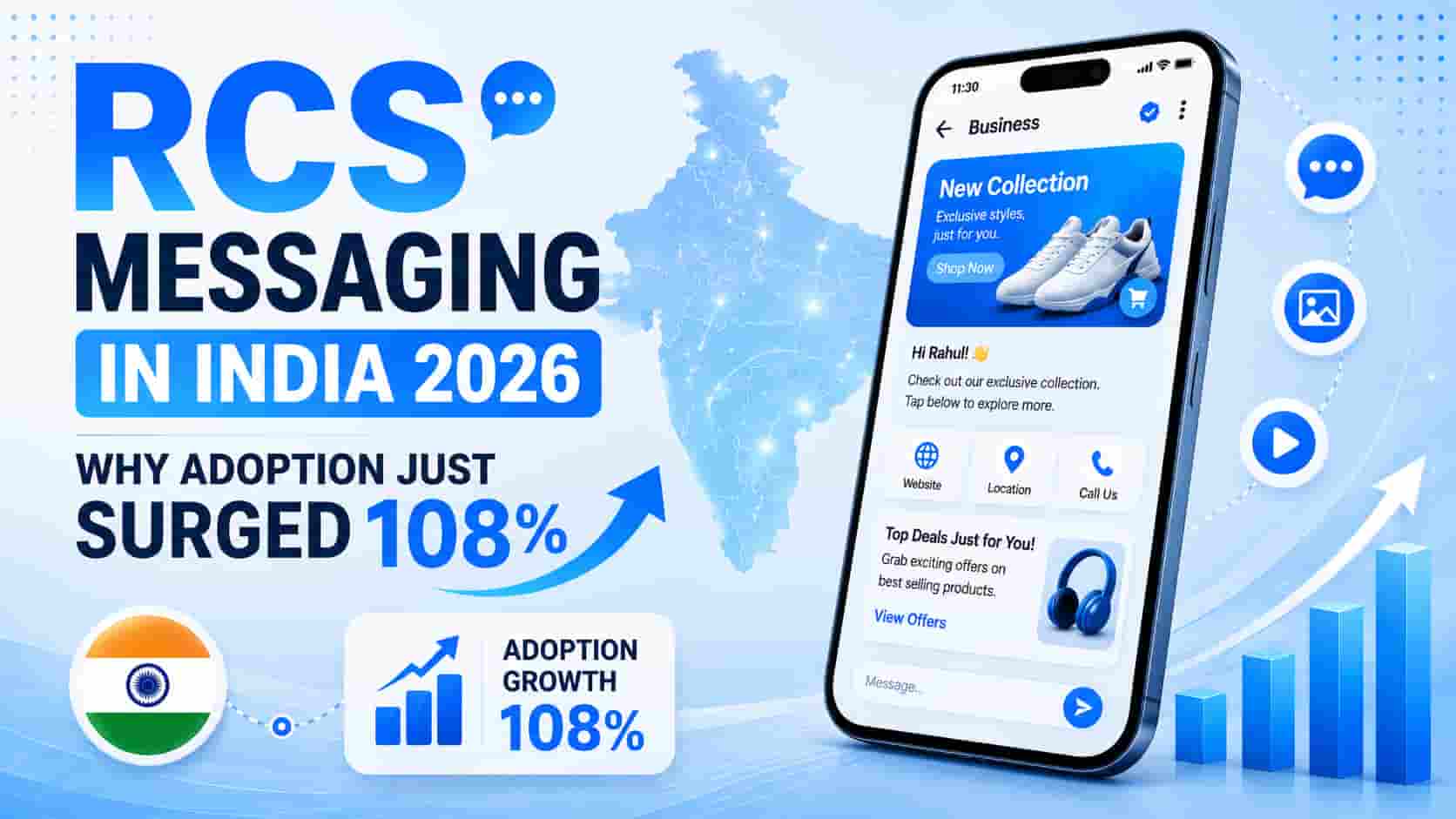
According to messaging data released in August 2026, RCS business interactions in India grew 108% between the first half of 2025 and the first half of 2026 — more than doubling in twelve months. Globally, RCS for Business traffic grew over 165% in the same period, but India's growth rate stands out even against that global surge, reflecting how quickly Indian brands are moving budgets from plain SMS into richer, app-like conversations.
This isn't a one-off spike either. An earlier industry report tracking a longer period found RCS interactions in India had already grown roughly 70%, with the RCS-capable user base crossing 550 million Android devices — one of the largest RCS-ready audiences anywhere in the world. Put the two data points together and the pattern is clear: RCS adoption in India is compounding, not plateauing.
Who's Actually Using RCS? Finance and Fintech Are Leading By a Mile
The most telling detail in the recent data isn't the growth rate — it's who is driving it.
Finance and fintech companies account for roughly three out of every four RCS interactions in India today. Marketing automation platforms come in second, followed by technology hardware and software brands. Retail, e-commerce and real estate also feature prominently among the fastest-growing categories.
That concentration in finance makes sense once you think about what RCS actually offers that SMS can't:
- Verified sender identity — customers see your brand name, logo and a verified badge, not an unfamiliar ten-digit number or a generic alphanumeric sender ID.
- End-to-end encryption on supported networks — a meaningful upgrade over plain-text SMS for anything sensitive.
- Read receipts and typing indicators — so support teams and bots know a message has actually reached the customer.
- Rich, in-message actions — customers can verify an OTP, confirm a transaction, or reply to a fraud alert without leaving the conversation thread.
For a bank, NBFC, or fintech app, that combination of trust and interactivity solves a real problem: customers are increasingly suspicious of unknown SMS senders, and phishing over SMS ("smishing") has made plain text messages a weaker channel for anything transactional. RCS's verified identity directly addresses that trust gap.
RCS vs SMS vs WhatsApp Business: What's the Real Difference?
Businesses evaluating messaging channels in India are usually choosing between three options. Here's how they stack up:
| Feature | SMS | RCS Business Messaging | WhatsApp Business |
|---|---|---|---|
| Format | Plain text only | Rich media, carousels, buttons | Rich media, catalogs, buttons |
| Brand identity | Sender ID / long number | Verified name, logo, colour | Verified business profile |
| Works without an app install | Yes (native to every phone) | Yes (native Android Messages) | No (requires WhatsApp installed) |
| Read receipts | No | Yes | Yes |
| Best for | High-volume alerts, OTPs | Transactional + promotional, trust-heavy sectors | High-engagement conversational commerce |
| iPhone support | Universal | Growing, still catching up to Android | Universal |
The practical takeaway: SMS still wins on pure universal reach and cost, WhatsApp wins on conversational depth, and RCS is emerging as the strongest middle ground — native to the phone (no app download needed) but with the rich, branded experience customers now expect.
Where RCS Is Winning Beyond Finance
While fintech dominates the current numbers, the use cases translate well across other sectors:
E-commerce and retail — order confirmations with a product image and an itemised summary, shipping updates with a live tap-to-track button, and abandoned-cart nudges that show the actual product carousel instead of a plain-text link.
Banking and NBFCs — verified OTPs, EMI reminders, statement alerts and fraud notifications that customers can trust are genuinely from their bank, not a spoofed sender ID.
Travel and hospitality — booking confirmations with boarding passes or check-in buttons, and itinerary updates that don't require downloading a separate app.
Real estate — property carousels with images, pricing and a "Schedule a Visit" button directly inside the message thread.
Healthcare — appointment reminders, reports-ready notifications and prescription refill actions, with the verified sender badge reassuring patients the message is legitimate.
Should Your Business Move to RCS in 2026?
A few honest considerations before you shift budget:
- Device coverage is strong but not universal. With 550 million+ RCS-capable Android devices in India, reach on Android is excellent. iPhone support is improving but still trails Android, so a fallback to SMS for unsupported devices is standard practice, not optional.
- Onboarding takes real setup. Brands need to register, get their sender verified, and design message templates — this typically happens through a business messaging platform or API provider rather than a self-serve tool.
- Cost is higher than plain SMS per message, so RCS makes the most sense for messages where trust, conversion or brand experience genuinely matter — transactional alerts, high-value promotions and support conversations — rather than blasting every low-priority notification through the richer channel.
- Compliance still applies. Promotional messaging in India continues to operate under DLT and consent regulations regardless of which channel you use, so existing opt-in and template-approval processes shouldn't be skipped just because the channel changed.
For most Indian businesses, the practical path is a hybrid strategy: RCS for verified, high-trust and high-value conversations, with SMS as an automatic fallback for devices or carriers where RCS isn't yet supported, and WhatsApp for ongoing conversational engagement.
Frequently Asked Questions
What is RCS messaging?
RCS (Rich Communication Services) is an upgrade to traditional SMS that supports images, carousels, buttons, verified branding, read receipts and richer two-way conversations, while still arriving in the phone's native messaging app.
Is RCS the same as WhatsApp Business?
No. RCS works through the phone's built-in messaging app without requiring the customer to install anything, while WhatsApp Business requires the customer to have WhatsApp installed. Both support rich media and verified branding, but they are separate channels with separate registration processes.
Why is RCS growing so fast in India right now?
A large existing base of RCS-capable Android devices, rising customer distrust of generic SMS senders, and finance/fintech brands adopting RCS for its verified identity and richer transactional experience are the main drivers behind the recent surge.
Do I need a new phone number to send RCS messages?
No — businesses typically send RCS through an existing business messaging platform or API provider, which handles brand verification, agent registration and fallback to SMS where needed.
Is RCS secure enough for banking and OTPs?
RCS supports verified sender identity and, on supported networks, end-to-end encryption — both of which make it a stronger option than plain SMS for sensitive transactional messages, which is a major reason finance and fintech brands lead adoption.