

RCS for Healthcare: Appointment Reminders and Patient Engagement in India

Why Patient Communication Needs a Rethink
Walk into the front office of any busy hospital, multi-specialty clinic, or diagnostic lab in India and you will see the same problem playing out on a whiteboard or a spreadsheet: missed appointments, patients who forget follow-up visits, and staff spending hours on the phone confirming bookings that could have been confirmed with a single tap. Healthcare providers depend heavily on SMS and WhatsApp today to send appointment reminders, test result notifications, and prescription refill nudges, and both channels have served the industry well. But as patient volumes grow and communication expectations rise, plain text messages are starting to show their limits.
No-shows are a quiet but costly problem. A patient who forgets a scan appointment wastes a slot that another patient could have used. A missed follow-up after a procedure can delay recovery tracking. And a patient who receives a generic, unbranded SMS about a hospital visit has no easy way to tell whether it is genuine or one of the many healthcare-themed scam messages circulating today, which try to trick people into clicking suspicious links or sharing personal details. This is exactly where RCS messaging for healthcare providers offers a meaningful upgrade over plain SMS, without asking patients to install a new app.
The Trust Problem: Why Verified Branding Matters in Healthcare
Healthcare is one of the most impersonated sectors in messaging-based fraud. Patients regularly receive fake messages claiming to be from hospitals or labs, asking them to pay fees, share OTPs, or click on unfamiliar links. Over time, this erodes trust in legitimate hospital communication too, and patients become hesitant to act on messages even when they are genuine.
RCS addresses this directly through verified sender branding. When a hospital, clinic, or diagnostic centre sends a message through RCS, the patient sees the organisation's verified name, logo, and brand colours right inside the messaging app — not an unfamiliar ten-digit number or a generic short code. This single visual cue does more for patient confidence than any disclaimer text ever could. A patient scrolling through their inbox can immediately distinguish a real reminder from their hospital from a phishing attempt, simply because the impersonator cannot replicate a verified badge.
Rich, Interactive Cards Replace Static Text
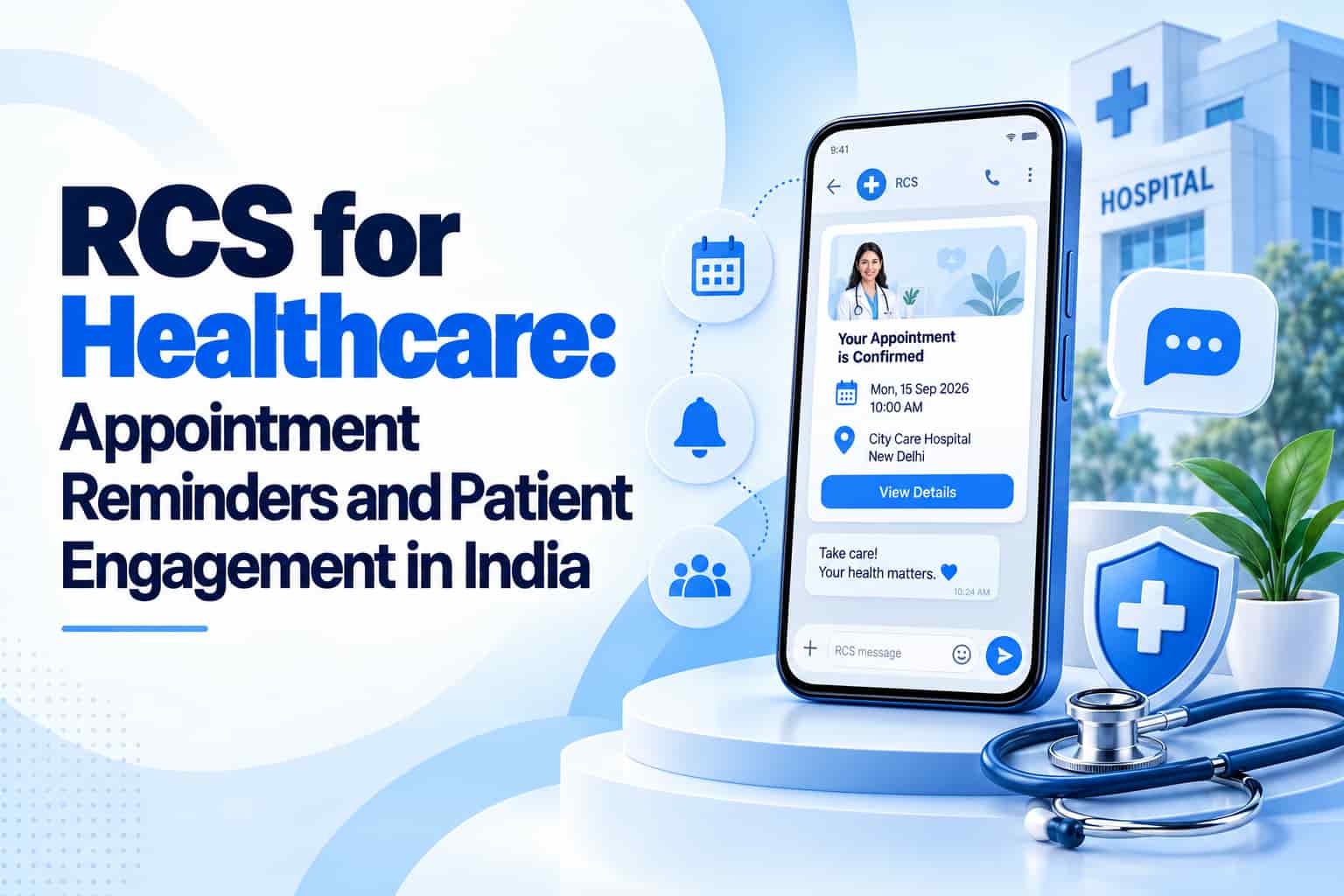
Beyond verification, RCS supports rich cards — visually structured messages that can include the clinic's location on a map, the doctor's name and department, appointment date and time, and action buttons, all within one message. Instead of a plain line of text saying "Your appointment is on Tuesday at 11 AM," a hospital can send a card with a clear layout and buttons such as "Confirm," "Reschedule," or "Get Directions." This turns a one-way reminder into a genuinely useful, two-way interaction.
Where RCS Fits Into the Patient Journey
The value of RCS in healthcare becomes clearest when you look at specific touchpoints along a patient's journey, from booking to follow-up care.
1. Appointment Reminders With Reschedule Options
Instead of patients calling the front desk to reschedule or, worse, simply not showing up, an RCS appointment reminder can include suggested-reply buttons like "Confirm," "Reschedule," or "Cancel." A tap is enough to update the booking system, reducing no-shows and freeing up front-office staff from repetitive confirmation calls.
2. Lab Report Ready Notifications
Diagnostic labs can notify patients the moment a report is ready, with a clear, branded card directing them to collect the report in person or log in securely to the lab's own patient portal — keeping sensitive results off open messaging channels while still giving patients a fast, reliable heads-up.
3. Prescription Refill Reminders
For chronic care patients — those managing diabetes, hypertension, or other long-term conditions — timely refill reminders make a real difference to treatment adherence. An RCS message with a "Reorder" or "Contact Pharmacy" button makes acting on the reminder effortless, rather than relying on the patient to remember on their own.
4. Post-Visit Follow-Up and Feedback
After a consultation or procedure, a simple follow-up message asking how the patient is doing, with a quick feedback rating button, shows patients that the provider is invested in their outcomes, not just their billing. This kind of light-touch engagement builds long-term loyalty.
5. Health Camp and Vaccination Drive Promotion
Hospitals and clinics running community health camps, vaccination drives, or seasonal check-up packages can use RCS's rich media cards to promote these initiatives with an image, date, venue, and a direct "Register" button — far more engaging than a plain text blast, and easily trackable in terms of response.
Handling Patient Data Responsibly
It is worth being direct about this: messaging channels, however secure, are not the right place for detailed medical information. Diagnosis details, treatment specifics, or sensitive test results should never be sent in full over SMS, WhatsApp, or RCS. The safer and more compliant approach is to keep messages generic — "Your report is ready," "Your appointment is confirmed," "Please visit the pharmacy to collect your refill" — and direct patients to a secure, authenticated channel such as a patient portal or an in-person visit for anything involving actual medical detail. Healthcare providers adopting RCS for clinics and diagnostics should treat this as a firm operating principle, not an afterthought, and train front-office and marketing teams accordingly before rolling out any messaging programme.
Implementation Checklist for Healthcare Businesses
For hospitals, clinics, diagnostic labs, and pharmacies looking to adopt RCS, a structured rollout works far better than an ad-hoc one. Consider the following steps:
- Start with high-volume, low-sensitivity use cases — appointment reminders and refill nudges are the easiest and safest place to begin.
- Get your sender profile verified with accurate branding, logo, and contact details so patients immediately recognise your organisation.
- Keep message content generic and never include diagnosis, prescription specifics, or report values directly in the message body.
- Design clear, simple action buttons — Confirm, Reschedule, Get Directions — that reduce friction for patients, including older or less tech-comfortable ones.
- Maintain SMS as a fallback for patients on devices or networks that do not support RCS, so no one is left without a reminder.
- Train front-desk and support staff on how RCS interactions feed into the appointment and patient management system.
- Review response and no-show data regularly to refine reminder timing and messaging.
Healthcare providers do not need to build this technical capability in-house. Working with an established RCS Messaging platform that already handles carrier onboarding, sender verification, and template design makes it possible to launch a pilot programme, such as appointment reminders for one department, within a matter of weeks rather than months. Once results are visible, the same setup can be extended to labs, pharmacy counters, and other departments through the same underlying business messaging solutions already used for reminders.
Frequently Asked Questions
Is RCS safe to use for patient communication?
Yes, when used correctly. RCS itself offers verified sender branding that helps patients distinguish genuine hospital messages from scams. However, providers should avoid sending detailed medical information over any messaging channel, including RCS, and stick to generic reminders and notifications, directing patients to secure portals for sensitive details.
What happens if a patient's phone doesn't support RCS?
Messages automatically fall back to standard SMS, so no patient is left without an appointment reminder. This makes RCS a safe channel to adopt without disrupting existing SMS-based workflows.
Can small clinics and diagnostic labs use RCS, or is it only for large hospitals?
RCS is well suited to organisations of every size. In fact, smaller clinics and labs often see faster results because their patient base is more localised, and reducing no-shows has a proportionally larger impact on their day-to-day scheduling.
Does RCS replace WhatsApp for healthcare communication?
Not necessarily — many healthcare providers use both. RCS works natively through the default messaging app without requiring the patient to have WhatsApp installed or active, which makes it a useful complement for reaching patients across different messaging preferences and devices.
Building Patient Trust, One Message at a Time
Patients today expect healthcare providers to communicate as clearly and reliably as any modern service business. Missed appointments, unclear reminders, and the constant background noise of scam messages all chip away at that trust. RCS gives Indian hospitals, clinics, diagnostic labs, and pharmacies a practical way to close that gap — verified branding that patients can recognise instantly, and rich interactive cards that turn a passive reminder into an easy, two-way conversation. Used thoughtfully, with sensitive medical information kept off open channels, RCS can meaningfully reduce no-shows, ease the load on front-office staff, and make every patient touchpoint feel a little more organised and a little more human.