

RCS Messaging Compliance in India: TRAI, DLT, and What Businesses Must Know in 2026

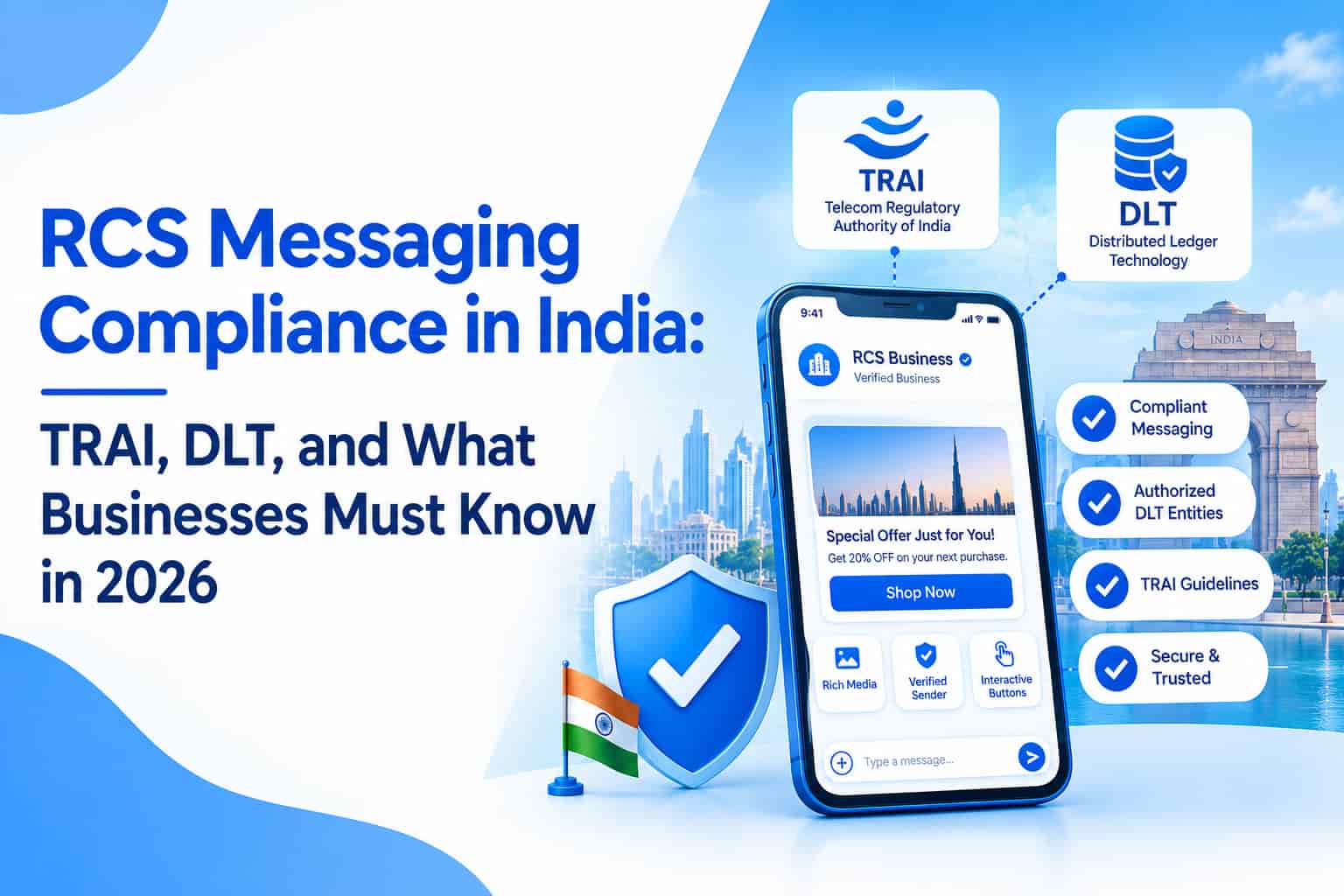
A business that assumes RCS Business Messaging sits outside India's SMS compliance rules — because it's a newer, richer format than plain text — is setting itself up for blocked campaigns or worse. India runs one of the most structured commercial messaging compliance systems globally, built on TRAI's DLT (Distributed Ledger Technology) framework, and the same underlying entity and consent rules that govern SMS apply to how a business registers and operates for RCS as well.
Principal Entity Registration Is the Starting Point
Every business sending commercial messages in India — SMS or RCS — must register as a Principal Entity (PE) on the DLT platform. This requires PAN, GST, and business registration documents, KYC for the authorized signatory including PAN and Aadhaar, and since February 2025, mandatory biometric authentication for new registrations. Registration carries a one-time fee (₹5,900 generally, ₹3,300 through BSNL) and typically clears within 24-72 working hours. Once approved, the business receives a unique Entity ID that must be referenced in every message sent.
Message Categories Determine the Rules That Apply
Since a May 2025 update, every registered sender header automatically carries a category suffix that determines what rules apply to messages sent under it:
- -T (Transactional): OTPs and payment confirmations — no separate consent required beyond the transaction itself.
- -S (Service): Delivery updates and warranty alerts — relies on an existing customer relationship.
- -P (Promotional): Marketing messages — must respect the Do Not Disturb (DND) registry and can only be sent between 10 AM and 9 PM IST, unless explicit digital consent was separately recorded.
- -G (Government): Reserved for state and central government communications.
A business planning an RCS campaign needs to classify it correctly under one of these categories before sending — misclassifying a promotional campaign as transactional is a compliance violation, not just a technicality.
Content Templates Must Be Pre-Approved
Every message sent — including RCS content — must match a pre-approved content template registered on the DLT platform in advance. Templates can include up to 5-6 variables (tagged by type: OTP, amount, name, date), must include the brand name in the template text, and since October 2024, any URL included must be "CTA-whitelisted" — public URL shorteners are not permitted. Registering a template is free but must happen before, not after, a campaign launches.
What This Means Practically for RCS Campaigns
Because RCS runs on the same underlying telecom compliance infrastructure as SMS in India, a business already registered and compliant for SMS marketing has most of the regulatory groundwork done — the additional step is ensuring RCS-specific rich content (carousels, suggested replies, embedded links) still maps back to an approved template and the correct message category. Businesses newer to compliant messaging should register as a Principal Entity and get templates approved well before planning any RCS launch date, since template approval and category classification aren't instant.
Consequences of Getting This Wrong
Non-compliant messages get filtered or blocked by carriers before reaching recipients, which means a poorly registered campaign doesn't just risk a fine — it risks simply not being delivered at all, wasting the campaign spend with no reach to show for it. The framework's recent additions — biometric authentication, CTA whitelisting, an extended 7-day spam complaint window — all point toward tighter enforcement over time, not looser.
Frequently Asked Questions
Does RCS require separate DLT registration from SMS?
The Principal Entity registration and template approval process runs through the same DLT infrastructure that governs SMS, so a business doesn't need an entirely separate registration system, but RCS-specific templates and categories still need proper approval before use.
Can a business send promotional RCS messages at any time of day?
No — promotional messages (category -P) are restricted to the 10 AM–9 PM IST window under DND regulations unless the recipient has given explicit digital consent recorded through the proper channel.
What happens if a message template isn't pre-approved?
It will typically be filtered or blocked by the carrier before reaching the recipient, since matching an approved template is a non-negotiable requirement in India's DLT framework.
Building Campaigns That Actually Get Delivered
Compliance in India's messaging ecosystem isn't a bureaucratic afterthought — it's the difference between a campaign that reaches customers and one that gets silently filtered out before it ever does. OM Enterprises handles Principal Entity registration, template approval, and category classification for Indian businesses launching RCS and SMS campaigns, so compliance is built in from day one rather than fixed after a blocked launch.