

RCS marketing: How to elevate your customer engagement

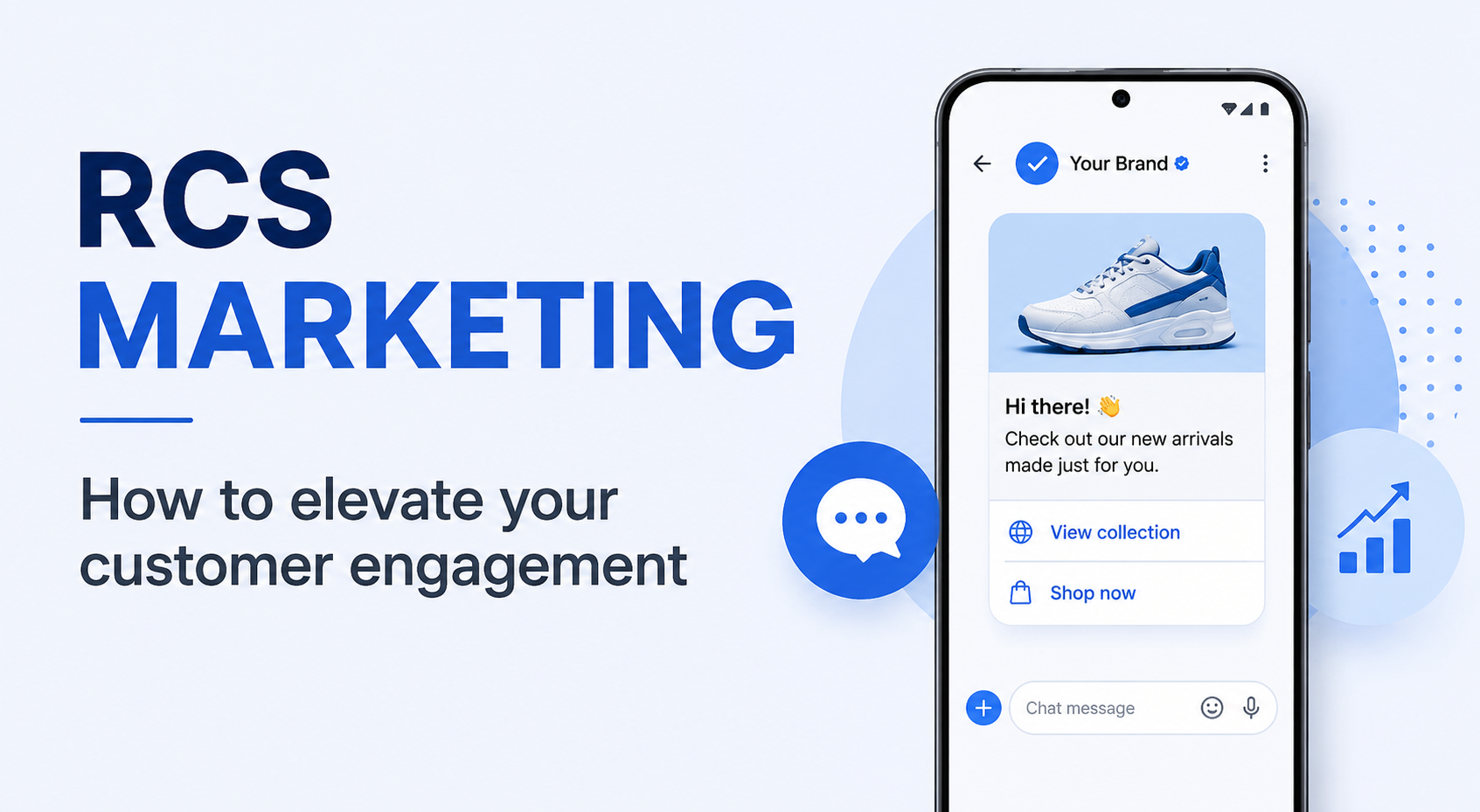
Customers today expect more than a plain text message from the brands they love. They want rich visuals, instant interaction, and seamless experiences — without being forced to download yet another app. That's exactly what RCS marketing delivers.
RCS (Rich Communication Services) is rapidly transforming how businesses communicate with customers on mobile. It combines the simplicity of SMS with the interactivity of a branded app, all inside a user's native messaging inbox. If you're still relying solely on SMS for mobile outreach, you're leaving serious engagement — and revenue — on the table.
This guide covers everything you need to know about RCS marketing: what it is, why it matters, how it compares to SMS, and how to launch campaigns that drive real results.
What Is RCS Marketing?
RCS marketing is the practice of using Rich Communication Services — an upgraded mobile messaging protocol — to send branded, interactive messages directly to customers' native messaging apps.
Unlike traditional SMS, RCS supports high-resolution images and videos, interactive buttons, carousels, suggested replies, branded sender profiles, and read receipts. Think of it as the next generation of business messaging: the reach of SMS combined with the visual richness of an app or email.
Originally developed as a universal standard by the GSM Association (GSMA), RCS has gained major momentum in recent years. Google's Messages app brought RCS to Android users globally, and Apple's adoption of RCS in iOS 18 was a watershed moment — finally bridging the gap between Android and iPhone users for richer business messaging.
For marketers, this means one channel that reaches virtually all smartphone users with engaging, app-quality experiences, no installation required.
RCS vs SMS Marketing
To understand the value of RCS, it helps to see it side by side with SMS — the channel it's set to replace for business messaging.
Key Differences
Feature | SMS | RCS |
|---|---|---|
Message format | Plain text only | Text, images, video, audio, files |
Branding | No branding | Verified sender name, logo, brand color |
Interactivity | None | Buttons, carousels, suggested replies |
Read receipts | Not supported | Supported |
Delivery confirmation | Basic | Rich delivery and read status |
Character limit | 160 characters | Up to 8,000 characters |
Link tracking | Limited | Full analytics and click tracking |
Verification | None | Verified business sender |
Internet required | No | Yes (Wi-Fi or mobile data) |
Fallback | N/A | Automatically falls back to SMS |
The core difference is experience. SMS delivers a message. RCS delivers an interaction. Customers can browse products in a carousel, confirm an appointment with a single tap, track a delivery in real time, or complete a simple transaction — all without leaving their messages app.
That said, SMS still plays an important role, particularly as a fallback for users on devices or networks that don't yet support RCS. A well-designed RCS strategy accounts for both.
Benefits of RCS Marketing
1. Enhanced Customer Engagement
RCS messages look and feel more like branded app experiences than traditional texts. Buttons, rich media, and interactive elements naturally prompt higher engagement. Industry data consistently shows RCS achieving significantly higher open rates, click-through rates, and conversion rates compared to SMS alone — with some campaigns reporting click-through improvements of 3x to 5x.
When a customer receives a visually rich message with a clear call to action, they're far more likely to act on it than when they receive a plain URL in a text.
2. Verified and Secure Messaging
One of the most underrated advantages of RCS is verified sender profiles. Businesses must go through a verification process before sending RCS messages, and customers can see the brand's official name, logo, and verification badge directly in the conversation.
This matters enormously for trust. Phishing and SMS scams have eroded customer confidence in text messages. RCS's verification system reassures customers that the message genuinely comes from the brand — reducing anxiety and increasing the likelihood they'll engage.
3. App-Like Experiences Without App Downloads
App download rates have been declining for years. Customers are fatigued by the friction of finding, installing, and managing apps — particularly for one-off or occasional interactions with a brand.
RCS sidesteps this entirely. You can deliver product carousels, booking flows, payment confirmation, and loyalty program updates directly in the messaging app customers already use every day. No download, no onboarding, no forgotten password.
This makes RCS especially powerful for lower-frequency interactions — travel bookings, healthcare appointments, financial alerts — where a dedicated app may not be justified but a rich experience is still valuable.
4. Advanced Analytics and Insights
RCS provides a level of campaign visibility that SMS simply cannot match. Marketers can track message delivery, read rates, button clicks, carousel interactions, and conversion events — giving a much clearer picture of what's working and what isn't.
These insights enable continuous optimization. You can A/B test different messages, CTAs, or media formats, then double down on whatever drives the best results. Over time, this data-driven feedback loop compounds into significantly better campaign performance.
5. Scalability with Fallback Options
RCS doesn't require you to abandon your existing SMS infrastructure. Most RCS platforms support automatic fallback: if a customer's device or carrier doesn't support RCS, the message is automatically delivered as a standard SMS instead.
This means you can adopt RCS without worrying about losing reach. You simply get a richer experience for the growing majority of users who can receive it, with SMS as a reliable safety net for everyone else.
Best Use Cases for RCS Marketing
Retail and eCommerce
Retail is one of the strongest fits for RCS. Rich product carousels let customers browse items, see prices, and tap through to purchase — all without leaving the messaging app. Brands are using RCS for:
Abandoned cart recovery with product images and a one-tap "Complete Purchase" button
Order tracking with real-time shipping updates and interactive delivery options
Flash sale announcements with countdown timers, hero images, and direct shop links
Loyalty programme nudges showing a customer's point balance and personalised reward offers
Post-purchase follow-ups with reorder buttons, product review prompts, and related item suggestions
The combination of visuals, personalisation, and frictionless CTAs makes RCS a natural driver of eCommerce conversions.
Travel and Hospitality
Travel customers have complex, time-sensitive information needs — exactly the kind of experience RCS handles brilliantly. Airlines, hotels, and travel agencies are deploying RCS for:
Check-in prompts with a boarding pass carousel and seat upgrade offer
Flight status updates with real-time gate changes, delays, and rebooking options
Hotel pre-arrival messages featuring room images, upsell options, and early check-in requests
Post-stay feedback with tappable rating scales and open review prompts
Itinerary reminders aggregating multiple booking details in a single rich message
At a time when travellers are stressed and attention is scarce, a clear, visual, interactive message cuts through the noise far better than a wall of text.
Financial Services
Banks, insurers, and fintech companies face a dual challenge: communicating important information quickly while maintaining trust. RCS is well suited to both. Applications include:
Transaction alerts with spend category breakdowns and quick-tap actions (e.g., "Report as fraud")
Loan and mortgage updates with document upload prompts and advisor contact buttons
Insurance renewal notices with policy summary cards and renewal CTAs
Investment notifications with portfolio snapshots and quick-access account links
Fraud alerts where the verified sender badge adds a crucial layer of credibility
The verification and security features of RCS are particularly important in financial services, where customers are rightly cautious about clicking links in messages.
How to Get Started with RCS
1. Understand RCS Setup and Onboarding
Getting started with RCS requires working with an RCS-enabled messaging provider or aggregator — sometimes called an RCS Business Messaging (RBM) platform. These platforms sit between your systems and the carrier networks, handling message routing, media hosting, fallback logic, and analytics.
Major messaging platforms including Twilio, Sinch, Infobip, and Google's own RCS Business Messaging APIs all support RCS campaigns. Your chosen provider will guide you through brand registration, content guidelines, and technical integration.
Before selecting a provider, evaluate their coverage (which carriers and countries they support), their fallback capabilities, their analytics dashboard, and the complexity of their API or no-code tooling.
2. Build Your First RCS Campaign
Start with a campaign where the interactive benefits of RCS are immediately obvious — a product promotion, appointment reminder, or delivery update. Plan your message template around the key elements RCS enables:
Hero image or video: A compelling visual that immediately communicates the offer
Short, punchy body copy: RCS supports longer messages, but brevity still wins
Action buttons: Two to four clear, action-oriented buttons (e.g., "Shop Now," "Learn More," "Get Directions")
Suggested replies: Quick-tap reply options that reduce friction for customers who want to respond
Map out the full interaction flow, including what happens when a customer taps each button, before you start building.
3. Automate and Personalise Customer Interactions
The most effective RCS campaigns go beyond a single message blast. Automation lets you trigger messages based on customer behaviour — a purchase, a browsing session, an upcoming appointment, or a lapse in engagement — while personalisation ensures the content feels relevant to each individual recipient.
Use your CRM and customer data to segment audiences and tailor messages. A customer who bought running shoes three months ago is a natural target for a personalised "time to replace your trainers" message with a dynamic product recommendation, not a generic sale announcement.
Automated conversational flows — where the system responds to button taps or text replies with contextual follow-up messages — can handle a huge range of customer interactions without human intervention.
4. Verify Your Brand and Sender Profile
Before going live, complete the RCS business verification process. This involves submitting your brand name, logo, and business details for review by your RCS provider and the relevant carrier networks.
Verification is non-negotiable. Unverified senders can't display branding in the message thread, which eliminates much of the trust and recognition value of RCS. The process typically takes a few days to a few weeks, so plan your timeline accordingly.
Once verified, ensure your sender profile accurately reflects your brand: use your official logo, a recognisable sender name (typically your brand name), and appropriate brand colours where your platform supports customisation.
5. Use Fallback Options for Wider Reach
Configure SMS fallback for every RCS campaign. Your messaging platform should support this natively — if a recipient's device or carrier doesn't support RCS at the time of sending, the message automatically converts to SMS.
Design your SMS fallback thoughtfully. It won't carry images or buttons, so the core message needs to work in plain text. Make sure any link in the SMS fallback is short, trackable, and leads to a mobile-optimised landing page that provides the experience the RCS version would have delivered.
6. Use Rich Media Features to Increase Engagement
Don't underuse the canvas that RCS provides. Beyond basic images, consider:
Product carousels: Multiple cards a customer can swipe through, each with its own image, headline, description, and CTA button
Video messages: Short clips (15–30 seconds tend to work best) for product demos, event announcements, or personalised greetings
Location sharing: Send a map card pointing to your nearest store, event venue, or service point
Quick reply chips: Pre-populated response options (e.g., "Yes, I'm interested," "Not right now," "Tell me more") that reduce friction and increase response rates
Always optimise media for mobile: compress images for fast loading, use portrait or square formats, and test how content renders on different screen sizes.
7. Track and Analyse Campaign Performance
RCS's analytics capabilities are one of its key differentiators. Set up tracking for the metrics that matter most to your goals:
Delivery rate: What percentage of messages reached recipients successfully?
Read rate: How many recipients opened the message?
Interaction rate: How many tapped a button, replied, or engaged with a carousel?
Conversion rate: How many completed the desired action (purchase, booking, sign-up)?
Fallback rate: What proportion of sends fell back to SMS, and how does that engagement compare?
Establish baseline benchmarks from your first campaigns, then use them to set improvement targets for future sends. Most RCS platforms provide real-time dashboards; integrate with your wider analytics stack where possible to connect message engagement to downstream business outcomes.
8. Test and Optimise Campaigns Before Launch
Never send to your full audience without testing first. Before launch:
Preview on device: Use your platform's preview tool and send test messages to actual devices to see exactly how the message renders
Test all interactive flows: Tap every button, reply to every suggested reply, and verify each action leads where it should
Check fallback: Confirm the SMS version works correctly and the fallback link functions properly
Soft-launch to a segment: Release to 5–10% of your audience first, monitor performance and error rates, then roll out to the full list once you're confident
A/B testing is equally important. Test different hero images, headline copy, button labels, and send times. Even small optimisations in each element compound significantly over the lifetime of a campaign.
Compliance, Consent, and Delivery Considerations
Opt-In Requirements
Like SMS, RCS is subject to local messaging regulations — and compliance is not optional. In most markets, you must obtain explicit opt-in consent before sending marketing messages via RCS. Key principles include:
Express written consent: Customers must actively agree to receive messages from you. Pre-ticked boxes or implied consent are not sufficient in most jurisdictions.
Clear purpose disclosure: Tell customers what they're signing up for at the point of consent — the type of messages they'll receive, the approximate frequency, and your brand name.
Easy opt-out: Every campaign message must include a clear, simple way for recipients to unsubscribe (a "STOP" keyword or a dedicated opt-out button).
Record keeping: Maintain records of when and how consent was collected for each subscriber.
Consult the regulations specific to your target markets. In the US, the TCPA (Telephone Consumer Protection Act) governs mobile messaging consent. In Europe, GDPR and national ePrivacy regulations apply. In India, TRAI rules set out requirements for commercial communications.
Regulatory non-compliance carries significant financial and reputational risk. When in doubt, work with your legal team and messaging provider to ensure your consent and opt-out processes are watertight.
Global Coverage and Device Compatibility
RCS coverage continues to expand but is not yet universal. As of 2025, RCS is supported on:
Android: Broadly supported via Google Messages across most Android devices on compatible carriers
iOS: Supported from iOS 18 onwards on iPhone 14 and later models
Carriers: Coverage varies significantly by country and carrier; most major networks in the US, UK, Europe, India, and other large markets now support RCS
The fallback mechanism means you're protected when RCS isn't available, but it's worth monitoring your fallback rate over time. As RCS adoption grows, you should see the proportion of SMS fallbacks decline — a useful indicator of your audience's device and carrier profile.
Check with your RCS provider for the latest coverage maps in your target markets before forecasting expected reach.
FAQs About RCS Marketing
What industries benefit most from RCS marketing?
While virtually any consumer-facing industry can benefit from RCS, the strongest early adopters have been retail and eCommerce, travel and hospitality, financial services, healthcare, and telecoms. These sectors share a common need: delivering complex, time-sensitive, or high-value information in a way that prompts immediate customer action. That said, any business that currently uses SMS for customer communications is a strong candidate for RCS.
Is RCS marketing better than SMS marketing?
For most use cases, yes — RCS delivers significantly richer experiences that drive higher engagement and conversion. However, "better" depends on context. SMS has near-universal reach, works without internet connectivity, and has no setup complexity. For simple transactional alerts (e.g., a one-time passcode), SMS remains perfectly adequate. For marketing messages where you want to showcase products, drive clicks, or prompt interactions, RCS is substantially more effective. The ideal approach uses both: RCS as the primary channel with SMS fallback.
Do users need to install an app for RCS?
No. RCS works within the native messaging app already installed on a user's phone — Google Messages on Android and the built-in Messages app on iPhone (iOS 18+). There's no installation, registration, or account creation required from the customer. This zero-friction access is one of RCS's most important advantages.
Can RCS messages fall back to SMS?
Yes. When configured correctly, RCS platforms automatically detect when a recipient's device or carrier doesn't support RCS and deliver the message as a standard SMS instead. The SMS version won't include rich media or interactive buttons, but the core message content is preserved. This fallback capability means RCS campaigns can achieve the same reach as SMS while delivering a superior experience to the growing share of users who can receive RCS.
How secure is RCS messaging?
RCS incorporates several important security features that SMS lacks. Business sender verification ensures customers can identify legitimate brand messages, reducing the risk of phishing. Google's implementation of RCS uses end-to-end encryption for peer-to-peer messages, and business messaging channels are authenticated through the carrier and platform ecosystem.
That said, no messaging channel is entirely immune to abuse. Businesses should follow security best practices: use your verified sender profile correctly, avoid asking customers to share sensitive information directly in a chat, and include clear contact details so customers can independently verify any request.
Conclusion: Turn Every Message into an Interactive Customer Journey with RCS Marketing
RCS marketing represents a genuine step change in mobile customer engagement — not just an incremental improvement over SMS. By combining the ubiquity of text messaging with the visual richness and interactivity of a branded app, RCS gives businesses a powerful new way to reach customers where they already spend their time.
The brands that move early will build a significant advantage: sharper engagement data, stronger customer relationships, and a more distinctive presence in the messaging inbox. As RCS adoption accelerates across both Android and iOS, the channel is quickly becoming a must-have rather than a nice-to-have.
Start with one high-value use case — a product promotion, an order update, an appointment reminder — and build from there. Focus on verified branding, compelling rich media, clear CTAs, and rigorous analytics. Use fallback to protect your reach while you scale.
The shift from text-only messages to interactive customer journeys is already underway. RCS is how you get there.