

RCS in 2026: Key Statistics, Market Insights & What It Means for Businesses

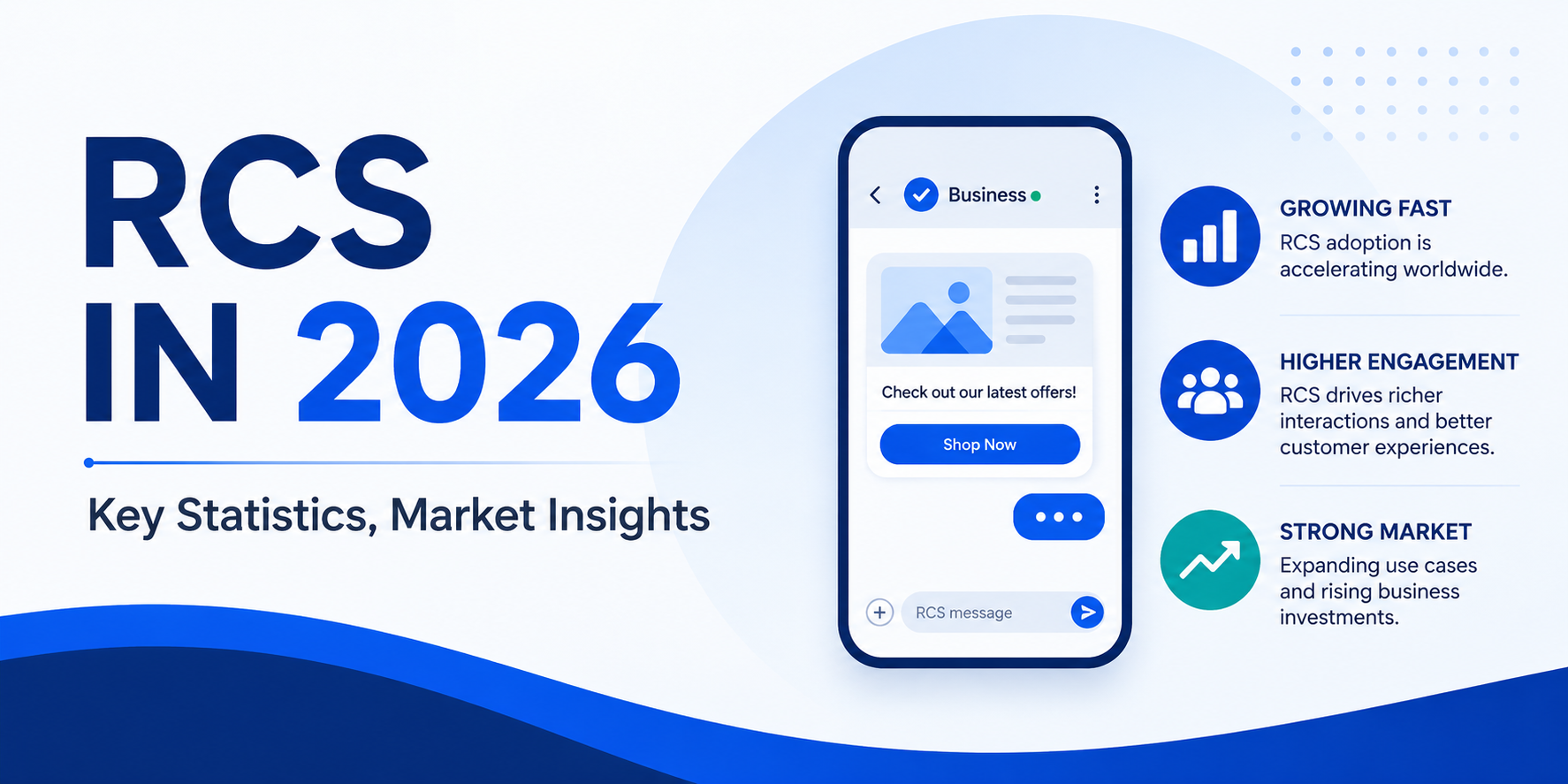
The way businesses communicate with customers is undergoing a seismic shift. Rich Communication Services (RCS) — once a quietly developing protocol overshadowed by WhatsApp, iMessage, and traditional SMS — has firmly arrived as a mainstream messaging standard. With Apple's historic adoption of RCS in iOS 18, a rapidly expanding carrier ecosystem, and soaring enterprise adoption rates, 2026 is shaping up to be the year RCS transitions from "promising technology" to "essential business channel." Here's a comprehensive look at the numbers, trends, and insights defining the RCS landscape right now.
Global User Base & Adoption
RCS monthly active users crossed 1.1 billion globally in 2026, with year-over-year growth of approximately 25%. This surge is driven by two parallel forces: aggressive carrier rollouts in Asia-Pacific and Latin America, and Apple's game-changing decision to support RCS natively on iPhones — unlocking a device base of over 1 billion users that was previously locked out of the RCS ecosystem.
RCS traffic volume has grown by over 150% in the past five years, with the steepest acceleration occurring in the last 18 months. The fastest-growing regions include India, Brazil, Southeast Asia, and Sub-Saharan Africa, where mobile-first populations and expanding 4G/5G infrastructure are creating fertile ground for RCS adoption. In terms of industry, retail, banking, and healthcare lead the pack in both traffic volumes and investment in RCS-enabled communication workflows.
Market Size & Revenue
The global RCS market — encompassing both person-to-person (P2P) and application-to-person (A2P) messaging — is valued at approximately $9.5 billion in 2026, up from around $4 billion in 2022. A2P RCS, which covers business-to-consumer messaging campaigns, customer service, and transactional alerts, is the dominant revenue driver, projected to account for nearly 70% of total market value by end of year.
Regional A2P revenue leaders include North America, Western Europe, and China, though South and Southeast Asia are emerging as high-growth markets with double-digit annual expansion rates. The broader business messaging market — of which RCS is now a significant and growing segment — is expected to surpass $80 billion globally by 2027, with RCS capturing an increasingly larger share at SMS's expense.
Business & Enterprise Adoption
Enterprise adoption of RCS has accelerated dramatically. Over 60% of large enterprises in retail, banking, travel, and healthcare now include RCS in their omnichannel communication strategy — up from roughly 25% in 2023. Key drivers include the ability to send branded, verified messages; rich media support (images, carousels, video previews); and built-in analytics that SMS simply cannot provide.
Industries leading in RCS deployment include:
Retail & E-commerce — product carousels, order tracking, flash sale alerts
Banking & Finance — verified OTPs, fraud alerts, balance notifications
Healthcare — appointment reminders, prescription updates, telehealth follow-ups
Travel & Hospitality — boarding passes, itinerary updates, loyalty program messaging
The cost-effectiveness of RCS, combined with dramatically higher engagement rates, is making the ROI case compelling for enterprises of all sizes.
Engagement & Performance Metrics
This is where RCS truly separates itself from legacy channels. RCS messages achieve an average open rate of 70–80%, compared to approximately 20% for email and 98% for SMS (though SMS lacks the rich engagement layer RCS provides). More importantly, RCS delivers click-through rates of 15–35% — several times higher than email's average of 2–4%.
Conversion rates for RCS campaigns in retail and e-commerce consistently outperform both SMS and email, with some brands reporting 2–3x conversion lifts when switching from SMS to RCS for promotional campaigns. Response rates in customer service contexts are equally impressive, reducing resolution times and improving CSAT scores.
Consumer sentiment is strongly favorable: surveys indicate that over 70% of users trust verified RCS messages from businesses more than they trust unbranded SMS, largely due to RCS's built-in sender verification and brand identity features (logos, verified checkmarks, color schemes).
Apple's iOS Impact
Perhaps no single event has reshaped the RCS landscape more than Apple's RCS support rollout beginning in late 2024 and now fully embedded in iOS 18. Previously, any message sent between an iPhone and an Android device defaulted to SMS/MMS — the lowest common denominator. With RCS support now live on iOS, cross-platform rich messaging is finally a reality.
For businesses, this is transformative. The addressable RCS audience in markets like the United States — where iPhone penetration is exceptionally high — has effectively doubled or tripled. Enterprises that were hesitant to invest in RCS infrastructure (fearing it would only reach Android users) now have clear justification to go all-in. Industry analysts expect Apple's adoption to add 300–400 million new addressable RCS users to the business messaging funnel over the next two years.
Pricing, Standards & the Competitive Landscape
RCS messaging costs vary by region and carrier but typically fall in the range of $0.01–$0.08 per message for A2P use cases — generally more expensive per message than basic SMS, but delivering dramatically superior engagement value. When measured by cost-per-conversion rather than cost-per-message, RCS consistently outperforms.
The latest RCS Universal Profile 2.7 standard, maintained by the GSMA, has brought improved security features, end-to-end encryption support, enhanced chatbot capabilities, and tighter brand verification protocols. Major technology providers — including Google, Syniverse, Twilio, Sinch, and Infobip — are building robust RCS infrastructure, while telecoms operators in over 80 countries now support the protocol.
Despite this progress, challenges remain. Carrier fragmentation in certain regions (notably parts of Africa and Eastern Europe) means RCS availability is still inconsistent. Consumer awareness outside of tech-savvy demographics remains relatively low, and the interoperability between competing vendor ecosystems requires ongoing standardization work.
Key Takeaways for Business Leaders
The data tells a clear story: RCS is no longer a future technology — it is a present-day competitive advantage. Businesses that integrate RCS into their customer communication strategy now are seeing measurable improvements in engagement, conversion, and customer trust. Those that delay risk falling behind as competitors capture the attention of increasingly RCS-native consumers.
For enterprises, the priorities are clear: audit your current messaging stack for RCS readiness, identify the use cases with highest ROI potential (transactional alerts, support automation, and promotional campaigns are excellent starting points), and partner with a capable RCS aggregator or CPaaS provider to accelerate deployment.
Conclusion
RCS in 2026 represents the most significant evolution in mobile business messaging in over a decade. With a billion-plus active users, a rapidly maturing ecosystem, Apple's full endorsement, and engagement metrics that dwarf traditional SMS and email, RCS has earned its place as a cornerstone of modern customer communication. The question for business leaders is no longer whether to adopt RCS — it's how quickly they can move to capture the opportunity before the channel becomes fully commoditized. The statistics make the case unambiguously: rich, verified, interactive messaging is what customers expect, and RCS is the technology delivering it at scale.