

RCS Business Messaging in India: Why 2026 Is the Year Every Brand Should Pay Attention

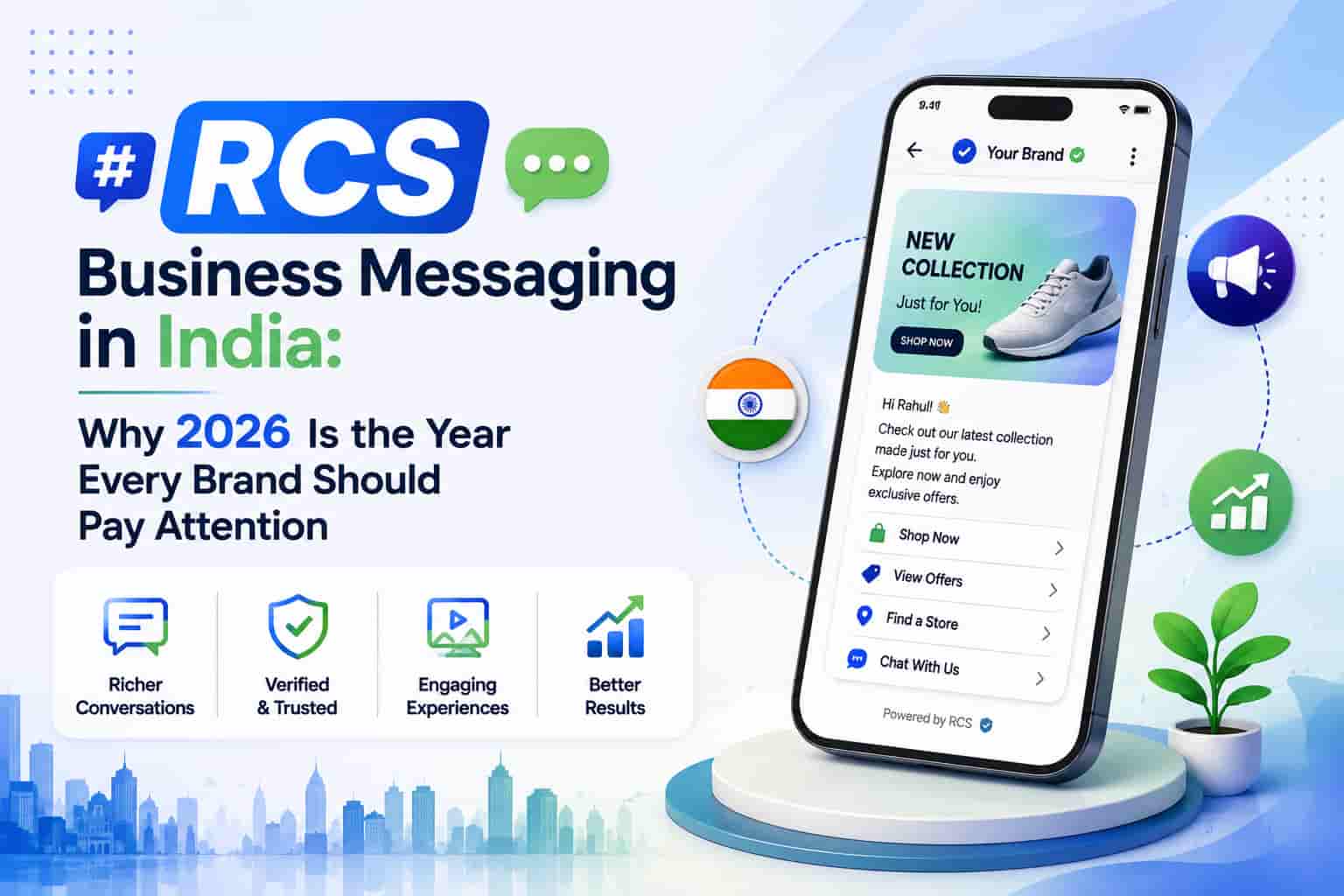
For years, RCS (Rich Communication Services) has been the "next big thing" in business messaging that never quite arrived in India — always a year away, always waiting on one more operator or one more OEM to switch it on. That wait is effectively over. Between Jio bringing RCS to iPhones, Airtel finally joining the fold as the last major carrier holdout, and a fresh carrier-backed security partnership between Airtel and Google, RCS in India has gone from "interesting pilot" to something every marketing and customer-communication team needs a plan for.
If you run a business that sends OTPs, delivery updates, appointment reminders, or promotional offers to customers — which, honestly, is most businesses — this shift changes what "good" business messaging looks like in India.
What Actually Changed
Three developments, stacked on top of each other, are why 2026 feels different: Apple and Jio brought RCS to iPhones for Jio users, closing the gap that used to make RCS an Android-only story in India. Then Airtel became the final major Indian operator to switch on RCS, integrating Google's spam-filtering layer directly at the network level. And most recently, Airtel and Google announced a carrier-backed RCS security model — one that layers telecom-grade fraud detection, AI-driven spam blocking, DND-aware message categorisation, and verified business identity on top of standard RCS. Airtel has been public about the scale of the problem this is meant to solve: over the past 18 months it says it has blocked 71 billion spam calls and 2.9 billion spam messages on its network, cutting related financial fraud losses by nearly 69%.
Put simply: RCS in India is no longer a niche feature waiting for adoption. It's becoming the default, carrier-endorsed way for verified businesses to reach customers — with the kind of trust signals that plain SMS was never built to carry.
The numbers back this up. RCS-capable subscribers in India grew close to 9% between 2024 and 2025, and industry estimates put growth for 2026 at closer to 18%, largely on the back of the iOS rollout. Globally, business messages sent over RCS are projected to jump from around 125 billion this year to nearly 485 billion by 2030 — and India is one of the markets driving that curve.
Who's Actually Using It — And Why It Matters by Sector
This isn't evenly distributed across industries, and that's useful to know if you're deciding where to invest first. Retail is currently the biggest user of business RCS globally, and in India that tracks — order confirmations, shipping updates, cart-recovery nudges, and festive-season offers translate naturally into RCS's rich cards and carousels, which simply perform better than a plain text SMS competing for attention.
Banking and healthcare are the categories to watch closest, though. Both are projected to see explosive growth in RCS adoption through 2030 — banking is expected to grow around 600%, healthcare over 1000% — and the reason is almost entirely about trust. A bank sending a verified, branded RCS message with its logo and a "Verified" badge is a very different experience from a customer squinting at an SMS from a random ten-digit number, wondering if it's a phishing attempt. In a country where SMS-based fraud and OTP scams are a genuine, ongoing headache for consumers, that verification layer isn't a nice-to-have — it's becoming the differentiator between a business customers trust and one they've learned to be suspicious of.
RCS vs Bulk SMS vs WhatsApp: How We're Advising Clients Right Now
We're not telling clients to abandon Bulk SMS — for pure OTPs, low-cost transactional alerts, and reaching feature-phone users in smaller towns, SMS still has a place, and DLT-registered SMS remains the most universal channel in the country. But for anything customer-facing where brand trust, engagement, or rich content matters — order updates, offers, appointment reminders, lead follow-ups — RCS is quickly becoming the better default on networks where it's live, with WhatsApp Business API continuing to be the heavyweight for two-way conversational engagement.
The practical approach we recommend to Indian businesses right now is a layered one: use RCS where it's supported and the message benefits from verification or rich media, fall back to Bulk SMS for guaranteed reach and low-cost transactional sends, and lean on WhatsApp for ongoing customer conversations and support. Treating these as competing channels misses the point — they're solving different problems, and the businesses getting the best results in 2026 are the ones blending all three intelligently rather than betting everything on one.
What This Means If You Haven't Touched RCS Yet
- Verification is worth doing early. Getting your business verified for RCS (branded name, logo, and the trust badge) is a one-time setup that pays off every time you message a customer afterward — and as more brands verify, unverified senders will start to look increasingly out of place.
- Don't rebuild your messaging strategy from scratch. If you already have SMS templates and WhatsApp flows in place, RCS slots in alongside them rather than replacing them — the migration is additive, not disruptive.
- Test on your actual customer base before committing budget. RCS reach still depends on the customer's device, OS version, and carrier, so a quick audit of how much of your customer list is even RCS-reachable today will tell you how aggressively to invest right now versus over the next six to twelve months.
- Fraud protection is now a selling point, not just a compliance checkbox. With Airtel and Google actively marketing their anti-spam and verification layer, businesses that adopt verified RCS early get to use "verified sender" as a genuine trust signal in their own customer communication — something worth highlighting in your own marketing, not just quietly enabling in the background.
The Bigger Picture
What's happening with RCS in India right now mirrors what happened with UPI a few years back: infrastructure that seemed slow to arrive suddenly reaches a tipping point once the major players align, and then adoption moves fast. Telcos, device makers, and platforms rarely coordinate this cleanly — Jio, Apple, Airtel, and Google all moving in the same direction within roughly a year of each other is a strong signal that RCS is past the experimental phase in India.
For businesses, the practical question isn't "should we care about RCS" anymore — it's "how quickly can we get verified and start using it well." The brands that move now will be the ones customers already associate with trustworthy, well-designed messaging by the time RCS becomes the norm rather than the exception.
FAQs
Is RCS available on all networks in India?
Coverage has expanded significantly through 2025 and into 2026, with Jio, Airtel, and Vi all supporting RCS, and Apple's rollout bringing it to iPhone users on Jio. Actual reach still depends on the customer's device and OS version, so it's worth checking your own audience before assuming full coverage.
Does RCS replace Bulk SMS for my business?
Not entirely. SMS remains the most universal fallback channel, especially for OTPs and reaching feature phones or older devices. Most businesses in India are best served by using RCS and SMS together rather than switching entirely.
How is RCS different from WhatsApp Business messaging?
RCS works natively inside a phone's default messaging app with no separate app or opt-in required, and now carries carrier-level verification and fraud protection. WhatsApp Business API is better suited to ongoing two-way conversations and support. Many brands in India are now using both, alongside SMS, depending on the use case.
Is getting verified for RCS expensive or complicated for a small or mid-sized business?
It's a structured but manageable process typically handled through an RCS/business messaging partner, and it's a one-time setup rather than an ongoing burden. For most businesses, the trust and engagement gains make it worth doing sooner rather than later.