

RCS for Banking and Fintech: Rich, Verified Messaging for OTPs and Account Alerts

A customer receives an SMS claiming to be from their bank about a "suspicious login," and — because plain SMS carries no reliable visual signal of who actually sent it — can't easily tell whether it's genuine or a phishing attempt spoofing the bank's name. This uncertainty is a real cost to banks and fintechs, not just a customer inconvenience: every successful SMS phishing attempt erodes trust in all SMS communication from that institution, including the legitimate ones.
Why RCS's Verification Matters More for Financial Messaging Than Any Other Category
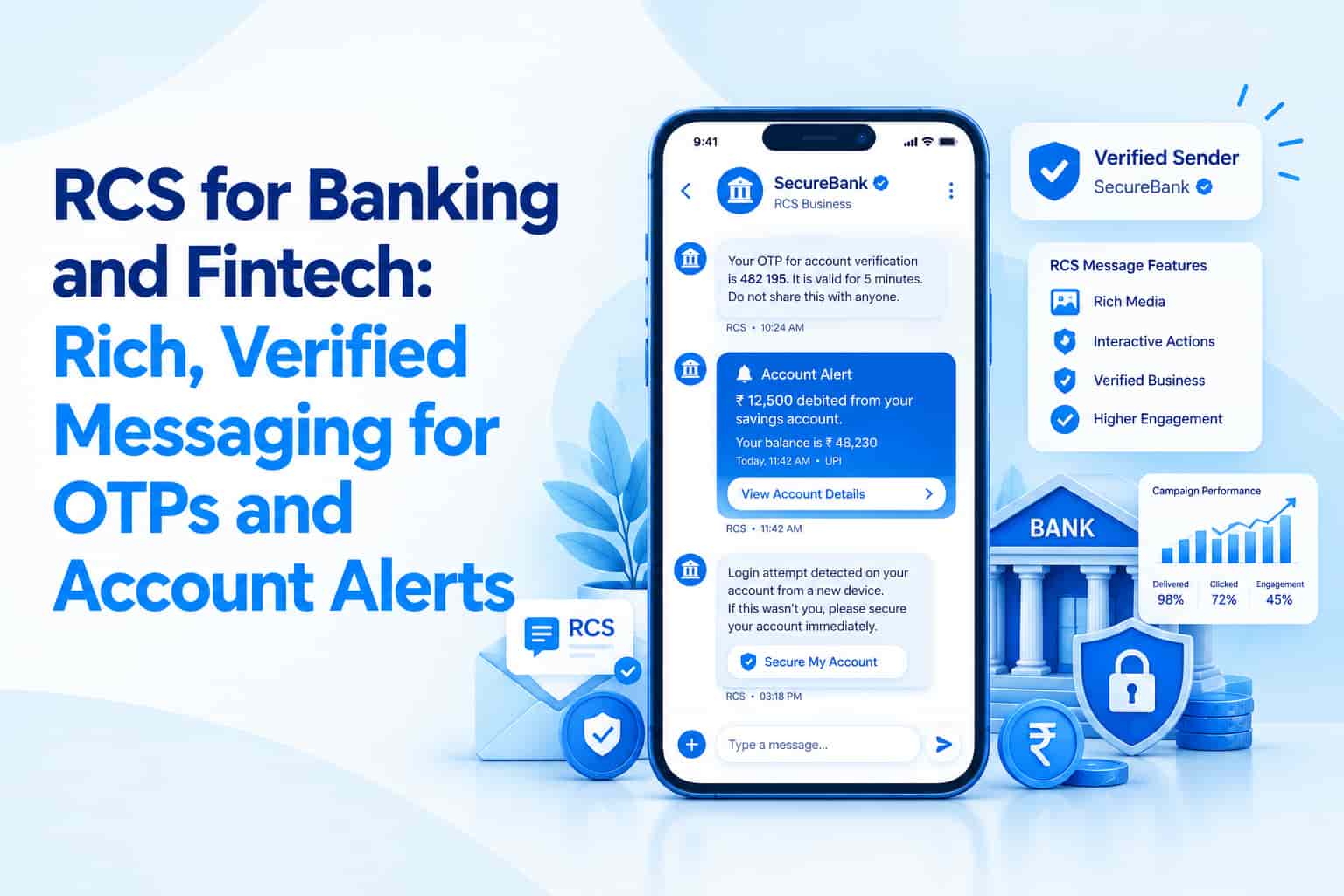
RCS Business Messaging includes a verified sender badge and branded business identity — a checkmark, logo, and verified business name displayed directly in the conversation — that plain SMS has no equivalent for. For a bank or fintech, this verification is arguably RCS's single most valuable feature, since it gives customers a visual, hard-to-spoof signal that a message claiming to be from their bank actually is, at a time when SMS-based phishing (smishing) targeting banking customers is a well-documented and ongoing problem.
Practical Use Cases Beyond OTPs
While OTP delivery remains the highest-volume transactional use case, RCS's richer format supports account alerts with clearer context — a spending alert that shows the merchant name and amount directly formatted rather than buried in a plain-text string, or a card-block confirmation with a direct "call support" action button rather than a number the customer has to dial manually. For fintechs specifically, RCS can support richer onboarding nudges — a KYC document reminder with a direct upload link — in a format that's harder to convincingly fake than a plain SMS with an embedded link.
The Reach Limitation Banks Need to Plan Around
RCS support depends on both the recipient's device and their carrier supporting the protocol — not universal across every Android device and carrier combination, and not supported at all on iPhones running without RCS-compatible configurations in some cases. This is why RCS for banking messaging is typically deployed with automatic SMS fallback: if a message can't be delivered via RCS, the system sends the same content as a standard SMS, so no customer is left without their OTP or alert because of a device or carrier gap.
Compliance and Security Considerations
Financial messaging carries stricter regulatory and security expectations than typical marketing messages — RCS's verified sender identity and encrypted transport during delivery are genuine security advantages for this category specifically, but they don't eliminate the underlying discipline required: businesses still need to register correctly, avoid embedding action links that could themselves be misused if the verification badge alone is trusted uncritically, and educate customers that verification exists so they know to look for it.
Frequently Asked Questions
Does RCS eliminate SMS phishing risk for banks entirely?
No — it significantly reduces one specific risk (sender impersonation) through verified branding, but doesn't replace broader customer security education or a bank's other fraud-prevention measures.
What happens if a customer's device doesn't support RCS?
A properly configured RCS messaging setup falls back to standard SMS automatically, so OTPs and alerts still reach the customer without requiring manual intervention.
Building Trust Into Every Message
For banks and fintechs, RCS's real value isn't richer formatting for its own sake — it's giving customers a reliable way to distinguish a genuine message from an impersonation attempt. OM Enterprises sets up verified RCS Business Messaging with SMS fallback for Indian financial services businesses that need both reach and trust in every OTP and alert they send.