

Push Notifications vs. SMS Messages: Which Should You Use?

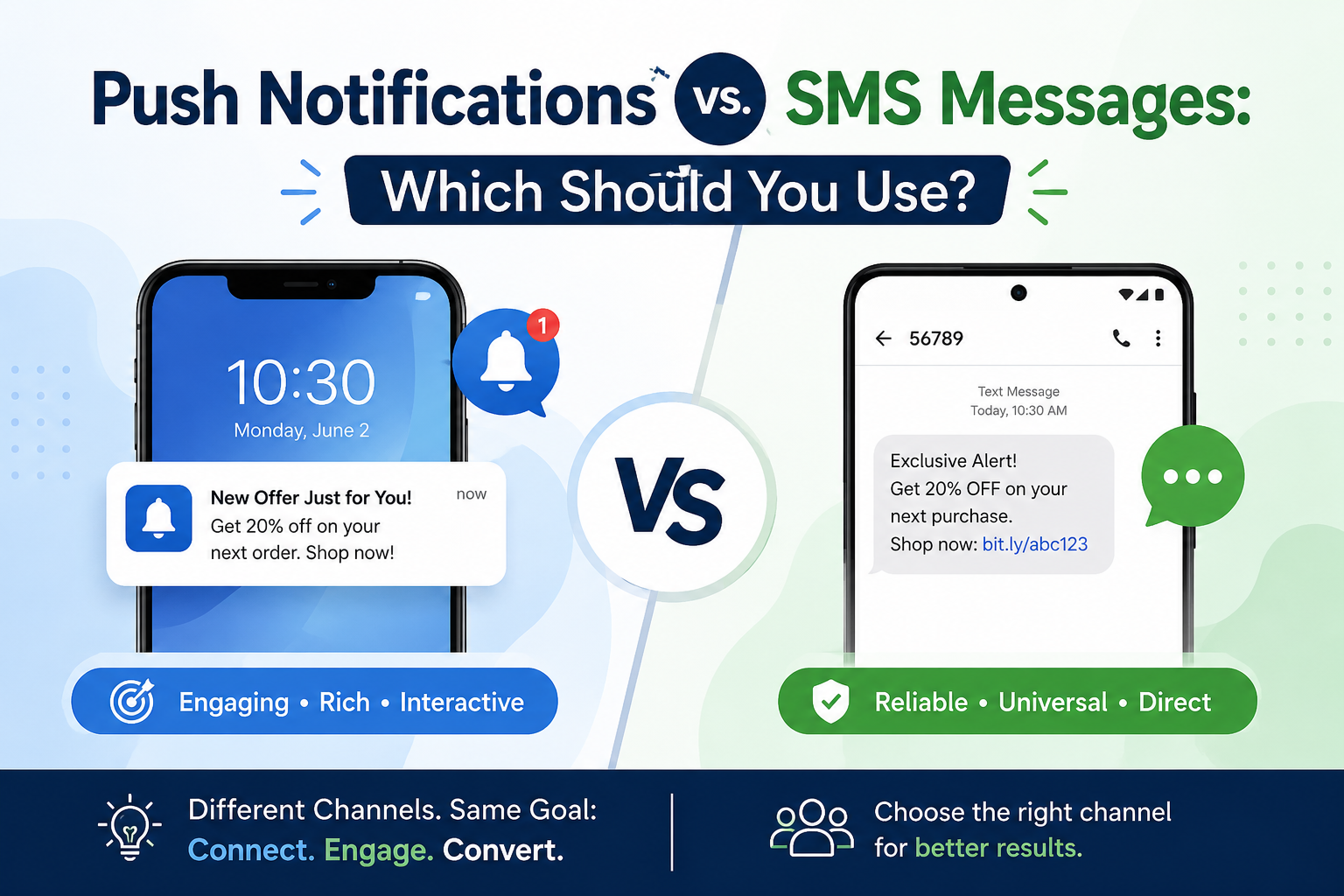
If you're building a mobile app or running a marketing campaign, chances are you've asked yourself this question: should you reach your audience through push notifications or SMS messages? Both channels promise fast, direct communication with your users, but they work in very different ways and serve different purposes.
Choosing the wrong channel can mean the difference between a message that drives action and one that gets ignored — or worse, prompts someone to unsubscribe or delete your app entirely. In this guide, we'll break down what separates push notifications from SMS messages, weigh the pros and cons of each, and help you decide which one (or which combination) is right for your business.
What's the Difference Between Push Notifications and SMS Messages?
At a glance, push notifications and SMS messages seem similar: both are short, immediate messages that show up on a user's phone. But the mechanics behind them — and what they require from your audience — are quite different.
Push notifications are messages sent through a mobile app to users who have installed that app and granted permission to receive alerts. They appear on the lock screen or notification center and rely entirely on an internet connection (Wi-Fi or mobile data) and the app being installed on the device.
SMS messages, on the other hand, are plain text messages sent directly to a user's phone number via the cellular network. No app, no internet connection, and no special software is required — just a working phone number capable of receiving texts.
Key Differences in Detail
Delivery method: Push notifications require an installed app and an internet connection; SMS works over any cellular network, even with no data plan.
Opt-in process: Push requires users to download the app and accept notification permissions; SMS requires users to provide their phone number and consent to receive texts.
Cost: Push notifications are generally free to send in high volumes; SMS messages typically incur a per-message cost, especially at scale.
Reach: SMS can reach virtually any mobile phone; push is limited to users who have your app installed and notifications enabled.
Character limits: SMS messages are traditionally capped at 160 characters, while push notifications can include richer, though still concise, content.
Visibility: Push notifications can be dismissed or missed if a user's phone is off or the app is deleted; SMS messages tend to sit in the inbox until read.
Advantages and Disadvantages of Push Notifications
Pros of Push Notifications
Free to send: Once a user has your app, sending push notifications typically costs nothing extra, regardless of volume.
Rich content: You can include images, action buttons, deep links, and personalized content that go beyond plain text.
Highly targeted: Push platforms often allow segmentation based on user behavior, location, or app activity.
Brand reinforcement: Notifications appear with your app icon and branding, keeping your product top of mind.
Real-time engagement: Ideal for time-sensitive updates like order status, breaking news, or app-specific alerts.
Cons of Push Notifications
Requires app installation: You can only reach users who have downloaded your app — a significant barrier compared to SMS.
Opt-in dependency: Many users disable notifications altogether, especially if they're overwhelmed by app alerts.
Easily ignored or dismissed: Push notifications can get lost among dozens of others competing for attention.
Platform limitations: Delivery can be inconsistent depending on the operating system, battery-saving settings, or connectivity issues.
Advantages and Disadvantages of SMS Messages
Pros of SMS Messages
Nearly universal reach: Almost every mobile phone can receive text messages, regardless of app usage or smartphone type.
High open rates: SMS messages are read at significantly higher rates than emails and often faster than push notifications.
No internet required: Messages are delivered over cellular networks, making them reliable even in areas with poor data coverage.
Sense of urgency: Because texts feel personal and immediate, they're effective for time-critical alerts like appointment reminders or security codes.
Cons of SMS Messages
Cost per message: Unlike push notifications, SMS campaigns usually come with a price tag that scales with volume.
Character limitations: The 160-character limit forces brevity and restricts how much information or branding you can include.
Regulatory requirements: SMS marketing is subject to strict compliance rules (like TCPA in the U.S.), requiring explicit consent and easy opt-out options.
Limited interactivity: Compared to push notifications, SMS offers fewer options for rich media, buttons, or deep linking.
Push Notifications vs. SMS Messages: Which Is More Effective?
Neither channel is universally "better" — effectiveness depends entirely on your goals, audience, and the nature of your message.
When to Use Push Notifications
Push notifications work best when you want to engage existing app users with contextual, in-the-moment updates. They're ideal for:
Cart abandonment reminders in e-commerce apps
Real-time updates like flight status or delivery tracking
Re-engagement campaigns for inactive app users
Personalized offers based on in-app behavior
When to Use SMS Messages
SMS is the stronger choice when you need guaranteed visibility and broad reach, especially for time-sensitive or high-stakes communication. Consider SMS for:
Two-factor authentication and security codes
Appointment or reservation reminders
Order confirmations and shipping alerts
Customers who haven't downloaded your app
How to Choose Between Push Notifications and SMS Messages
When deciding which channel to prioritize, ask yourself a few key questions:
Do most of your customers use your app, or do you primarily interact with them outside of it?
How time-sensitive is the message, and does it need guaranteed delivery?
What's your budget for messaging, and can it absorb per-message SMS costs?
Do you need rich media or interactivity, or is plain text sufficient?
Best Practice: Use a Multi-Channel Approach
Rather than treating this as an either-or decision, many successful businesses use both channels strategically. Push notifications can handle everyday engagement and in-app behavior triggers, while SMS can be reserved for critical, high-priority communications that demand immediate attention. Combining the two allows you to maximize reach while keeping messaging costs manageable, and it ensures you're meeting customers wherever they are — whether that's inside your app or simply on their phone.
Conclusion
Push notifications and SMS messages each bring distinct strengths to the table. Push notifications offer a free, richly interactive way to engage users who already have your app installed, while SMS delivers near-universal reach and high open rates, even without an internet connection. Rather than picking one over the other, the smartest approach is often to use both — leaning on push notifications for everyday engagement and SMS for urgent, high-value communications.
Optimize Your Messaging Strategy
The right channel mix comes down to understanding your audience, your message's urgency, and your budget. By testing both push notifications and SMS within your marketing and communication strategy, you can identify what resonates most with your users — and build a messaging approach that keeps them engaged, informed, and coming back.