

Personal Branding vs Business Branding: What's Best for You

Introduction
Whether you're a solopreneur launching a personal brand or an entrepreneur building a scalable business, the branding strategy you choose will shape everything — from how customers find you to how much your brand is worth. This guide breaks down the core differences between personal and business branding, explores real-world examples, and helps you decide which path fits your goals.
What Is Personal Branding vs. Business Branding?
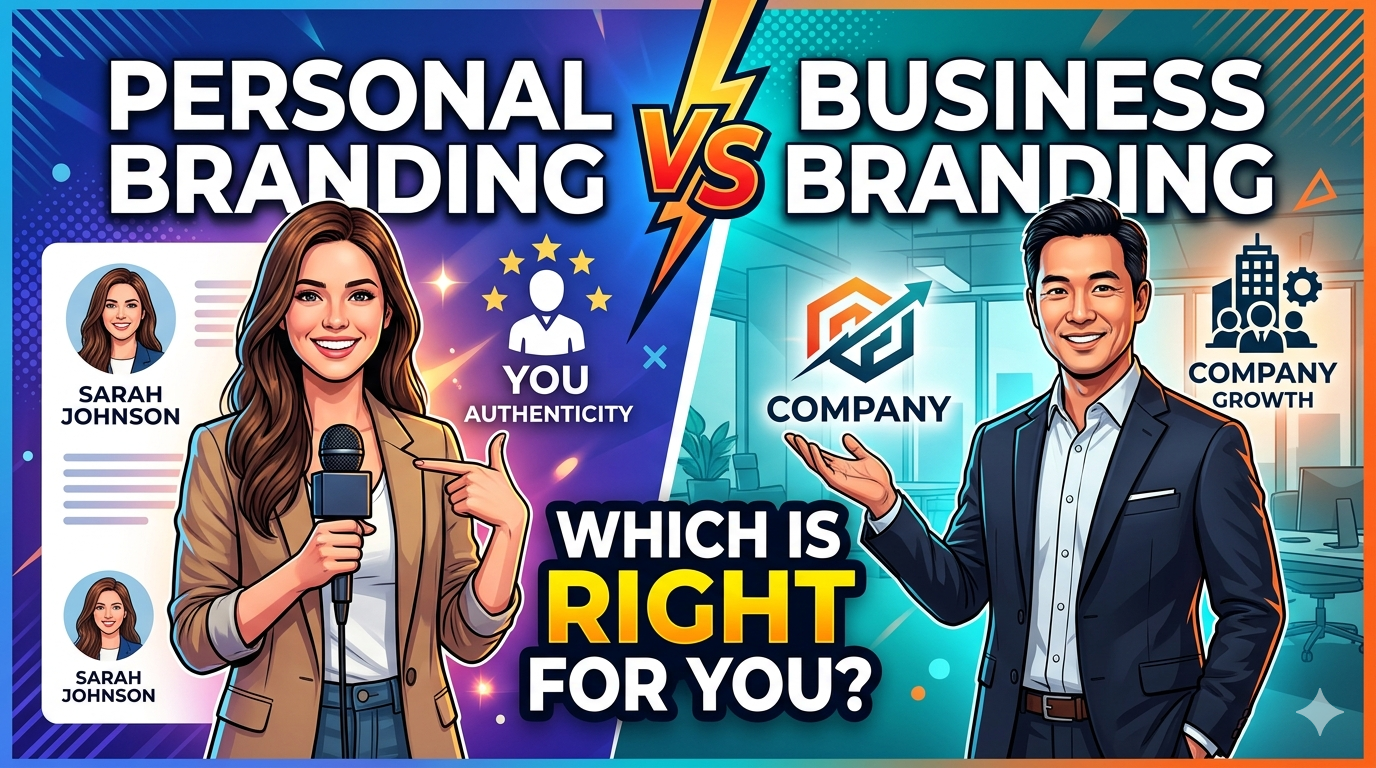
At its core, the difference comes down to who — or what — is at the center of the brand. Personal branding puts an individual front and center. Business branding builds an identity around a company, product, or service that can exist independently of any one person.
Personal Branding
You are the brand. Your personality, story, and expertise drive trust and connection.
Business Branding
The company is the brand. A logo, mission, and voice define an identity larger than any individual.
What Is Personal Branding?
Personal branding is the practice of positioning yourself as an authority, thought leader, or recognizable figure in a particular niche. Your name, face, voice, and values become the product.
Famous examples of personal brands
Think of Oprah Winfrey, Gary Vaynerchuk, or Marie Forleo — their names carry immediate weight. When people follow them, they're buying into a person, not a logo.
Personal branding is ideal for
Coaches, consultants, and freelancers
Speakers, authors, and content creators
Professionals building thought leadership in a specific field
Key strengths of personal branding
Builds deep trust and authentic audience connection
Lower startup cost — your story is your asset
Highly flexible and easy to pivot
What Is Business Branding?
Business branding creates a standalone identity for a company. Think of Apple's bitten apple, Nike's swoosh, or Airbnb's bélo symbol — none of these require a founder's face to communicate value.
Examples of business branding done right
Brands like Apple, Nike, and Airbnb demonstrate how a strong business identity can transcend personalities. Their branding outlasts leadership changes and scales globally.
Business branding is ideal for
Startups aiming for scale or investment
Product-based or SaaS businesses
Entrepreneurs planning to sell or exit
Key strengths of business branding
Scalable beyond the founder's personal capacity
Sellable as an independent asset
Easier to build a team and culture around
Pros and Cons of Personal Branding
Benefits
High trust, low cost, authentic storytelling, loyal community, flexible pivoting, direct monetization.
Disadvantages
Hard to scale, tied to your time, reputation risks, difficult to sell or hand off.
Pros and Cons of Business Branding
Benefits
Scalable, team-driven, sellable asset, investor-friendly, consistent across markets.
Disadvantages
Higher cost to build, slower trust, requires consistent brand management and team alignment.
Key Differences Between Personal and Business Branding
Factor | Personal Brand | Business Brand |
|---|---|---|
Primary focus | The individual | The company / product |
Audience connection | Emotional, personality-driven | Value and mission-driven |
Growth potential | Limited by personal capacity | Unlimited with the right team |
Exit strategy | Very difficult to sell | Can be sold independently |
Marketing style | Storytelling, personal content | Consistent brand messaging |
Real-World Examples
Personal brands
Neil Patel built his personal brand before launching NP Digital. Tim Ferriss became the brand — his name alone sells books, podcasts, and courses. Brené Brown's face is inseparable from her research on vulnerability.
Business brands
Mailchimp, Shopify, and HubSpot each built recognizable business identities. Their founders are rarely the public face — the product and positioning do the heavy lifting.
How to Decide Which Is Right for You
→Do I want to be the face of the brand long-term? If yes, personal branding gives you full control and authenticity.
→Am I planning to build a team and step away? Business branding lets the company outlive your involvement.
→Is my personal story key to selling? If your journey is the product, personal branding will convert better.
→Do I want to build a sellable asset? Business branding is the clear winner for future exits or investment.
→Can I stay consistently visible? Personal brands demand ongoing content and presence — honest self-assessment matters.
Hybrid Branding: The Best of Both Worlds
What is hybrid branding?
Hybrid branding blends a recognizable personal identity with a scalable business structure. The founder gives the brand human warmth and credibility, while the company can grow, hire, and eventually operate independently.
Why it works
It captures the trust of a personal brand while building the scalability of a business. Audiences connect with the person; the product sustains the revenue.
Examples of hybrid models
Elon Musk and Tesla. Oprah and OWN Network. Tony Robbins and his suite of businesses. Each person lends their credibility to a company that functions on its own.
Conclusion
There's no single right answer between personal and business branding — the best choice depends on your goals, lifestyle, and long-term vision. If you value deep human connection and flexibility, personal branding may be your fastest path to impact. If you're building something that scales, teams up, and eventually stands on its own, business branding lays the right foundation. And if you want the best of both? Hybrid branding is increasingly the strategy smart entrepreneurs are choosing. Whatever path you take, the most important thing is to start with clarity, stay consistent, and build something that genuinely reflects who you are — or what you stand for.