

Patient Communication in 2026: How Clinics and Hospitals Are Cutting No-Shows with SMS and WhatsApp

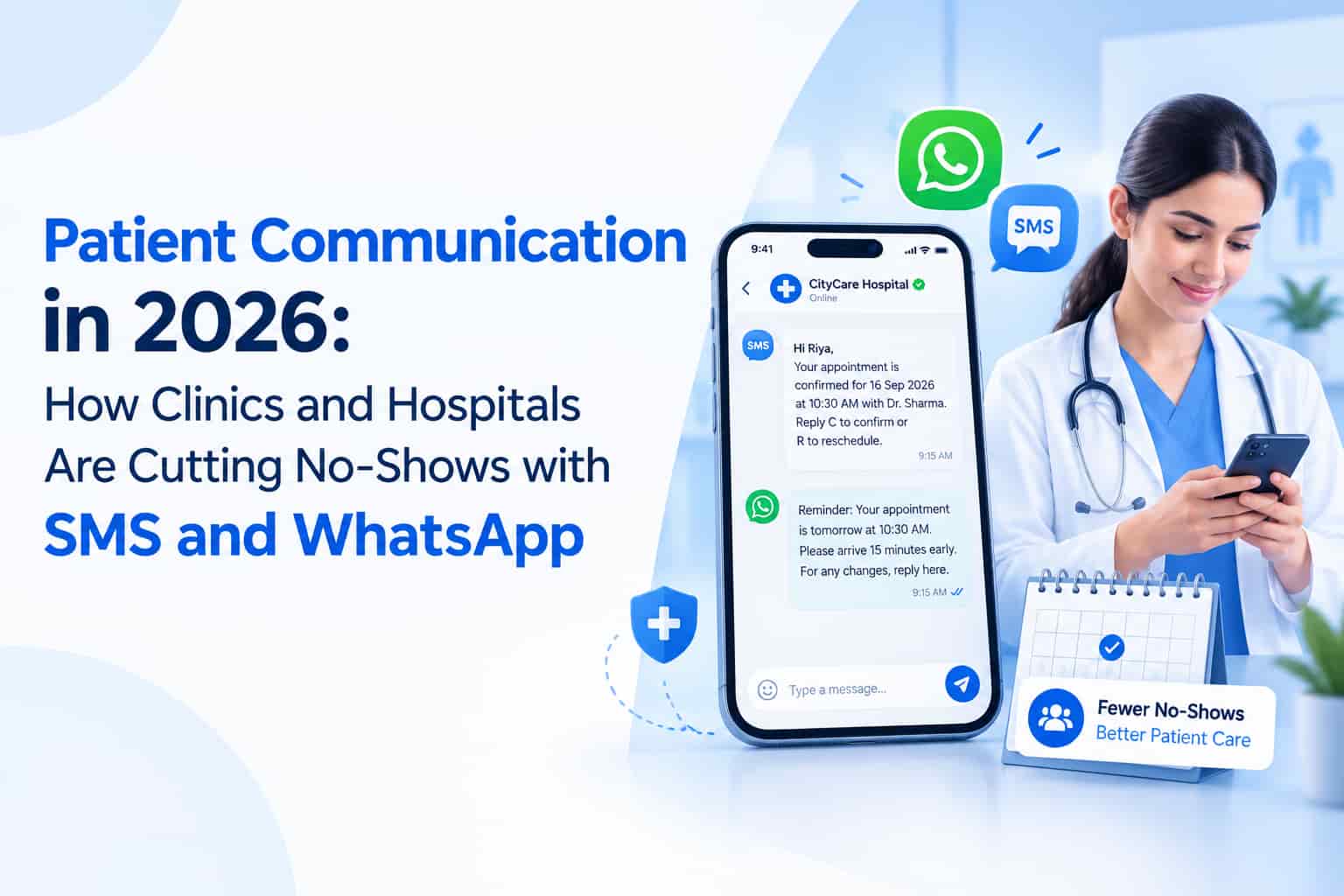
A clinic books a full day of appointments and still ends up with several empty slots by afternoon — not because patients cancelled, but because they simply forgot. For any healthcare provider running a packed schedule, a no-show isn't a minor inconvenience; it's a slot that could have gone to another patient, and time and staff capacity that don't come back. Automated reminders sent by SMS and WhatsApp have become one of the simplest, highest-impact fixes available for this specific problem.
Why this works better than a phone call reminder
A front-desk team manually calling every patient the day before an appointment is time-consuming, and reaches a shrinking share of patients who actually answer calls from unfamiliar numbers. A short SMS or WhatsApp message lands directly, gets read in seconds, and — critically — can be automated entirely once connected to a clinic's scheduling system, with no ongoing staff time required per appointment.
What an effective reminder sequence actually looks like
Confirmation immediately after booking
An instant message confirming the date, time, doctor, and location right after a booking is made reduces the number of patients who simply forget they booked at all — the earliest point of reinforcement matters as much as the reminder closer to the date.
A reminder with an easy reschedule option
A reminder sent 24–48 hours ahead that includes a simple way to confirm, reschedule, or cancel — a reply keyword or a tap-through link — converts a share of would-be no-shows into rescheduled appointments instead, which is a better outcome for both the clinic and the patient than a missed slot discovered too late to fill.
Post-visit follow-up where relevant
For clinics running recurring care — physiotherapy, dental follow-ups, chronic condition management — an automated follow-up message about the next recommended visit keeps patients on track without relying on staff to manually track and call every individual case.
Compliance and tone matter here more than in most industries
Healthcare messaging carries a higher bar for care than typical promotional messaging — reminders should stick to logistics (appointment details, general instructions like fasting requirements) rather than including any specific clinical details in a plain-text message, and should always use a properly registered sender template through TRAI's DLT framework rather than an unregistered number, both for compliance and so patients recognize the message as legitimate.
Where WhatsApp adds something SMS can't
WhatsApp allows richer content — a location pin for the clinic, a document attachment for pre-visit instructions or forms to fill in advance, and two-way replies that are easier for a patient to use than replying to an SMS. For clinics handling any pre-appointment paperwork, this alone can meaningfully cut time spent at the front desk on visit day.
FAQ
Do small, single-location clinics benefit from this, or only larger hospital groups?
Both — a single-doctor clinic often feels the cost of a no-show just as acutely as a larger practice, relative to its total daily capacity, and the automation involved doesn't require hospital-scale infrastructure to set up.
Is it appropriate to send promotional health camp or check-up offers this way?
Yes, with proper opt-in and DLT-registered promotional templates — the key distinction is separating logistics/utility messages (which patients expect and welcome) from promotional messages (which need explicit consent, the same as any other business).
What's the realistic impact on no-show rates?
Results vary by clinic and patient base, but a well-implemented reminder sequence consistently reduces no-shows compared to no reminder system at all — the exact improvement is worth measuring against your own clinic's baseline rather than assuming a fixed figure.
Conclusion
Reducing no-shows rarely requires a complex system — it requires a reliable, automated sequence of confirmations and reminders that reach patients on a channel they actually check, with an easy way to reschedule when something comes up. For clinics and hospitals working with tight scheduling and real capacity constraints, this remains one of the most straightforward, high-return communication investments available.