
Native, Cross-Platform or PWA: Choosing the Right Mobile App Approach for Your Business

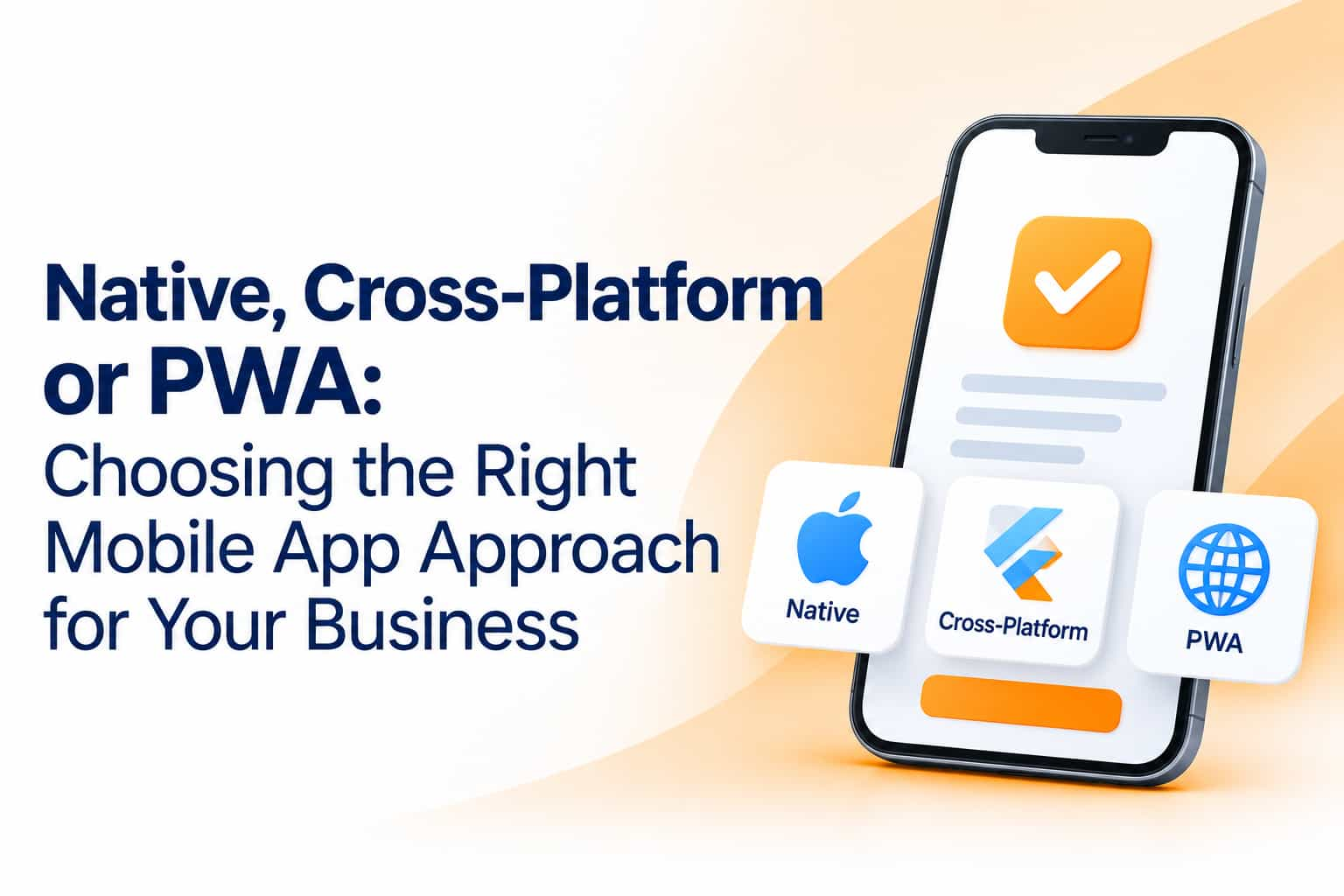
Every business owner eventually hears the same suggestion: "You should have an app." It sounds modern and professional, but an app is a significant investment, and many businesses discover too late that their customers would have been just as happy with a fast mobile website. Before commissioning development, it helps to understand the three main ways to put a business on a customer's phone: native apps, cross-platform apps and progressive web apps. Choosing the right one is the biggest factor in cost, speed and success of mobile app development for your business.
First, ask whether you need an app at all
Apps make sense when customers use your service frequently, when you need deep access to phone features, or when a smooth experience is a core part of the product. Examples include food delivery, banking, ride booking, fitness tracking and learning platforms. They make less sense for businesses whose customers visit rarely, such as a furniture shop, a wedding photographer or a once-a-year service. A well-built mobile website, together with WhatsApp for communication, often serves these businesses at a fraction of the cost. Be honest about how often a typical customer would open the app, and whether they would bother to download it.
Option one: native apps
A native app is built separately for each operating system, usually Android with Kotlin or Java and iPhone with Swift. It uses each platform's official tools and design conventions.
Strengths. Native apps offer the best performance, the smoothest animations and the most complete access to device features such as camera, sensors, biometric login, background tasks and the latest platform updates as soon as they arrive. They feel natural to users.
Weaknesses. You effectively build and maintain two products, which raises cost and timelines. Teams need specialists for each platform, and features must be kept consistent across both.
Best for. Performance-critical products, such as games, camera-heavy tools, complex fintech and apps that rely heavily on device features.
Option two: cross-platform apps
Cross-platform frameworks let developers write most of the code once and run it on both Android and iPhone. Popular frameworks include Flutter and React Native, among others. They produce installable apps that you publish through the app stores.
Strengths. A shared codebase usually means lower cost and faster delivery than building two native apps. Updates and new features can be released together. Modern frameworks give near-native performance for most business apps, such as e-commerce, booking, content, loyalty and internal tools.
Weaknesses. Very demanding graphics or highly specialised device features may need custom native code. Some platform-specific behaviours may take extra effort to match. Frameworks evolve, so you rely on their long-term support.
Best for. Most small and medium businesses that want a real app on both platforms within a reasonable budget.
Option three: progressive web apps
A progressive web app, or PWA, is a website built with extra capabilities that make it behave like an app. Users can open it from a browser link, add it to their home screen, receive some notifications and use parts of it offline, depending on browser and platform support. It is not downloaded from an app store in the usual way.
Strengths. One codebase serves all devices, development is typically cheaper, updates are instant, there is no download barrier and it is easy to share through a link or QR code. It is good for people with low storage or slow connections.
Weaknesses. Access to device features is more limited than in native apps, and behaviour differs between browsers and operating systems, especially on iPhone, where support for some features has historically lagged. App store visibility is limited, and users may not discover or trust it as an "app".
Best for. Content sites, catalogues, simple booking and ordering, service portals and businesses testing demand before building a full app.
Comparing the cost and time
Exact costs depend on features, design, backend work and team location, so ask for detailed quotes. As a rule of thumb, a PWA is usually the lowest cost and fastest, a cross-platform app sits in the middle and two native apps are the most expensive. Remember that the first release is only part of the cost. Plan for the backend, admin panel, testing, app store fees, security reviews, analytics, hosting and ongoing maintenance, which is often a meaningful share of the initial build cost each year.
Questions that decide the choice
Which phone features are essential? Do you need offline use, push notifications, payments, maps or camera? How important is top-level performance? Are your customers mostly on Android, iPhone or both? How soon must you launch? What is your budget for both build and maintenance? Do you want store visibility? Would a quick PWA test validate the idea before a larger investment?
A sensible path for most businesses
Start with a clear problem and a small set of must-have features. Validate demand with a mobile-friendly website or a PWA. If customers use it often, move to a cross-platform app for both stores. Reserve fully native development for cases where performance or special features demand it. This staged approach limits risk and lets real customer behaviour guide spending.
Backend and integrations matter
An app is only as good as the system behind it. Plan for secure APIs, user accounts, databases, admin dashboards, notifications through SMS, WhatsApp and email, payment integrations and links to your existing software such as ERP or CRM. Weak backends cause slow apps and broken experiences, regardless of the front-end choice.
How to choose a development partner
Ask to see apps they have built and speak to past clients. Check how they handle design, testing, security, post-launch support and ownership of source code. Insist that you own the code, app store accounts and domain. Beware of unrealistically low quotes, vague scopes and no maintenance plan.
Frequently asked questions
Which is cheaper: native or cross-platform?
Cross-platform is usually cheaper, since much of the code is shared.
Can a PWA replace an app?
For some businesses, yes, though device feature access and store presence are more limited.
How long does it take to build an app?
Simple apps can take a few months, while complex ones take longer.
Plan the right mobile product
OM Enterprises helps businesses decide between a mobile website, PWA and app, and builds solutions with the right integrations. Talk to our development team.