

The Marketing Funnel Explained: How to See Where Customers Drop Out and What to Fix First

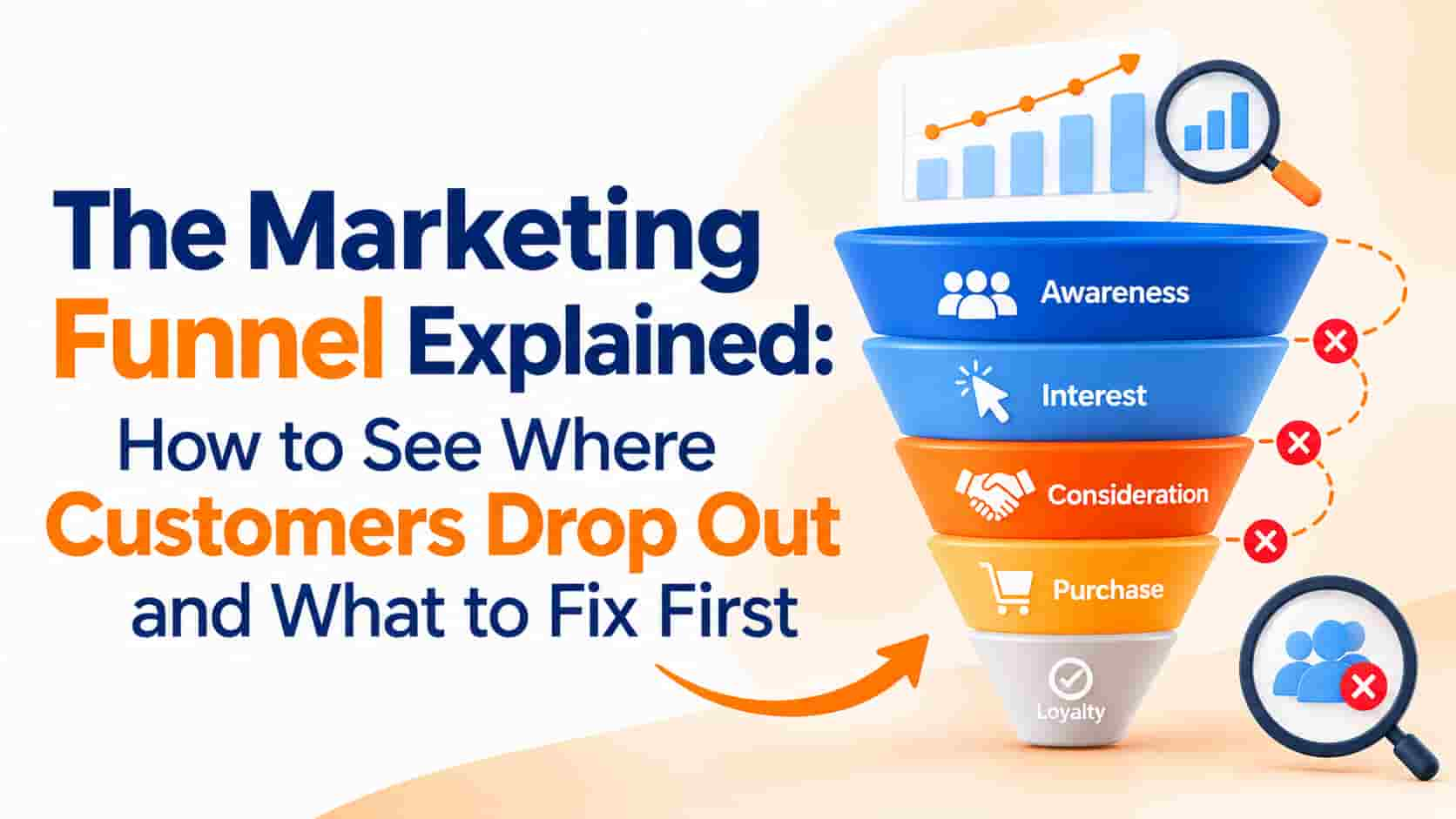
Businesses often describe their marketing problem in one sentence: "We need more leads." But more leads rarely fix the real problem. Sometimes the problem is that nobody knows the brand. Sometimes people know it but do not trust it. Sometimes they trust it but never get a clear reason to act, and sometimes they buy once and never return. A marketing funnel is a way of seeing these different problems at once, by describing the path from stranger to loyal customer in stages. Understanding your funnel shows you where customers are dropping out and what to fix first.
What a marketing funnel is
A marketing funnel is a model that describes the stages a person goes through before and after buying. It is called a funnel because many people enter at the top and fewer move to each following stage. The names and number of stages vary between models, but the logic is the same: different people need different information at different moments, and a single message cannot serve everyone.
A simple five-stage view
Awareness. The person discovers that you exist or realises they have a problem. They may find you through a search, a social post, an ad, a recommendation or a marketplace listing.
Interest. They start to learn more. They read content, watch a video, visit your website or follow your page.
Consideration. They compare options. They look at prices, reviews, features, case studies and alternatives, and may ask questions.
Decision. They are ready to act and need a final push: a clear offer, reassurance, easy purchasing and quick answers.
Retention and advocacy. After buying, they use the product, return for more and possibly recommend you to others. This stage is sometimes drawn as a loop or flywheel, since satisfied customers feed new awareness.
Why the funnel matters
The funnel prevents common mistakes. A business that pushes discounts at people who have never heard of it wastes money. A business that publishes only educational content but never asks for the sale leaves interest unconverted. A business that spends heavily on getting new customers but ignores service loses them quickly. By mapping activities to stages, you can see imbalance and direct effort where it is needed most.
Match content and channels to each stage
Awareness. Use channels that reach new people: search engine optimisation, social media posts and short videos, YouTube, ads, influencer collaborations, local listings and marketplaces. Content should be helpful and easy to consume, such as tips, explainers and answers to common questions. The goal is attention, not the sale.
Interest. Offer deeper content: detailed guides, comparison articles, webinars, newsletters and demonstrations. Invite people to subscribe or follow so you can stay in touch with permission.
Consideration. Provide proof and detail: case studies, customer reviews, product comparisons, pricing pages, free trials, samples, consultations and live chat or WhatsApp support. Answer objections openly.
Decision. Make buying easy. Clear offers, simple checkout, multiple payment options, quick quotes, limited-time incentives that are real, and prompt responses to enquiries. Retargeting and reminders can help those who hesitate.
Retention. Deliver on your promise: onboarding, usage tips, service reminders, loyalty rewards, replenishment prompts, feedback requests and referral invitations. Use WhatsApp, SMS and email with consent to stay in touch.
Measure each stage
Define one or two metrics for every stage. Awareness: reach, impressions, branded searches and new visitors. Interest: engaged visits, time on site, video views, sign-ups and followers. Consideration: product page views, enquiries, demo requests and returning visitors. Decision: conversion rate, cost per acquisition, abandoned carts and sales. Retention: repeat purchase rate, churn, lifetime value, reviews and referrals. Compare numbers between stages to find where the biggest drop occurs.
Find your leak
Look at the conversion between each stage. If many people visit but few enquire, the problem may lie in trust, clarity or offer. If many enquire but few buy, the problem may be sales follow-up, pricing or product fit. If many buy but few return, the problem may lie in delivery, quality or customer care. Fix the biggest leak first. Spending more on awareness while the middle of the funnel leaks only makes the waste larger.
The funnel for different businesses
A local clinic's funnel might move from a Google search to the profile, reviews, a call or WhatsApp enquiry, an appointment and follow-up care. An online store's funnel might move from an Instagram reel to a product page, cart, checkout, delivery and reorder reminder. A B2B software firm's funnel might move from a LinkedIn post to a guide download, a webinar, a demo, a proposal and a long-term account relationship. Draw your own funnel by listing the real steps your customers take.
Limits of the funnel model
Real customer journeys are rarely a straight line. People jump between stages, loop back, compare in parallel and use many channels. Some buy impulsively, while others take months. The funnel is a useful simplification, not a precise map. Combine it with customer interviews, analytics and sales conversations to understand how your customers actually behave.
Build a funnel review into your routine
Once a month, review the key number at each stage and note what changed. Ask which stage is weakest, what experiments could improve it and who will do them. Run one improvement at a time, and measure the effect. Share results with sales, service and marketing teams, since each owns part of the journey.
Common mistakes
Common errors include focusing only on the bottom of the funnel, ignoring retention, sending the same message to everyone, tracking vanity metrics, not following up on leads and treating the funnel as fixed instead of testing and improving.
Frequently asked questions
How many funnel stages should I use?
Use as many as help you act. Three to five is common.
Is the funnel still relevant?
Yes, as a thinking tool, though real journeys are messier than the diagram.
Where should I start?
Measure each stage, find the biggest drop and fix that first.
Find and fix your funnel leaks
OM Enterprises maps customer journeys and builds campaigns across search, social, WhatsApp and email for every funnel stage. Request a free funnel review.