

Do You Need an llms.txt File? What Google Actually Says About AI Search Visibility

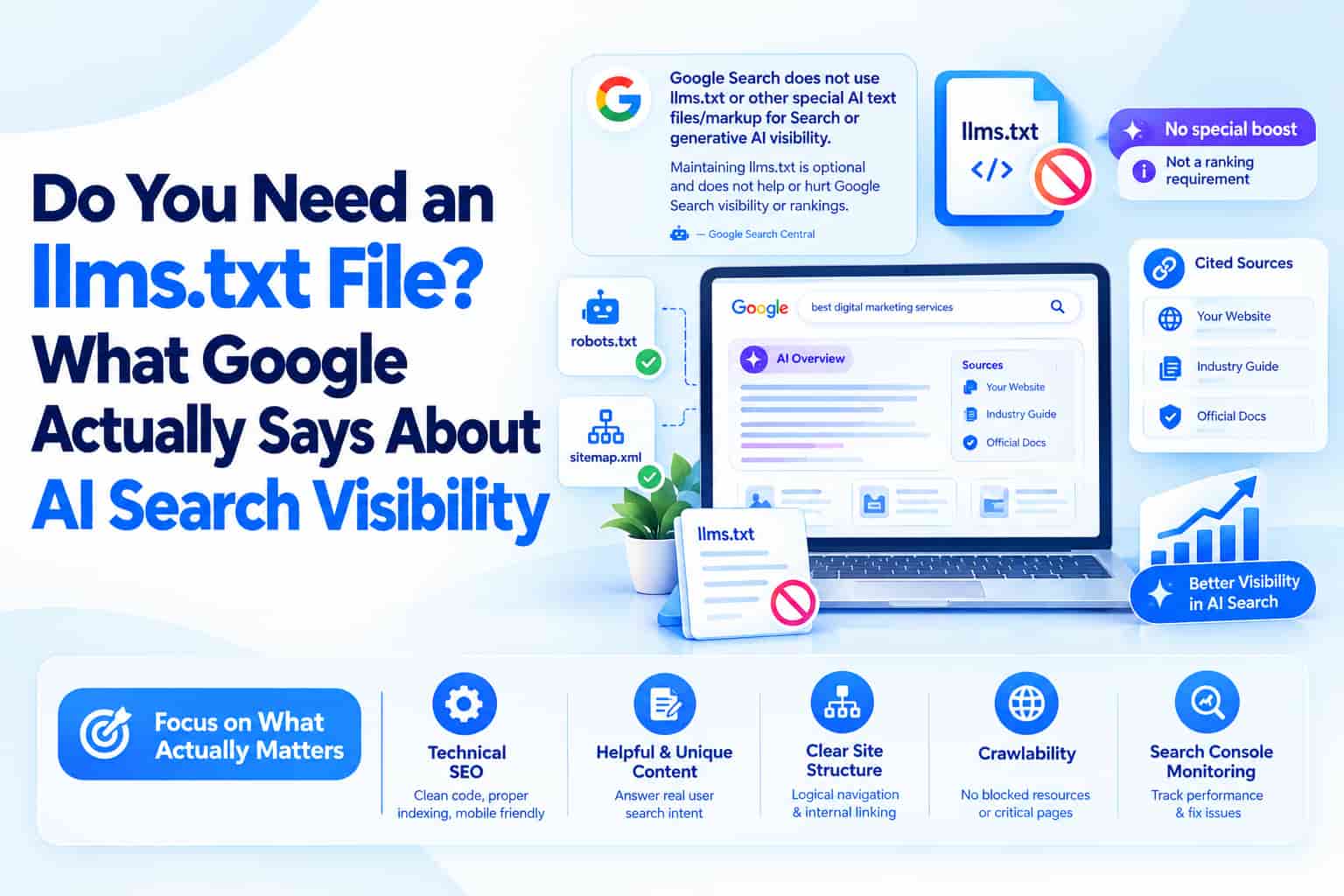
Over the past year, a lot of business owners have been told the same thing by a vendor or an online checklist: "Add an llms.txt file to your website so ChatGPT and Google's AI can find you." It sounds technical, cheap and urgent — the perfect combination for a quick sale.
The problem is that the evidence doesn't support it, at least not for Google. Here is what llms.txt is, what Google has said about it on the record, and where your time is better spent.
What is llms.txt?
llms.txt is a proposed convention from late 2024: a Markdown file placed at the root of a website (yoursite.com/llms.txt) that gives language models a curated summary of your most important pages. The idea was to make it easier for AI tools to understand a site without crawling everything.
It is not an official web standard, and it is not the same thing as robots.txt. robots.txt tells crawlers what they may or may not access. llms.txt is more like a voluntary reading list — and reading it is entirely optional for any AI system.
What Google has said
Google's position has been consistent and public:
- At Search Central Live in July 2025, Google's Gary Illyes said Google does not support llms.txt and has no plans to.
- John Mueller compared the idea to the old keywords meta tag — a self-declared signal search engines stopped trusting because anyone could write anything in it. When people noticed llms.txt files on some Google properties, he clarified that this was not done for Search.
- In May 2026, Google Search Central published guidance on optimising for its generative AI features, stating that llms.txt and other special AI-only files are not needed for AI Overviews or AI Mode. The reasoning: those features draw on the same Search index and ranking systems as regular results.
What the data shows
Independent studies point the same way. An SE Ranking analysis of roughly 300,000 domains found no meaningful correlation between having an llms.txt file and how often a site is cited in AI answers. Ahrefs reported that the vast majority of llms.txt files it examined received no traffic from AI crawlers, and crawler-log analyses suggest major AI bots rarely request the file at all.
No major AI provider has publicly confirmed that its production search or answer systems rely on llms.txt.
So is llms.txt useless?
Not entirely — but its real use case is narrow. It can be handy for developer documentation that people load into coding assistants or retrieval tools manually. For a typical business website trying to show up in Google's AI Overviews, AI Mode or ChatGPT search, it is not a meaningful lever.
If it already exists on your site, there's no harm in leaving it. Just don't pay for it as an "AI SEO" service, and don't let it distract from the work that actually matters.
What actually helps you appear in AI-powered search
Because Google's AI features sit on top of normal Search, the fundamentals still decide whether you're eligible to be cited:
1. Be crawlable and indexable
Check Search Console for indexing issues. Pages that aren't indexed can't be used in AI answers. Make sure important content is in HTML, not locked inside images or scripts that fail to render.
2. Answer real questions clearly
AI summaries pull from pages that directly answer what the user asked. Put the answer near the top, then expand. Use descriptive headings that mirror how people phrase questions.
3. Show genuine expertise
Original data, real examples, named authors with relevant experience and up-to-date information make your content more useful — and more likely to be chosen over thin, generic pages.
4. Use structured data where it fits
Schema doesn't guarantee AI citations, but accurate markup for your organisation, products, local business details and FAQs helps search engines understand your pages.
5. Build visibility beyond your website
AI tools also learn about brands from reviews, directories, YouTube, news coverage and social platforms. This is where a Search Channel Optimization approach helps: consistent, accurate information about your business across every channel people and machines use to research you.
6. Don't block the crawlers you want
Some sites accidentally block search or AI crawlers in robots.txt or through firewall rules. Review these settings deliberately, deciding which bots you allow based on your goals.
A quick way to evaluate any "AI SEO" tactic
- Has the platform (Google, OpenAI, etc.) confirmed it uses this signal?
- Is there independent data showing an effect?
- Does it make your content more useful to a human reader?
If the answer to all three is no, be sceptical — no matter how confident the sales pitch sounds.
Frequently asked questions
Does llms.txt help with Google AI Overviews?
No. Google has stated it is not needed for AI Overviews or AI Mode, which use the same signals as regular Search.
Is llms.txt the same as robots.txt?
No. robots.txt controls crawler access. llms.txt is an optional summary file that AI systems may or may not read.
Should I delete my llms.txt file?
There's no need. It won't hurt. Just don't expect it to improve your visibility in Google.
What's the best way to get cited by AI search tools?
Strong technical SEO, clear and expert content that answers real questions, accurate structured data, and a consistent brand presence across trusted platforms.
Get an honest AI search audit
OM Enterprises reviews your website for the things that genuinely affect visibility in Google Search and AI-powered results — indexing, content quality, structured data and multi-channel brand presence — without selling shortcuts that don't work. Request a technical SEO audit today.