

How Google Search Console Supports Search Channel Optimization (SCO)

Introduction
For years, marketers have treated "ranking on Google" as the finish line of digital visibility. But the way people actually search has changed. Today's audiences don't just type queries into Google — they search on YouTube, scroll TikTok for recommendations, browse Amazon for products, ask voice assistants questions, and post queries in niche forums and communities. This broader, multi-platform reality is what's driving the shift from traditional SEO toward Search Channel Optimization (SCO).So where does Google Search Console (GSC) — a tool built specifically around Google's own search index — fit into a strategy that's explicitly about looking beyond Google? The answer is that GSC remains the anchor of any serious SCO strategy. It doesn't optimize TikTok or Amazon directly, but the intelligence it provides about search behavior, content performance, and technical health is often the foundation on which cross-channel strategy is built. Let's explore how.
1. GSC Reveals the Search Intent Behind Every Channel Decision
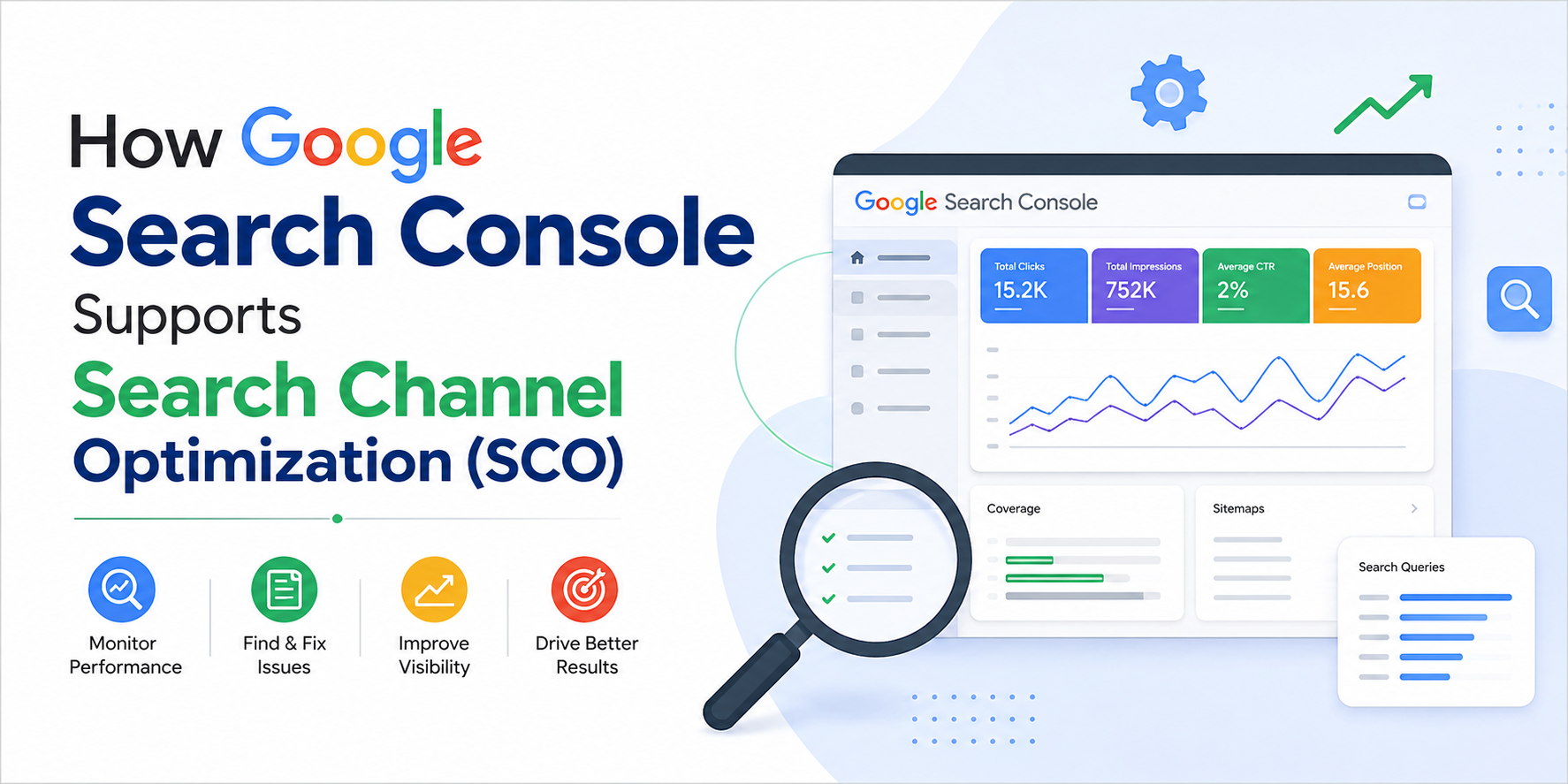
Search Channel Optimization starts with understanding what people are actually searching for and in what context. Google Search Console's Performance report shows the exact queries driving impressions and clicks to your site, along with click-through rate and average position for each one.
This query-level data is often the starting point for SCO planning. If GSC reveals that users are searching informational, how-to style queries, that's a strong signal that the same audience may also be searching YouTube for tutorial videos. If queries are highly visual or product-based ("best running shoes for flat feet"), that suggests overlap with Pinterest, Instagram, or Amazon search behavior. In other words, before you decide where to expand your channel strategy, GSC tells you what your audience actually wants — insight you can then translate into content for other search-driven platforms.
2. Identifying Content Gaps That Other Channels Can Fill
One of the most practical SCO use cases for GSC is gap analysis. By reviewing queries with high impressions but low click-through rates, or queries where your site ranks on page two or three, you can identify topics your website isn't fully capturing.
Rather than treating this purely as an on-page SEO fix, SCO thinking asks a different question: could this topic be better served on a different channel? A complex, visual, or process-driven topic might perform better as a YouTube tutorial than a blog post. A product comparison query might convert better through an optimized Amazon listing than a category page. GSC surfaces the opportunity; SCO strategy decides which channel is best positioned to capture it.
3. Technical Health as a Foundation for Cross-Channel Authority
Regardless of how many channels you're optimizing for, your website usually remains the hub that other channels link back to — whether that's a YouTube video description, a TikTok bio link, or an Amazon brand page. Google Search Console's indexing, Core Web Vitals, and mobile usability reports ensure that hub stays healthy.
If your central website has crawl errors, slow load times, or poor mobile experience, it undermines the credibility of your entire cross-channel presence. Traffic driven from other search channels back to your site will bounce if the landing experience is poor. GSC's technical reports act as quality control for the destination that all your other SCO efforts ultimately funnel toward.
4. Structured Data and Rich Results Extend Visibility Beyond the Blue Links
Google Search Console's Enhancements reports track structured data implementation — schema markup for products, FAQs, reviews, videos, and events. This is a direct bridge between traditional SEO and SCO thinking, because structured data is what allows your content to show up in Google's more visual, channel-like search features: video carousels, shopping results, FAQ accordions, and image packs.
These rich result formats often mirror the presentation style of dedicated platforms like YouTube or Pinterest. Getting your structured data right in GSC essentially lets you compete for real estate that behaves like a separate search channel, even within Google's own results page.
5. Backlink Data Reveals Where Cross-Channel Conversations Are Happening
The Links report in GSC shows which external domains link to your site. Reviewing this data often reveals which platforms and communities are already discussing or referencing your brand — forums, niche publications, review sites, or social platforms.
For SCO purposes, this is valuable reconnaissance. If a large share of your referring traffic comes from Reddit threads, YouTube video descriptions, or industry forums, that's a clear signal about where your audience already searches and engages. Rather than guessing which channels to prioritize, you can let your existing backlink profile point you toward channels with proven relevance to your niche.
6. Monitoring Long-Term Trends Across Devices and Regions
GSC's ability to segment performance data by device type and country adds another layer to SCO planning. A brand seeing strong mobile search growth in a particular region might prioritize channels that dominate mobile discovery in that market, such as TikTok or WhatsApp-based search behavior, over channels that skew toward desktop users.
This kind of segmentation prevents a one-size-fits-all channel strategy and instead lets data — rather than assumption — guide where marketing resources are allocated.
Conclusion
Search Channel Optimization is fundamentally about meeting your audience wherever they search — and Google remains one of the biggest and most measurable of those channels. Google Search Console doesn't manage your YouTube, TikTok, or Amazon presence directly, but it provides the query intelligence, technical diagnostics, and backlink insight that inform smart decisions across every other channel in your SCO strategy.
Rather than viewing GSC as a legacy SEO tool disconnected from the multi-channel search landscape, forward-thinking marketers treat it as a diagnostic hub: a place to understand real search intent, spot content gaps, and validate technical health — all of which strengthen the broader search channel strategy built around it. In a search landscape that's only getting more fragmented, that kind of grounded, data-backed starting point is more valuable than ever.