

Has Mobile Become the Primary Digital Marketing Interface?

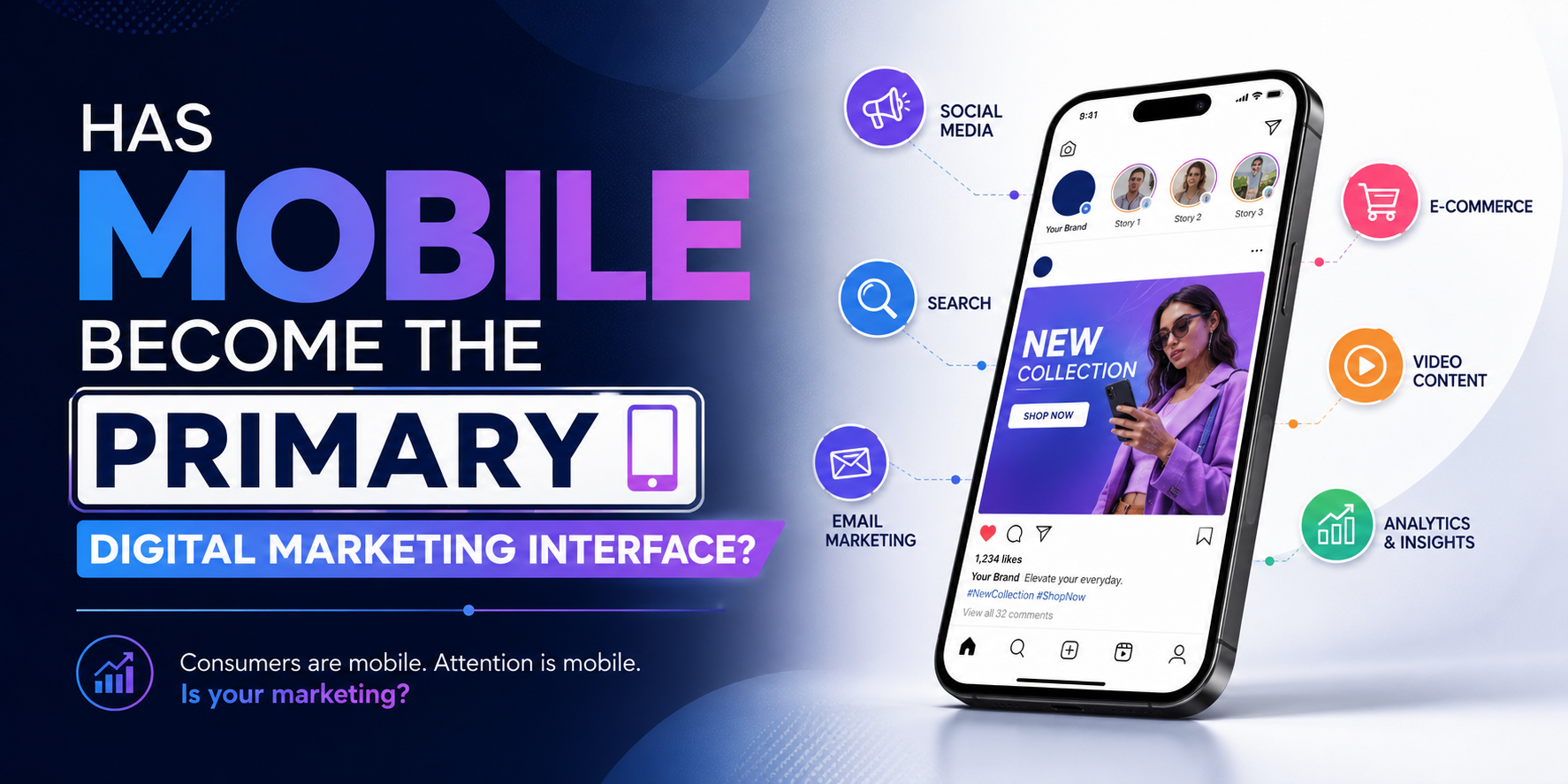
The smartphone in your pocket has quietly become the most powerful marketing channel
in history — and brands that haven't woken up
to that fact are already falling behind.
Introduction
Cast your mind back to the early 2010s, when digital marketing was largely a desktop affair. Brands designed websites for large screens, email campaigns were opened on office computers, and paid ads were sized for browser windows. Then something seismic happened: smartphones moved from luxury gadgets to everyday essentials, and consumers began carrying the internet with them everywhere they went — on the morning commute, at the dinner table, in bed before sleep. Today, that shift has reached a tipping point. Mobile is no longer just a digital marketing channel; for a growing number of brands and markets, it has become the primary one. But is the transition complete, and what does it truly mean for marketers? Let's unpack the numbers, the trends, and the strategic implications.
The Numbers Don't Lie: Mobile Has Taken Over Screen Time
The clearest indicator of mobile's dominance is where people spend their time. Global mobile internet traffic now consistently accounts for more than 60% of all web traffic worldwide, a figure that climbs even higher in mobile-first markets across South Asia, Southeast Asia, and Sub-Saharan Africa. In India, for instance, the average user spends over five hours per day on their smartphone — much of it on social media, video streaming, and messaging apps.
Ad spending has followed attention. Mobile advertising now captures the majority of global digital ad budgets, surpassing desktop as the preferred placement environment for performance marketers. Social platforms like Instagram, Facebook, YouTube, and TikTok — all predominantly consumed on mobile — have become the go-to arenas for brand discovery, influencer marketing, and direct-response campaigns. When you combine paid social, in-app advertising, SMS marketing, and mobile search, the picture becomes undeniable: mobile commands the lion's share of digital marketing investment.
Why Mobile Works So Powerfully as a Marketing Channel
Mobile's rise isn't accidental. The smartphone offers marketers something no previous channel could match: a persistent, personal, location-aware connection to the consumer.
Personalization at scale. Mobile devices are deeply personal — one phone, one user, carrying a rich data trail of habits, preferences, locations, and behaviours. This allows brands to deliver hyper-targeted messages at precisely the right moment. A coffee chain can push a discount notification when a loyal customer walks within 500 metres of a store. A fashion app can retarget a user minutes after they abandon a cart.
Always-on accessibility. The average person checks their phone over 150 times a day. That frequency gives marketers repeated, low-friction touchpoints that no other channel can replicate. Email and desktop browsing require intent; mobile reaches consumers even in passive moments.
The app ecosystem. Branded apps have become marketing platforms in their own right. Loyalty programmes, push notifications, in-app exclusive offers, and gamified experiences keep consumers engaged in a branded environment rather than a general browser. Brands like Starbucks and Amazon have turned their apps into significant revenue engines.
Vertical video and short-form content. Formats born for mobile — Instagram Reels, YouTube Shorts, TikTok videos — have reshaped how creative is produced and consumed. The vertical, full-screen, swipe-driven experience is native to the mobile interface, and brands that master it enjoy outsized engagement compared to those repurposing desktop content.
The Challenges Marketers Still Face
Despite its dominance, mobile is not without friction for marketers.
Privacy and tracking. Apple's App Tracking Transparency (ATT) framework and the broader shift away from third-party cookies have complicated mobile targeting significantly. Marketers can no longer rely on the same cross-app tracking signals that once made mobile advertising so efficient. First-party data strategies — loyalty programmes, account-based experiences, consent-driven engagement — have become critical.
Creative adaptation. Many brands still approach mobile as an afterthought, shrinking desktop assets rather than designing mobile-first. Consumers notice. Cluttered landing pages, slow load times, and ads not optimised for a 6-inch vertical screen drive bounce rates up and conversion rates down. True mobile-first marketing demands a creative overhaul, not a resize.
Attention fragmentation. While mobile offers frequency, it also competes with an avalanche of notifications, apps, and content. Breaking through that noise requires relevance, timing, and creative excellence — not just presence.
Mobile-First vs. Mobile-Only: Getting the Balance Right
It is important to distinguish between mobile being the primary interface and it being the only interface. For most consumer categories — e-commerce, food delivery, travel booking, entertainment, financial services — mobile is where the majority of discovery, research, and purchase decisions happen. But desktop still plays a meaningful role in high-consideration purchases, B2B journeys, and long-form content consumption.
The smart marketer's answer is not to abandon desktop but to architect campaigns with a mobile-first mindset. That means designing landing pages, ad creatives, email templates, and checkout flows for the mobile experience first, then adapting them upward to desktop — rather than the other way around. It means measuring mobile attribution rigorously and understanding the cross-device journey. And it means investing in the channels — search, social, in-app, SMS — where mobile users actually spend their time.
What This Means for Brands in Emerging Markets
For brands operating in markets like India, where mobile penetration outpaced desktop adoption entirely, the conversation is even more clear-cut. Many consumers here experienced the internet for the first time — and continue to experience it exclusively — through a smartphone. WhatsApp marketing, vernacular-language content, UPI-linked mobile commerce, and influencer partnerships on Instagram and YouTube are not supplementary strategies; they are the core of digital marketing. Ignoring mobile in these contexts is not a missed opportunity — it is a fundamental strategic failure.
Conclusion
So has mobile become the primary digital marketing interface? By almost every meaningful measure — traffic share, ad spend, consumer time, and creative innovation — the answer is yes. The smartphone has redefined where brands meet consumers, how stories are told, and what "engagement" actually means. But primacy is not permanence, and dominance is not simplicity. Mobile marketing rewards those who approach it with intention: designing for the screen people actually use, respecting their privacy, earning their attention with relevant and well-crafted content, and building direct relationships that don't depend on third-party data pipes. The brands that treat mobile as a genuine strategic priority — not a checkbox — are the ones writing the next chapter of digital marketing. For everyone else, the gap is only getting wider.
The shift to mobile isn't coming. It's already here. The only question is whether your marketing strategy has caught up.
Ready to Take Your Brand Mobile-First?
Om Enterprises helps businesses navigate the evolving digital landscape with smart, results-driven marketing strategies tailored for today's mobile consumer.
📞 Call us today: 98153 00730 Let's build a mobile marketing strategy that works for your brand.