

Google Discover in 2026: How Indian Websites Can Win Traffic After the Discover Core Update

Open the Google app on most Android phones in India and swipe — that feed of articles you never searched for is Google Discover. For many news sites, blogs and content-heavy businesses, it now sends more visitors than traditional search. And unlike search, nobody types a keyword. Google decides what you might want to read next.
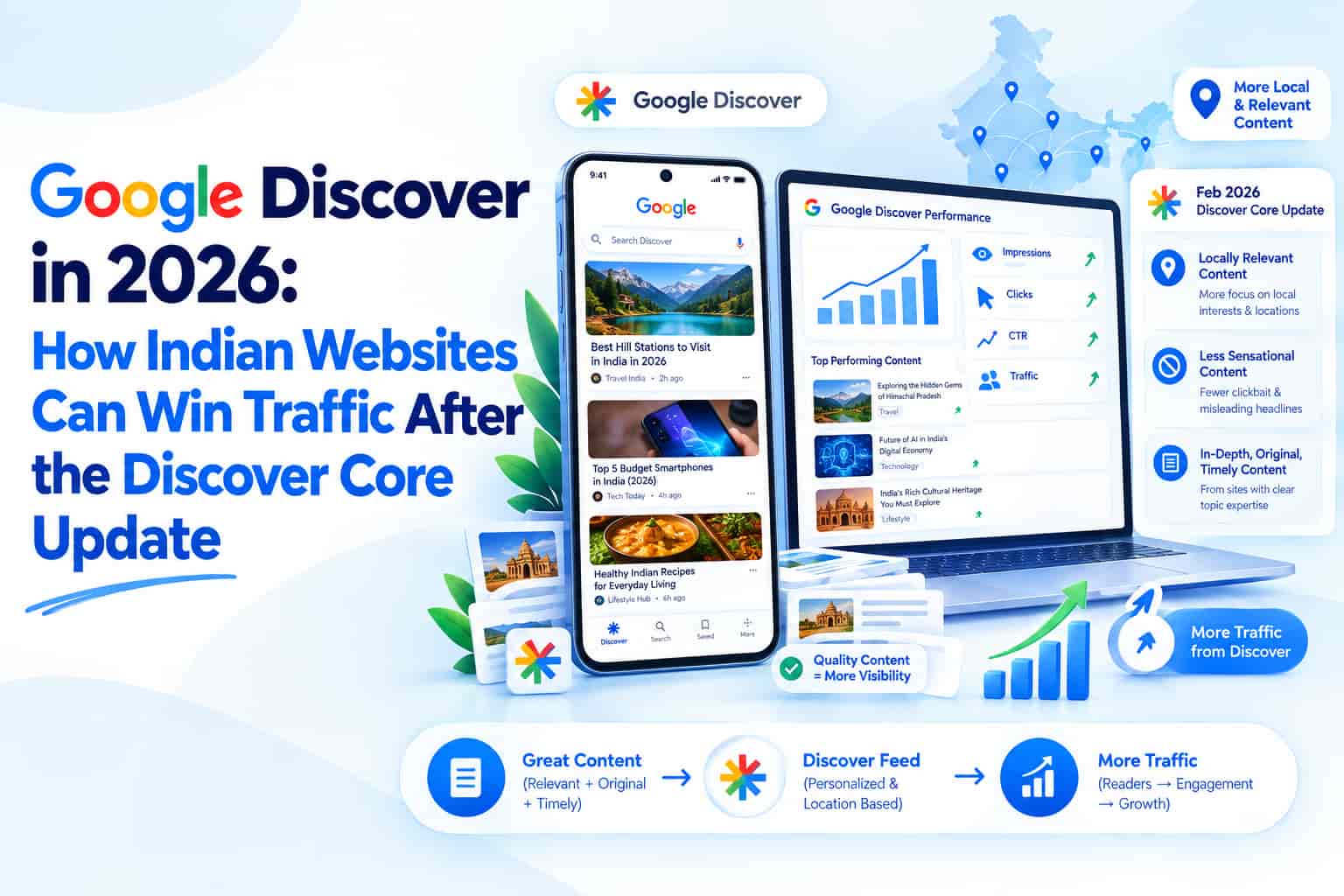
In February 2026, Google released its first-ever Discover-specific core update. It shifted which sites get shown, and the direction of that shift tells Indian businesses a lot about how to earn this traffic.
What changed in the February 2026 Discover update
Google described three goals for the update:
- More locally relevant content from websites based in the user's own country.
- Less sensational content and clickbait.
- More in-depth, original and timely content from sites with demonstrated expertise, assessed topic by topic.
The rollout started with English-language users in the United States, with Google indicating it would expand to other regions over time. Some international publishers that had relied on US Discover traffic saw drops, while the local-first emphasis is expected to benefit publishers in their home markets as it expands.
For Indian websites writing primarily for Indian readers, the local-relevance goal is good news — if the content is genuinely useful.
Why Discover matters for businesses, not just news sites
Discover isn't only for breaking news. It regularly shows:
- How-to guides and explainers
- Product and buying advice
- Industry updates and regulation changes
- Local business, food, travel and lifestyle stories
A business blog that explains, say, a new tax rule for small traders or a new feature in a popular app can reach thousands of relevant readers through Discover without ranking for any specific keyword.
How Discover decides what to show
Discover is driven by a user's interests, built from their search and browsing activity. Google then picks content it believes matches those interests and meets its quality standards. You can't target Discover directly — but you can make your content eligible and appealing.
8 practical ways to earn Discover traffic
1. Pick a lane and stay in it
The update evaluates expertise topic by topic. A site that publishes consistently on digital marketing, or on Punjab real estate, or on personal finance for salaried employees, builds stronger topical signals than one that chases every trend.
2. Write headlines that tell the truth
"You won't BELIEVE what Google just did" is exactly what the update targets. A clear, specific headline — "Google moves Search ads to AI Max: what Indian advertisers should check" — is both Discover-friendly and more trustworthy.
3. Use large, high-quality images
Google's Discover guidance recommends large, compelling images at least 1,200 pixels wide and enabling large image previews (the max-image-preview:large robots setting). Avoid using your logo as the main image.
4. Be first with something original
Timeliness helps, but rewriting other people's news adds little. Add your own angle: what it means for a specific audience, a local example, data from your business, or an expert view.
5. Show who wrote it
Named authors with visible experience, clear publish and update dates, and an "about us" page that explains who you are all support trust.
6. Make pages fast and clean on mobile
Discover is a mobile feed. Intrusive pop-ups, heavy ads and slow loading undermine the experience Google wants to protect.
7. Write for Indian readers specifically
Use local examples, rupee figures, Indian regulations and places. Content that is clearly relevant to readers in India aligns with the update's local-first direction.
8. Publish consistently
Sporadic bursts are less effective than steady publishing in your niche. A dependable rhythm helps Google understand what you cover.
How to measure Discover performance
In Google Search Console, open the Discover report (it appears once your site has a minimum level of Discover impressions). Track clicks, impressions and CTR by page, and compare which topics and headline styles perform best. Remember that Discover traffic is naturally spiky — judge trends over weeks, not days.
What not to do
- Don't publish misleading or exaggerated headlines to chase clicks.
- Don't mass-produce thin AI-written posts on trending topics.
- Don't stray far outside your expertise just because a topic is popular.
- Don't rely on Discover as your only traffic source; it fluctuates.
Frequently asked questions
Can I submit my content to Google Discover?
No. There's no submission process. Indexed content that meets Google's policies is automatically eligible.
Does Discover traffic affect my search rankings?
They're separate surfaces. A Discover core update affects Discover visibility, not your regular search rankings directly.
Why did my Discover traffic suddenly drop?
Discover is volatile by nature. Check whether the drop lines up with a known update, then review headline style, image quality and topical focus.
Do small business websites appear in Discover?
Yes, if they publish timely, useful content in a consistent area of expertise. You don't need to be a news publisher.
Grow traffic beyond search
OM Enterprises builds content strategies that earn visibility across Google Search, Discover, AI-powered results and social platforms — with a focus on genuine expertise and consistent publishing. Talk to our SEO team about your content plan.