

Google Ads vs Meta Ads for Indian E-commerce Brands: Which Delivers Better ROI in 2026

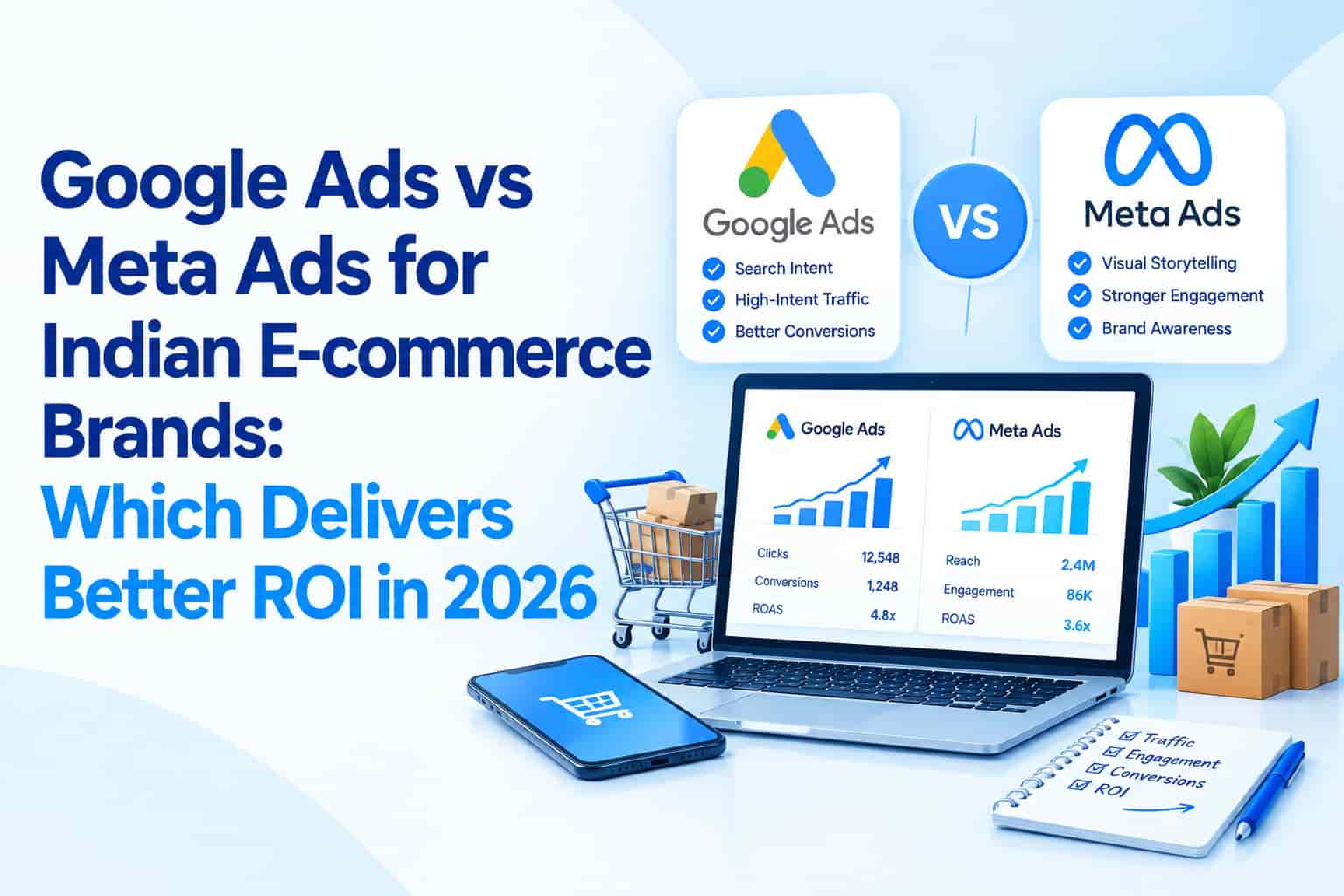
An e-commerce founder with a fixed ₹50,000 monthly ad budget usually asks the wrong first question — "Google or Meta?" — when the honest answer for most D2C brands in India is "both, doing different jobs." The real question is where each rupee works hardest at each stage of the funnel.
What the Cost Data Actually Shows
For Indian e-commerce and retail specifically, published 2026 benchmarks show:
| Platform | Typical Cost Range | What It Buys |
|---|---|---|
| Google Ads (Search) | ₹15–₹50 CPC, ₹200–₹600 CPL | High-intent clicks from people actively searching for the product |
| Meta Ads (D2C Fashion/Lifestyle) | ₹60–₹150 CPM, ₹80–₹250 CPL | Discovery and retargeting reach among people not yet actively searching |
Globally, Google Search converts at roughly 3.75% on average versus about 1.85% for Meta campaigns — which sounds like an easy win for Google, until the funnel stage is factored in. Meta's job for most e-commerce brands isn't to convert cold traffic in one click; it's to build the awareness and retargeting pool that Google Search later captures at a much lower cost per conversion.
Where Each Platform Actually Wins for E-commerce
Google Ads wins for:
- Branded search defense — capturing people already searching for the exact product or brand name
- High-intent category terms ("buy running shoes online India") where the customer has already decided to purchase
- Shopping ads with product images directly in search results, which convert well for well-photographed catalogs
Meta Ads wins for:
- Cold-audience discovery for visually strong products — fashion, home decor, beauty — where scrolling itself can trigger a purchase intent that didn't exist a minute earlier
- Retargeting cart-abandoners and product-page visitors at a lower cost than trying to re-capture them through search
- Building a lookalike audience once a base of paying customers exists
The Combined Approach That Outperforms Either Alone
Cross-platform remarketing — sending Meta-driven traffic that didn't convert into Google's retargeting pool, and vice versa — has been shown to cut cost-per-sale by 35–50% compared to running either platform in isolation. One documented case: an Indian exporter saw revenue-generating inquiries rise 284% after deliberately splitting budget so Meta handled top-of-funnel discovery and shortened the buying cycle, while Google captured the resulting high-intent searches close to purchase.
For a new D2C brand with a limited budget, a practical split looks like: 60–70% of budget on Meta for discovery and retargeting in the first few months while building a customer base, shifting toward 50/50 or higher Google allocation once branded search volume and a retargeting pool exist.
Frequently Asked Questions
Which platform is cheaper for a new e-commerce brand in India?
Google Search CPCs are often lower per click for e-commerce (₹15–₹50), but Meta is usually cheaper for building initial audience awareness before there's branded search demand to capture.
Can a small D2C brand run both platforms at once?
Yes, and it's usually more efficient than choosing one — even a modest budget split between Meta discovery and Google Search capture tends to outperform putting everything into a single platform.
How long before ad spend starts converting efficiently?
Most e-commerce accounts need 2–4 weeks of data (and a working retargeting pixel) before cost-per-acquisition stabilizes enough to judge true performance.
Building a Strategy Instead of Picking a Side
The "Google vs Meta" framing makes for a good headline but a poor strategy — the brands seeing the best returns in India right now are the ones using each platform for the job it's actually good at. OM Enterprises helps Indian e-commerce brands build and manage exactly this kind of combined Google and Meta strategy, from initial campaign structure to the retargeting workflows that connect the two.