

Google Ads AI Max Auto-Upgrade: What Changed in September 2026 and What to Fix Now

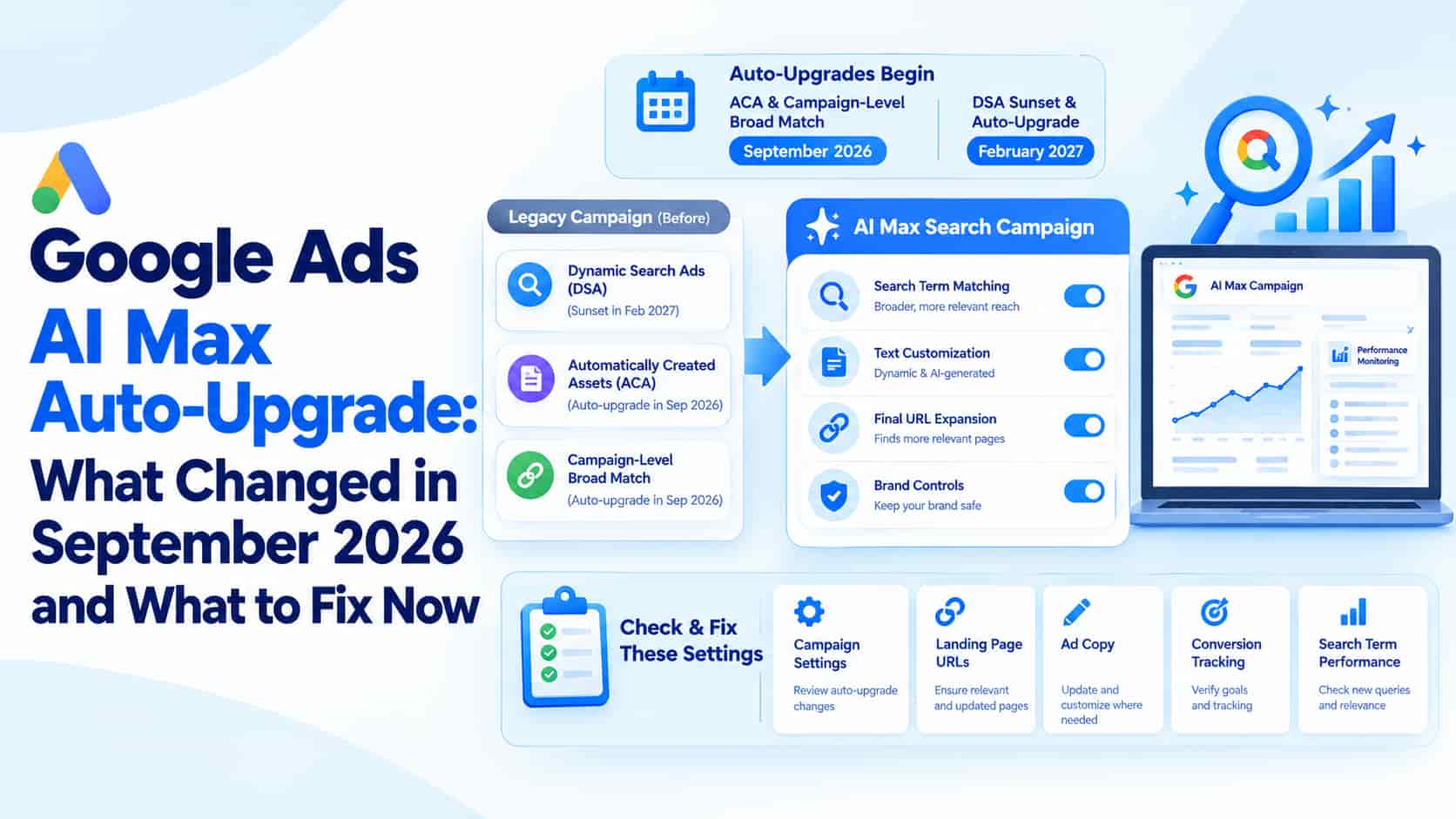
If you logged into Google Ads this month and found new columns in your search terms report, ad copy you never wrote, or traffic landing on pages you never selected, you are not imagining it. Through September 2026, Google automatically moved a large share of Search campaigns onto AI Max for Search. Many advertisers in India only noticed when their cost per lead moved.
This guide explains what actually changed, which campaigns were affected, and the specific settings worth checking before the Navratri–Diwali spending peak.
The short answer: what happened in September 2026
AI Max for Search left beta and became generally available in April 2026. From 1 September 2026, Google began auto-upgrading eligible Search campaigns that used two legacy features:
- Automatically created assets (ACA) – these campaigns were moved to AI Max with both search term matching and text customisation switched on by default.
- Campaign-level broad match setting – these campaigns were moved with search term matching switched on by default.
Dynamic Search Ads (DSA) were originally part of the same plan, but Google postponed the DSA migration. According to Google's own announcement, DSA auto-upgrades now begin in February 2027.
Google also confirmed in September that exact and phrase match keywords in standard Search campaigns can now serve text ads in Google's AI Mode for direct-intent queries — so even advertisers who were not migrated are now appearing in a new surface.
What AI Max actually does to your campaign
AI Max is not a new campaign type. It is a layer of automation added on top of a normal Search campaign. It has three parts:
| Feature | What it does | Risk if left unchecked |
|---|---|---|
| Search term matching | Matches your ads to queries beyond your keyword list, using your landing pages and assets as signals | Spend on loosely related queries |
| Text customisation | Generates headlines and descriptions tailored to each query | Off-brand claims or offers you don't run |
| Final URL expansion | Sends users to whichever page on your site Google thinks fits best | Traffic to blog posts, careers or old offer pages |
Google reports that advertisers using the full suite see around 7% more conversions or conversion value at a similar CPA or ROAS compared with search term matching alone. That is an average — your account can do better or worse depending on how clean your data and website are.
Who is most likely to feel the impact
- Lead-gen businesses with thin websites (coaching institutes, clinics, real estate) — fewer pages means AI Max has less context and may expand into irrelevant queries.
- Regulated categories (finance, health, education) — auto-generated copy can drift into claims your compliance team never approved.
- E-commerce stores with out-of-stock or seasonal pages still live — final URL expansion may send paid clicks there.
- Accounts tracking only clicks or form views — the system optimises toward whatever you call a conversion. Weak signals produce weak expansion.
7 things to check this week
1. Find out which campaigns were migrated
Go campaign by campaign. Migrated campaigns show AI Max settings and the new reporting columns; non-migrated ones won't. Note which had ACA (copy will now be customised) and which had broad match only.
2. Read the new "search terms and ad combinations" view
Google added reporting that shows the search term, the headline served and the landing page together. This is the single most useful report for spotting bad expansion. Review it every few days for the first month.
3. Add negatives and brand exclusions
AI Max respects negative keywords, account-level negatives and brand exclusions. Add "free", "jobs", "salary", "course" (if you don't sell courses), "near me" variations for cities you don't serve, and competitor brands if you don't want to bid on them.
4. Set text guidelines
Use text guidelines to block phrases you can't legally or commercially use — "guaranteed", "lowest price", "100% placement", specific discounts. This is essential for BFSI, healthcare and education advertisers.
5. Exclude URLs from final URL expansion
Exclude blog, careers, policy, login and old campaign pages. If you only want traffic on two or three landing pages, consider turning URL expansion off for that campaign.
6. Fix your conversion tracking before you scale
If your primary conversion is "page view of thank-you page" on a form that also accepts spam, AI Max will happily find more spam. Import offline conversions (qualified leads, closed sales) where you can, and demote micro-conversions to secondary.
7. Compare before and after — fairly
Compare the four weeks after migration with the same weekdays before, and check cost per qualified lead, not just cost per lead. September also had shifts in language targeting settings, so isolate variables where possible.
Should you turn AI Max off?
Not by default. For many advertisers, especially e-commerce stores with clean product pages and solid conversion data, AI Max finds genuine demand that keyword lists miss. The sensible approach is:
- Keep it on where you have strong conversion data and clear landing pages.
- Restrict URL expansion and text customisation in regulated or high-ticket lead-gen campaigns.
- Run a controlled test (one campaign with full suite, one with search term matching only) before festive budgets go up.
How this fits into a wider search strategy
AI Max is another sign that paid search is shifting from "choose the keywords" to "give the system good signals". The same principle applies to organic visibility in AI Overviews and AI Mode: a well-structured website with clear, specific pages helps both your paid and organic performance. Advertisers who invest in landing pages and tracking now will get more out of every automated feature Google releases next.
Frequently asked questions
Were all Google Search campaigns moved to AI Max?
No. Only eligible campaigns using automatically created assets or the campaign-level broad match setting were auto-upgraded in September 2026. Dynamic Search Ads follow from February 2027.
Can I still use exact and phrase match?
Yes. AI Max keeps keyword-level control, and exact and phrase match keywords now also qualify for text ads in AI Mode on direct-intent queries.
Will AI Max increase my cost per click?
It can, because it enters more auctions. Whether cost per conversion improves depends mostly on your negatives, landing pages and conversion data.
Do I need to rebuild my campaigns?
Usually not. Audit settings, negatives, text guidelines and URL exclusions first. Rebuilding is only worth it if the account structure was already messy.
Get your account festive-ready
If your Google Ads performance shifted in September and you're not sure why, OM Enterprises can audit your migrated campaigns, clean up search terms and conversion tracking, and set guardrails before your Navratri and Diwali budgets go live. Talk to our performance marketing team today.