

Generative Engine Optimization vs Traditional SEO: What's Actually Different

A marketing team is told they need a "GEO strategy" separate from their existing SEO strategy, budgets for an entirely new specialized initiative, and later realizes most of what actually needed to change was a handful of specific adjustments to their existing content practice — not a ground-up replacement of their SEO approach. GEO and SEO overlap far more than the newer term's marketing suggests, and understanding exactly where they diverge prevents both wasted budget and missed opportunity.
The Shared Foundation
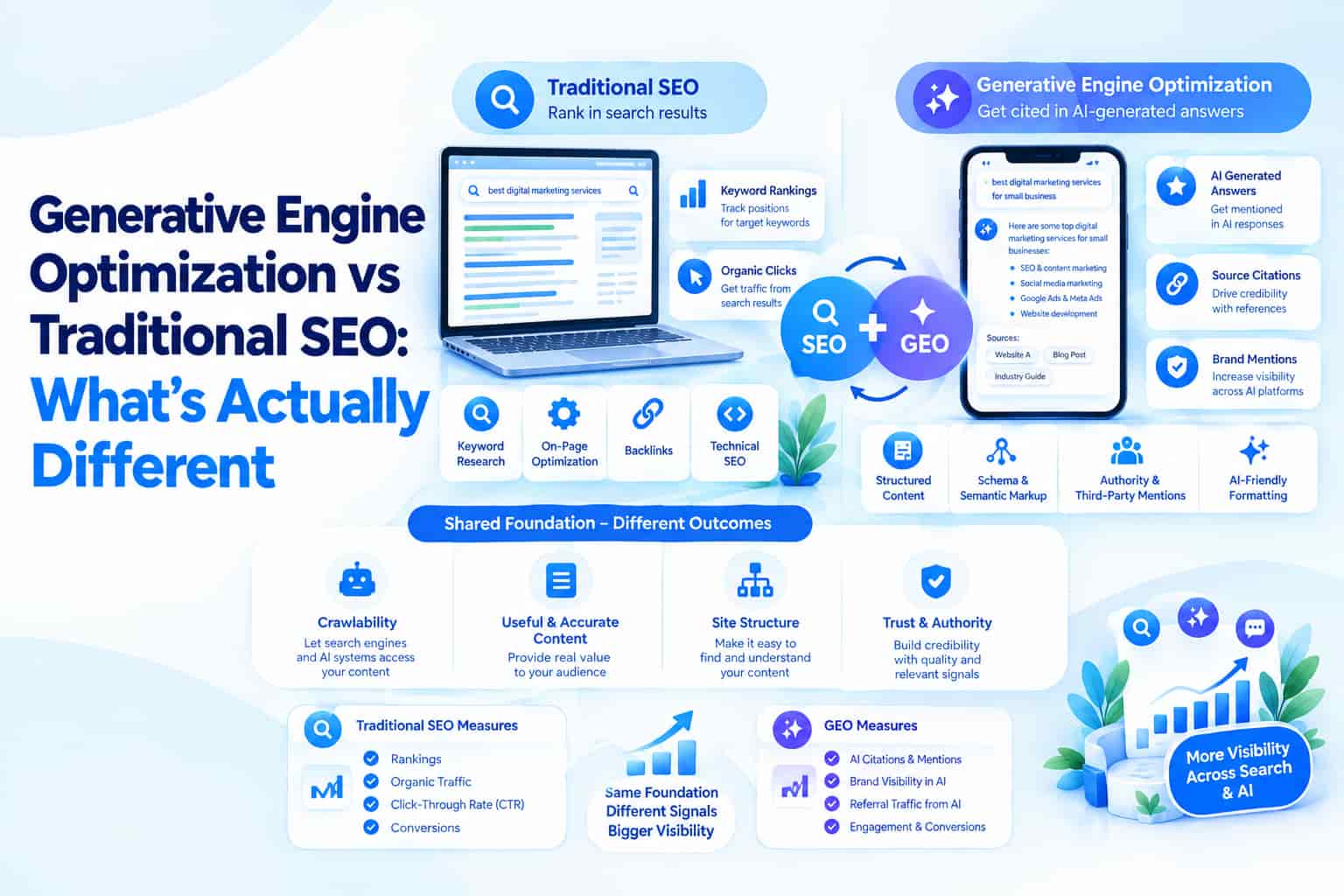
Both traditional SEO and Generative Engine Optimization (GEO) depend on the same underlying requirements: content that's crawlable, technically accessible, genuinely relevant to real search intent, and backed by some signal of authority and trust. A site with poor technical health or thin, low-value content won't perform well under either discipline — there's no GEO shortcut that bypasses these fundamentals.
Where the Two Genuinely Diverge
Traditional SEO optimizes for a ranking position within a list of results a user then chooses from — click-through rate, position, and the searcher's own evaluation of the results all matter. GEO optimizes for being selected and accurately cited within a synthesized answer the AI system generates — the "click" doesn't happen the same way, since the user may get their answer from the citation itself without visiting the source at all. This changes what "success" looks like: a page can be an excellent GEO source (frequently cited, contributing to many AI-generated answers) while seeing fewer direct clicks than its traditional ranking would predict.
Content Structure Differences That Matter in Practice
GEO rewards content that states direct, extractable answers clearly and early, question-phrased headings that match natural query patterns, and specific, original information that gives an AI system a reason to cite this source over a more generic alternative. Traditional SEO cares about these to some degree too, but has historically tolerated more narrative buildup and less directly-stated answers than AI extraction systems handle well.
Measurement Is Genuinely Harder for GEO
Traditional SEO has mature, standardized measurement — rankings, click-through rate, organic traffic, all trackable through established tools. GEO citation tracking is comparatively immature; there's no universal, reliable way to measure how often a business's content is being cited within AI-generated answers across every AI platform, which makes GEO harder to report on with the same confidence as traditional SEO, even when the underlying content work is sound.
A Practical Approach: One Content Strategy, Not Two Competing Ones
Given the shared foundation, most businesses are better served treating GEO as an extension of existing SEO practice — applying the additional structural considerations (direct answers, question-based headings, originality) to content that's already being produced for traditional SEO purposes — rather than building a separate content program. This avoids both duplicated effort and the risk of a GEO-only strategy that neglects the technical and authority fundamentals still doing most of the real work.
Frequently Asked Questions
Does a business need a completely separate GEO strategy from its SEO strategy?
Generally no — GEO shares SEO's foundation and is better treated as an additional set of structural considerations applied to the same content program, rather than a separate initiative.
Can GEO performance be measured as reliably as traditional SEO rankings?
Not yet — citation tracking across AI platforms remains far less mature and standardized than traditional rank tracking, making GEO harder to measure with confidence.
Building Content That Works for Both
Rather than treating GEO as a competing discipline requiring its own budget and strategy, the more practical path is strengthening existing SEO content with the structural traits that also help it perform in AI-generated answers. OM Enterprises builds content for Indian businesses that's grounded in solid SEO fundamentals and structured to perform well in AI search as an extension of that same work.