

Front-End, Back-End & Full-Stack Development Explained

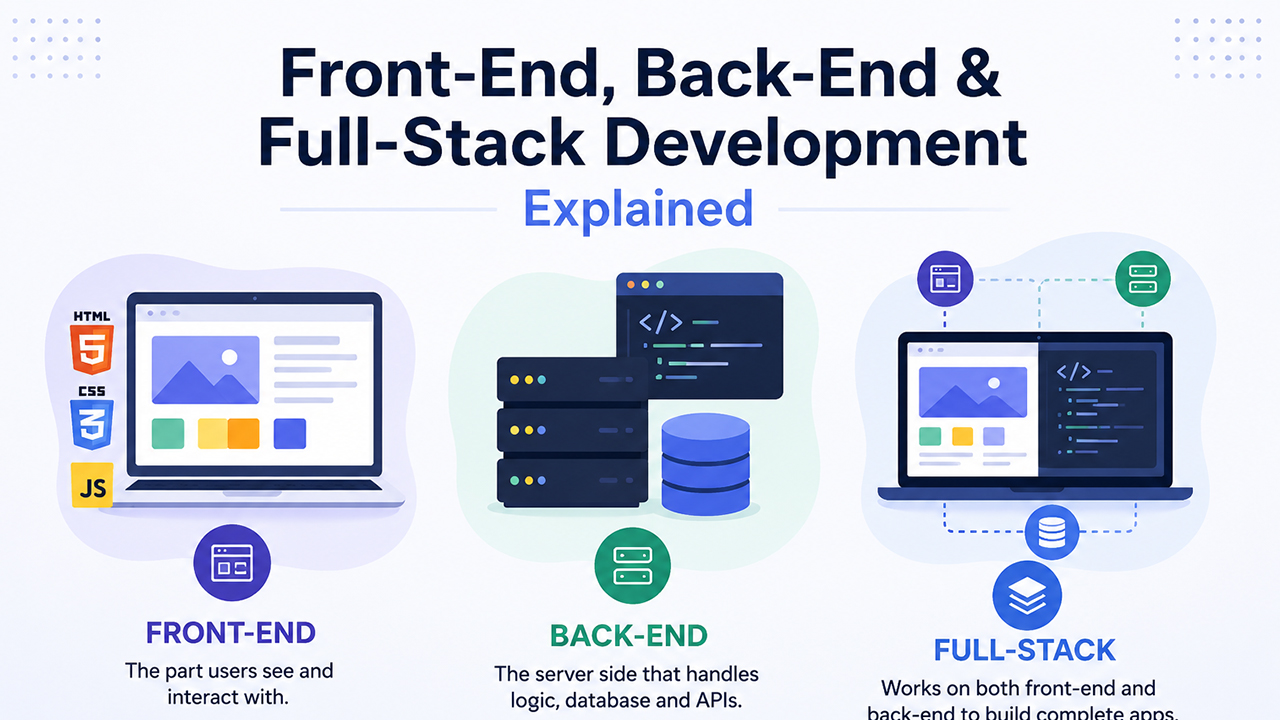
The web development industry is vast, dynamic, and full of opportunity — but it can also be confusing for newcomers trying to figure out where they fit. Terms like "front-end," "back-end," and "full-stack" get thrown around constantly in job listings and tech conversations. What do they actually mean? Which path suits your skills and career goals? This guide breaks it all down clearly.
Front-End
What users see and interact with — interfaces, animations, and user experience.
Back-End
The engine behind the scenes — databases, APIs, servers, and business logic.
Full-Stack
The complete picture — fluency across both front-end and back-end layers.
What is Front-End Development?
Front-end development — sometimes called "client-side" development — is the craft of building everything a user directly experiences on a website or web application. When you click a button, watch a menu animate open, or swipe through a carousel on your phone, you're interacting with front-end work.
Front-end developers use three foundational technologies: HTML for structure, CSS for styling, and JavaScript for interactivity. Modern front-end work typically involves frameworks like React, Vue, or Angular that make it easier to build complex, dynamic user interfaces. Responsiveness, accessibility, and performance are constant concerns — a site must look great on a 4K monitor and a small phone screen alike.
The objective of a front-end developer is clear: create an experience that feels intuitive, fast, and visually polished. Their biggest challenges include cross-browser compatibility, keeping up with rapidly evolving JavaScript tooling, and translating designer mockups into pixel-perfect code.
What is Back-End Development?
If front-end is the stage, back-end is everything backstage that makes the show possible. Back-end development — also called "server-side" development — deals with the systems, databases, and logic that power an application from behind the scenes. When you log in to a website, it's the back end that verifies your password. When you place an order, the back end processes the transaction and updates the database.
Back-end developers work with languages like Python, Node.js, Ruby, Java, PHP, or Go. They design and manage databases (both SQL and NoSQL), build REST or GraphQL APIs, handle authentication, and ensure that data flows securely and efficiently between the server and the client.
Key challenges in back-end work include scaling systems to handle millions of users, securing sensitive data, maintaining API contracts, and optimising database queries for speed. It's a discipline that rewards systematic thinking and a love of problem-solving beneath the surface.
What is Full-Stack Development?
Full-stack developers work across the entire spectrum — they can write a React component in the morning and design a database schema in the afternoon. The term "full-stack" reflects fluency with both ends of web development, along with an understanding of how they connect.
Full-stack developers are especially valued at startups and smaller teams, where one person often needs to wear many hats. They don't necessarily need to be experts at every layer, but they must be competent enough to move fluidly between front-end and back-end tasks. Popular full-stack combinations include the MERN stack (MongoDB, Express, React, Node.js) and LAMP stack (Linux, Apache, MySQL, PHP).
Key differences at a glance
Dimension | Front-End | Back-End | Full-Stack |
|---|---|---|---|
Focus | UI & user experience | Server & data logic | Both layers |
Tools | React, CSS, HTML, JS | Node.js, Python, SQL | Full toolchain |
Objective | Looks & feels great | Works reliably & securely | Ships end-to-end |
Main challenge | Browser & device parity | Scale & security | Depth vs. breadth |
Skills required
Front-End
HTML, CSS, JavaScript
React / Vue / Angular
Responsive design
Web accessibility (WCAG)
Version control (Git)
Browser dev tools
Back-End
Python / Node / Go / Java
REST & GraphQL APIs
SQL & NoSQL databases
Authentication & security
Cloud (AWS / GCP / Azure)
Linux & Docker
Full-Stack
All of the above
System architecture
DevOps fundamentals
Product thinking
Cross-team communication
Salaries and job outlook
Web development remains one of the most in-demand fields in tech globally. While salaries vary by country, company size, and experience, here's a rough picture of average annual pay in the US market:
Front-End
~$90,000 – $120,000
Back-End
~$100,000 – $140,000
Full-Stack
~$110,000 – $160,000
The US Bureau of Labor Statistics projects web developer employment to grow around 16% through 2032 — significantly faster than average. Demand is especially strong in fintech, e-commerce, SaaS, and health tech sectors.
Which path should you choose?
Your choice should align with your interests, not just your salary expectations. If you're drawn to visual design, colour, typography, and how things feel when you use them — front-end development will feel natural and rewarding. If you prefer working with systems, data structures, algorithms, and the logic behind how things work — back-end development offers deep intellectual challenge.
If you're indecisive, starting with front-end is often the gentler on-ramp. The feedback loop is faster — you see results in the browser immediately. Many developers naturally expand into full-stack territory over time as their curiosity pushes them further into the stack.
Pro tip: Don't let "full-stack" intimidate you. Most senior developers naturally arrive there after years of specialising in one area and gradually exploring the other. Start focused. Broaden later.
Conclusion
Front-end, back-end, and full-stack development are not competing disciplines — they're complementary layers of the same craft. Front-end developers bring ideas to life visually. Back-end developers build the reliable, secure systems that power those experiences. Full-stack developers bridge both worlds, enabling faster iteration and broader ownership of a product.
Whatever path you choose, the most important thing is to start building. Technology changes fast, but the core problem-solving mindset that makes a great developer transcends any particular framework or language. Pick your direction, commit to the fundamentals, and the rest will follow