

Failure To Launch: Why 60%–90% Of Business Strategies Fail Before They Start

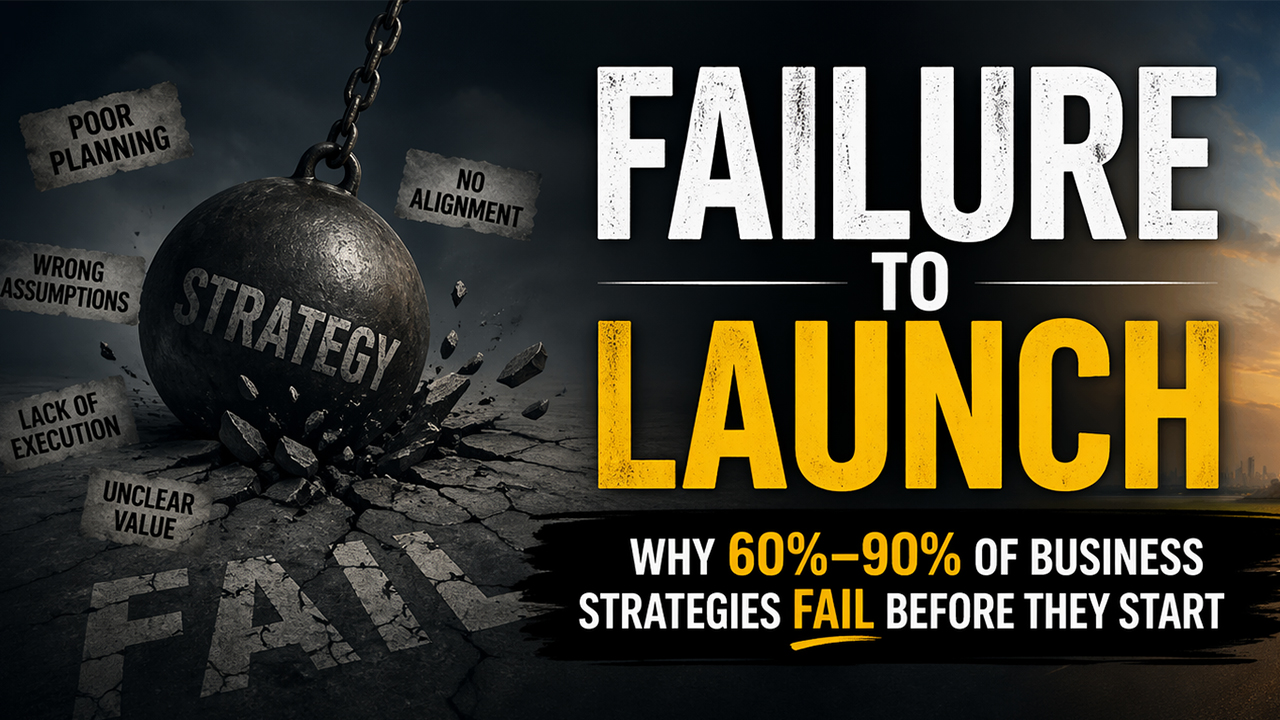
Every year, boardrooms around the world fill up with ambitious plans, bold visions, and polished strategy decks. Leaders gather, ideas spark, energy builds — and then, almost silently, the momentum dies. Studies consistently show that between 60% and 90% of business strategies never get properly executed. That is not a statistic about bad ideas. It is a statistic about broken follow-through.
The hard truth is this: most organizations are surprisingly good at crafting strategy and devastatingly poor at sticking to it. The failure rarely happens in the planning room. It happens in the weeks and months after, when the real world collides with the written plan — and the plan loses.
So what goes wrong? And more importantly, how do you make sure your strategy is part of the minority that actually succeeds?
— ✦ —
67%of strategies fail due to poor execution, not poor planning
95%of employees don't understand their company's strategy
3×more likely to succeed when strategy is clearly communicated
The Illusion of a Good Plan
Here is a dangerous trap that many leaders fall into: confusing the creation of a strategy with the execution of one. A well-written strategic document — complete with SWOT analyses, KPIs, and quarterly targets — can create the psychological feeling of progress without producing any actual movement. This is sometimes called "planning theater."
When a strategy looks thorough on paper, it is easy to believe the hard work is done. In reality, the hard work has barely begun. A plan without an execution engine is just a document. And documents, no matter how beautifully formatted, do not move markets.
A vision without a plan is just a dream. A plan without action is just a wish. Execution is where strategy comes alive — or quietly dies.
The Five Reasons Strategies Collapse Before They Start
1. Lack of clarity at every level. Senior leaders understand the strategy, but the people responsible for implementing it — middle managers, team leads, frontline workers — are left with vague directives and no clear connection between their daily tasks and the bigger picture. When people do not know how their work maps to the plan, they default to what feels urgent rather than what is strategically important.
2. No accountability structure. A strategy that belongs to everyone, in practice, belongs to no one. Without clear ownership — specific names attached to specific outcomes — execution dissolves into good intentions. Teams assume someone else is handling the critical pieces, and the gaps multiply quietly until they become chasms.
3. The strategy is treated as an annual event. Far too many organizations treat strategy as something you do once a year in a two-day offsite. The plan gets unveiled, applauded, and filed — and then the daily grind takes over. Strategy must be a living, breathing rhythm built into weekly meetings, monthly reviews, and quarterly pivots. It cannot be an annual ceremony.
4. Resource misalignment. Organizations frequently announce a bold strategic priority and then fail to reallocate time, money, and people to support it. You cannot pursue a new direction while keeping all your resources locked in the old one. If the budget does not reflect the strategy, the strategy does not reflect reality.
5. Fear of adaptation. The business environment does not pause to respect your planning calendar. Markets shift. Competitors move. Consumer behavior evolves. Leaders who treat their strategy as a sacred, unchangeable document — unable to adapt when circumstances change — are not demonstrating discipline. They are demonstrating rigidity. There is a critical difference between sticking to your direction and stubbornly clinging to a plan that the world has already moved past.
— ✦ —
Stick To The Plan — But Know What "The Plan" Really Means
When we say "stick to the plan," we do not mean blind, inflexible adherence to every detail written six months ago. What we mean is something far more powerful: unwavering commitment to your strategic intent. The destination matters more than the exact route. Disciplined organizations know the difference between changing direction entirely — which signals weakness and confusion — and adjusting their approach while keeping the goal locked in view.
Amazon did not abandon its customer-obsession strategy when logistics became complicated. Apple did not abandon its design-first philosophy when competitors flooded the market. These organizations adapted their tactics constantly while their strategic core remained non-negotiable. That is the model worth following.
Sticking to the plan means building strategy into your operating rhythm — weekly check-ins, visual dashboards, honest conversations about what is working and what is not. It means leaders who actively champion the strategy in every room, not just the boardroom. And it means building a culture where execution is as valued as ideation.
The Execution Habits of Strategies That Survive
Organizations that successfully execute their strategies share recognizable habits. They translate strategy into specific, measurable quarterly priorities. They create accountability by assigning clear ownership. They communicate the strategy relentlessly — through all-hands meetings, team briefings, and one-on-ones — until every employee can articulate how their work connects to the larger mission. And critically, they build in regular review cycles that allow for honest course correction without abandoning strategic direction.
These are not complicated practices. They are consistent ones. And consistency, it turns out, is the real competitive advantage most organizations are missing.
Conclusion
The graveyard of business strategy is not filled with bad ideas. It is filled with good ideas that were never properly followed through. The gap between strategy and results is an execution gap — and it is one of the most costly, most preventable problems in business today.
If your organization is part of the staggering majority whose strategies underperform or never launch, the solution rarely lies in crafting a better plan. It lies in building the discipline, the accountability, and the culture to execute the one you already have.
Plan boldly. Communicate clearly. Execute relentlessly. And above all — stick to the plan.