

Demand Generation vs. Lead Generation: What’s the Difference?

Introduction
Ask ten marketers what "demand generation" means, and you'll get ten different answers. Ask about "lead generation," and most will describe the same thing — a form, a download, a name in your CRM. The confusion between the two is real, and it costs companies growth every year.
The truth is that demand generation and lead generation are not competing strategies. They're sequential, complementary forces. One builds the conditions for the other. Understanding where each one begins and ends is the key to designing a marketing engine that actually closes deals — not just fills spreadsheets.
What you'll learn
The precise definitions of demand gen and lead gen — and why most people confuse them
The unique goals each one serves in the buyer journey
How the two work together in a full-funnel strategy
Actionable tactics for each, and when to use them
How AI is reshaping both disciplines in 2026
Demand Generation vs. Lead Generation: What Are They?
Before diving into goals and tactics, it's worth getting precise. These terms are thrown around interchangeably, but they describe different phases of the revenue journey.
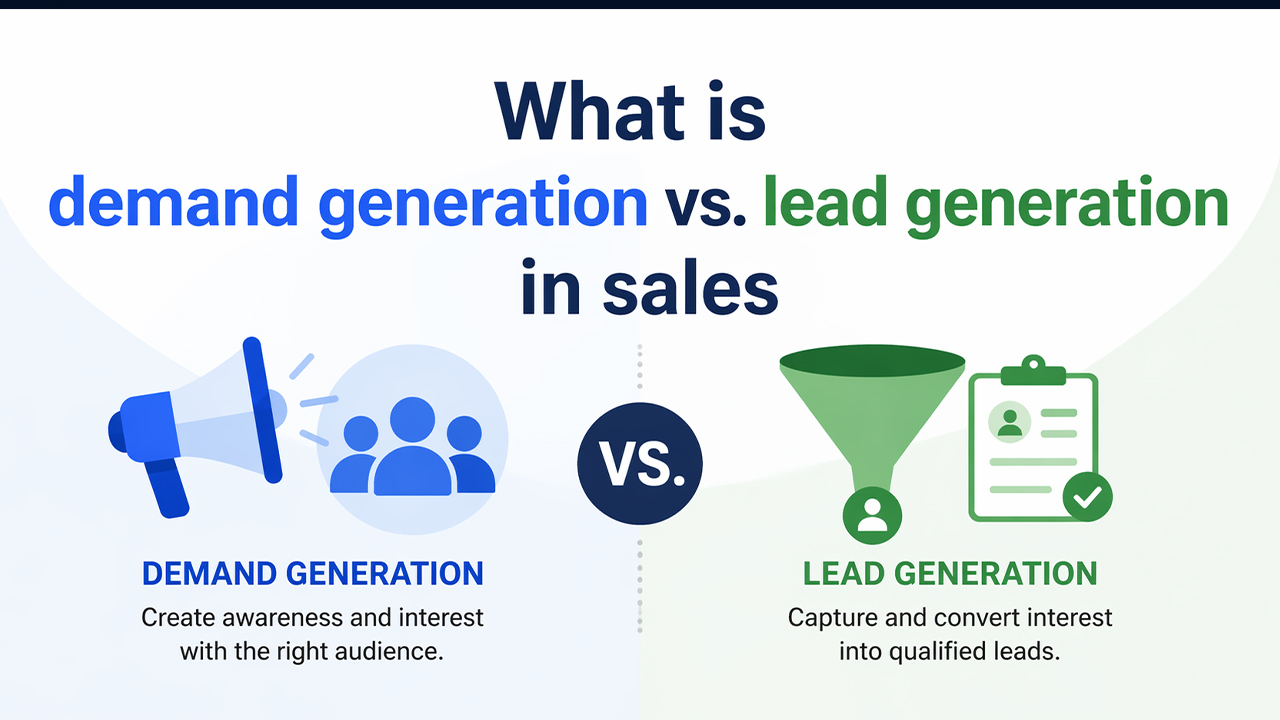
Demand Generation
Create the appetite
Builds awareness and desire for your category or solution — often before a buyer even knows they have a problem.
Lead Generation
Capture the interest
Converts existing interest into identifiable prospects by collecting contact information and qualifying intent.
Demand Generation
Demand generation is the broad, top-of-funnel work of making people care. It includes content marketing, thought leadership, social media, webinars, podcasts, brand advertising, and community building. The output isn't a lead — it's awareness, affinity, and category education. A prospect who has consumed your demand gen content arrives at the lead gen stage already warmed up, already trusting you, already looking for a solution like yours.
Lead Generation
Lead generation is transactional by nature. It asks the prospect to exchange something — an email address, a phone number, a few minutes of their time — in return for something valuable. Gated white papers, demo requests, free trial sign-ups, and contact forms are all lead gen instruments. The goal is identification: turning an anonymous visitor into a named, reachable prospect.
A useful mental model: demand generation is a broadcast; lead generation is a handshake. You need the broadcast to reach enough people before the handshake means anything.
What Are the Goals of Demand Generation?
Demand generation operates on a longer time horizon than most marketing metrics reward. Its goals include:
Category creation and education — helping your target market understand the problem you solve
Brand awareness at scale — ensuring your name surfaces when buyers begin researching
Trust and authority building — positioning your team as the go-to experts in a domain
Pipeline influence — shaping the preferences of buyers long before they raise their hands
Demand gen metrics tend to be softer: share of voice, organic traffic growth, content engagement, brand search volume, and influenced pipeline. These are harder to tie to a quarterly number, which is why demand gen often gets underfunded in favor of tactics that produce immediate, attributable leads.
What Are the Goals of Lead Generation?
Lead generation has clearer, shorter-cycle goals:
Volume — generating enough top-of-funnel contacts to feed the sales pipeline
Quality — ensuring leads match your ideal customer profile (ICP)
Velocity — moving leads quickly from first contact to sales-qualified status
Cost efficiency — keeping cost-per-lead (CPL) within acceptable bounds for unit economics
Lead gen metrics are concrete: MQLs, SQLs, CPL, conversion rates, and demo-to-close ratios. This makes them easier to defend in budget conversations — and easier to over-optimize at the expense of long-term brand health.
How Demand Generation and Lead Generation Work Together
The two disciplines live on a continuum. Demand gen warms the market; lead gen harvests that warmth. A company that runs only lead gen will find that its cost-per-lead keeps rising as it exhausts audiences who already know the brand. A company that runs only demand gen will generate buzz but struggle to convert it into revenue.
The most effective marketing orgs treat demand gen as infrastructure and lead gen as the collection mechanism sitting on top of it. When a buyer who has read six of your blog posts and attended two webinars finally fills out a contact form, that lead is exponentially more likely to close — and to close faster — than a cold lead acquired through paid ads alone.
When (and how) to focus on demand generation
Lean into demand gen when you're entering a new market, launching a new category, or facing a long sales cycle (typically 60+ days). Invest in owned media channels — a strong editorial blog, a podcast, an active LinkedIn presence — that compound over time. Prioritize ungated content so ideas spread freely. The goal is to be already trusted when the buying committee finally forms.
Early-stage: heavy demand genGrowth-stage: balance bothMature market: optimize lead gen
Tactics for Lead Generation
Once demand is in the market, these tactics convert it into pipeline:
Gated content — research reports, templates, and playbooks that justify a form fill
Free trials and freemium tiers — product-led capture that lets the product sell itself
Demo and consultation requests — high-intent CTAs for buyers further along in evaluation
Paid search and retargeting — capturing in-market intent from buyers already researching
Webinars and live events — structured exchanges that combine demand and lead gen in one format
Email nurture sequences — systematic follow-up that keeps leads warm until they're sales-ready
Trending Insights in Modern Marketing
How generative AI helps marketers connect with customers
In 2026, generative AI has fundamentally changed both sides of this equation. On the demand gen side, AI enables content teams to produce high-quality, deeply personalized educational material at scale — tailoring blog posts, video scripts, and thought leadership to specific industries, personas, or pain points without a proportional increase in headcount.
On the lead gen side, AI-powered scoring models now analyze behavioral signals — page visits, content consumption patterns, email engagement — to surface leads who are genuinely in-market, reducing the noise that sales teams historically had to wade through. The result is a tighter handoff between marketing and sales, and a meaningfully better buyer experience.
The companies winning today are those using AI not to replace strategy, but to execute it faster and at greater depth — letting human marketers focus on the judgment calls that still require context and creativity.
Conclusion
Find the Right Balance and Close More Deals
Demand generation and lead generation are not rivals. They're partners in a well-sequenced revenue motion. Demand gen earns the right to be heard; lead gen converts that permission into pipeline. The marketers who understand this — and who build budgets and metrics to honor both — consistently outperform those who chase leads without ever building demand.
Start by auditing which side of this equation your organization underinvests in. If your CPL is rising and lead quality is falling, the answer is usually more upstream investment in brand and education. If you have plenty of awareness but a weak conversion path, sharpen your lead gen infrastructure. Most likely, you need both — calibrated to your market maturity and sales cycle.
The goal was never more leads. The goal was more closed deals. Getting there means thinking upstream.