

CPaaS in India: What It Is and How to Compare Providers Before You Choose

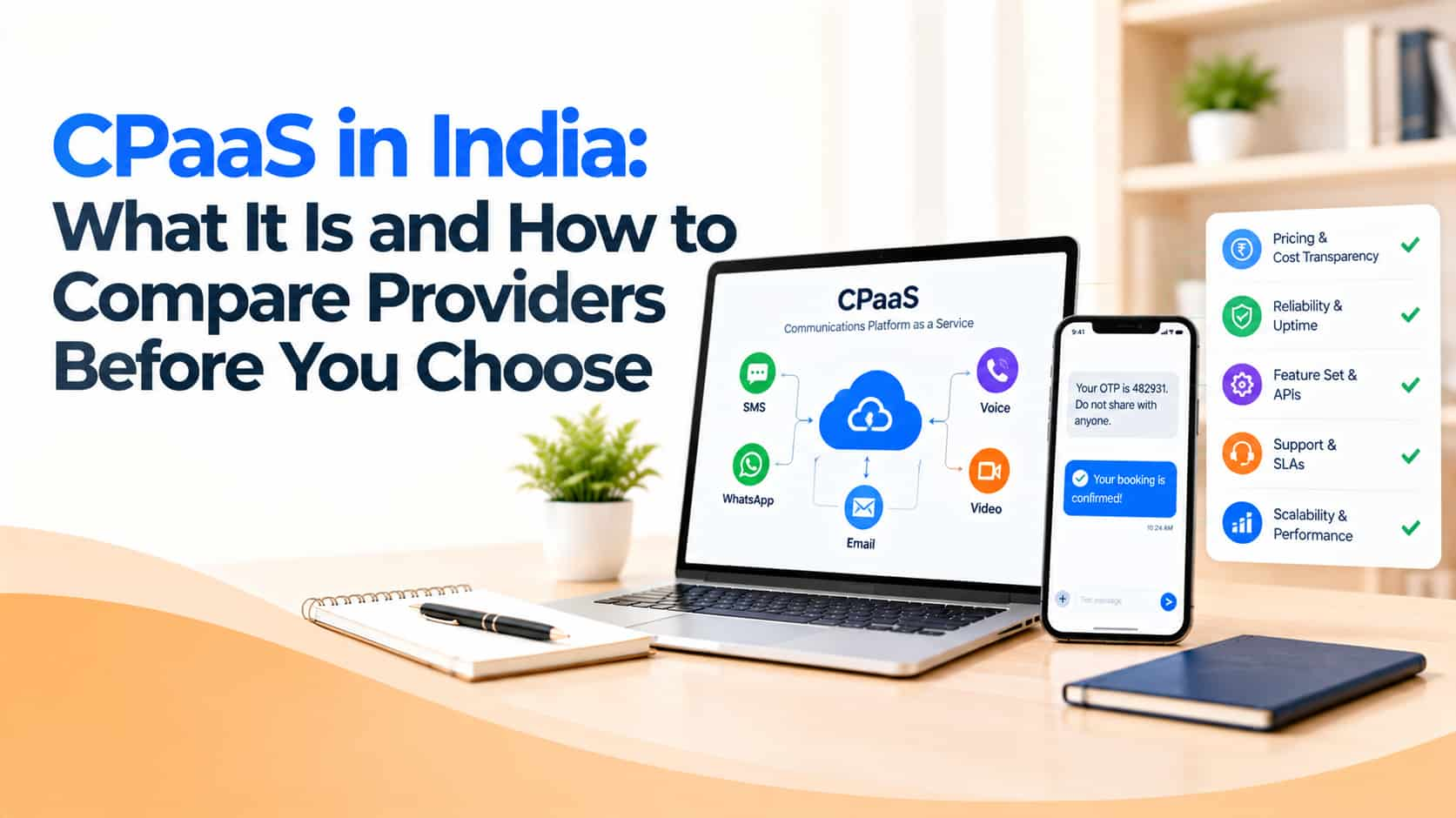
Behind every OTP you receive, every delivery update from a food app and every WhatsApp reminder from a bank, there is usually a technology layer most customers never hear about. Businesses do not build telecom networks to send those messages. They plug into a platform that does the heavy lifting through simple software interfaces. That layer is called CPaaS, and if you are searching for CPaaS companies in India, it helps to understand what you are actually buying.
What CPaaS means
CPaaS stands for Communications Platform as a Service. It is a cloud-based service that lets businesses add communication features to their own applications and workflows using APIs, software development kits and ready-made tools. Instead of negotiating separately with telecom operators and messaging platforms, a business connects to a single provider that offers channels such as SMS, voice calls, WhatsApp Business messaging, RCS, email and sometimes video.
In simple terms, a CPaaS provider gives you building blocks. Your developers or marketing team use those blocks to trigger messages and calls automatically when something happens: a customer signs up, an order ships, a payment fails or an appointment is near.
What CPaaS can do for a business
Transactional messages. OTPs, payment alerts, booking confirmations and shipping updates are sent in seconds through APIs.
Marketing campaigns. Teams send offers and reminders through SMS, WhatsApp or RCS using templates, audience lists and scheduling tools.
Voice services. Cloud IVR, click-to-call, masked calling and voice broadcasts connect customers and teams without private telephone exchanges.
Conversational support. Shared inboxes and chatbots handle customer queries on WhatsApp and other channels.
Omnichannel journeys. A message can start on one channel and automatically fall back to another if it is not delivered or read.
Analytics. Dashboards show delivery rates, read rates, replies and conversions in one place.
Who uses CPaaS
Banks and fintech firms use it for authentication and alerts. E-commerce brands use it for order journeys and cart recovery. Education companies send admission and fee reminders. Healthcare providers manage appointments. Logistics companies send tracking updates. Even small businesses use simplified CPaaS tools through dashboards without writing code.
Key factors when comparing providers
Channel coverage. Check which channels are supported: SMS, voice, WhatsApp Business API, RCS, email and others, and whether they work in one unified platform or as separate products.
Regulatory compliance. Indian communication rules require DLT registration for SMS, template approval and consent management. A strong provider supports onboarding, template submission and compliance guidance.
Direct connectivity and delivery quality. Ask about operator routes, delivery rates, average delivery time for OTPs and how failures are monitored. Request sample reports rather than relying on marketing claims.
Reliability and uptime. Communications are often mission-critical. Look for redundancy, status pages, support for retries and clear service commitments.
API quality and documentation. Developers need clear documentation, sandbox testing, webhooks for delivery events and libraries for common programming languages. Test the integration experience with a trial.
No-code tools. Marketing and support teams benefit from dashboards for campaigns, templates, contact management, flows and chat inboxes.
Security and data protection. Ask where data is stored, how long logs are kept, which certifications the provider holds and how they support India's data protection framework.
Support. Check response times, support channels, availability during festive periods and whether you get a named account manager.
Pricing. Models vary: per message, per minute, per conversation, per agent, monthly platform fees and setup fees. Compare total cost for your expected volume, including fallback messages and taxes.
Scalability. Confirm the platform can handle peak loads, such as sale days or exam result days, without delays.
Questions to ask during evaluation
How long does DLT and WhatsApp onboarding take? Which operators are connected directly? What is the typical delivery time for OTPs? How are failed messages handled? Can I see reports by campaign, channel and template? Is there a sandbox? What happens if a channel fails? Can you provide references from companies in my industry? Which parts of the service are provided in-house and which through partners?
Run a pilot
Before signing a large contract, run a small pilot using real use cases. Send test OTPs and campaign messages across major operators, compare delivery speed and reports, test support responsiveness and integrate with one workflow in your systems. Pilots expose problems that brochures do not.
Avoid common mistakes
Do not choose only on the lowest per-message price, because poor delivery costs more through lost customers. Do not ignore compliance support. Avoid locking into long contracts without performance guarantees, and do not assume all channels are equally mature on every platform.
Frequently asked questions
Do small businesses need CPaaS?
Many use it indirectly through simple dashboards for bulk messaging, chat and calling without custom coding.
Is CPaaS the same as a bulk SMS provider?
A bulk SMS provider is one type of service. CPaaS usually covers more channels and API-driven workflows.
Can I switch providers later?
Yes, but plan for template re-approval, number migration and integration changes.
Build your communication stack
OM Enterprises offers SMS, WhatsApp, RCS and voice solutions with compliance support and APIs. Talk to our communications team.