

Conversational Commerce with RCS: How AI Chatbots Are Changing Customer Journeys

What Conversational Commerce Really Means
For years, the customer journey followed a predictable, disjointed path: see an ad, open a browser or app, search for the product, dig through menus, and eventually check out on a separate payment page. Conversational commerce collapses that entire path into a single conversation. Instead of being pushed out of the chat window to "visit our website," the customer discovers a product, asks a question, compares options, and moves toward a purchase decision without ever leaving the messaging app they already trust.
This shift matters enormously for Indian businesses, where chat apps are often the primary digital touchpoint for a customer, more so than a mobile website. The question is no longer whether brands should talk to customers inside chat, but which messaging channel can support a genuinely useful, structured, two-way conversation rather than a plain text thread. This is exactly where RCS (Rich Communication Services) has started to stand out.
Why RCS Is a Natural Fit for Conversational Commerce
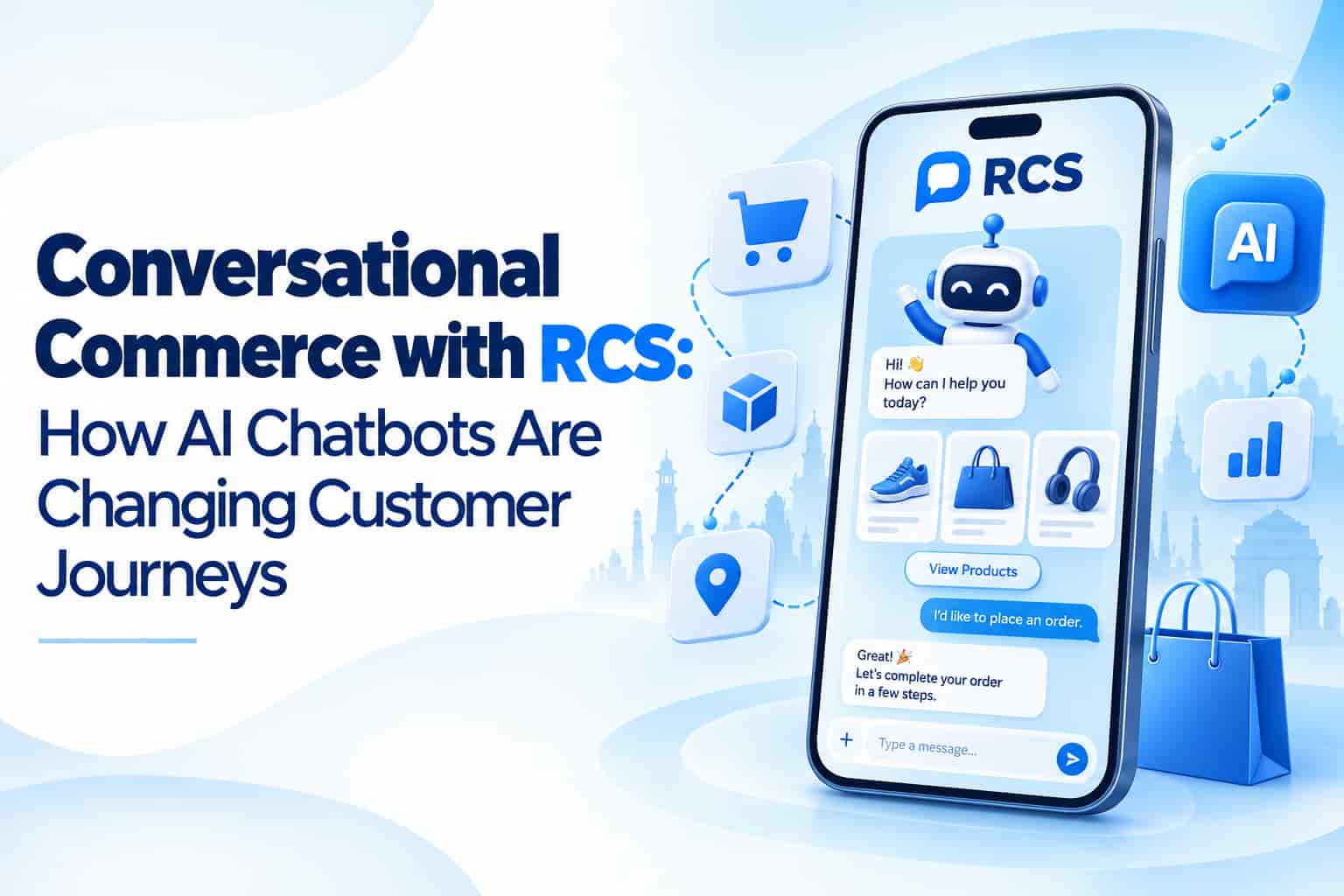
RCS was built as an evolution of SMS, but functionally it behaves closer to an app experience delivered inside the native messaging inbox. It supports rich cards with images, carousels of multiple products, suggested-reply chips, and quick-action buttons, all without requiring the customer to install anything. That structure is what makes AI-driven conversations usable at scale.
A plain text chatbot has to describe everything in words, which quickly becomes clunky when a customer is comparing three product variants or choosing a delivery slot. An RCS AI chatbot in India can instead show a horizontal carousel of options, let the customer tap a suggested reply instead of typing, and keep the conversation moving with minimal friction. The rich formatting does the visual work; the AI layer does the understanding and decision-support work. Together, they turn a chat thread into something closer to a lightweight, guided storefront.
How AI Chatbots Work Inside RCS
At a practical level, an AI-enabled RCS conversation typically combines three layers working together.
Natural Language Understanding
The chatbot interprets what the customer typed in their own words, whether that is "do you have this in blue" or "where is my order," and maps it to an intent the brand has defined, such as product search, order status, or a billing query.
Structured Rich Responses
Once intent is understood, the reply is not just a sentence. It can be a product carousel, an order-status card with tracking details, an FAQ-style set of suggested replies, or a simple confirmation card, all rendered natively inside the chat.
Guided, Branching Conversation Flow
Suggested replies keep the customer on a guided path, reducing typing effort and reducing the chance of the conversation going off track. A customer can move from "browsing shoes" to "selected size and colour" to "share delivery address" through a series of taps rather than open-ended typing, with the AI filling in the natural-language gaps whenever a free-text question comes in.
This blend of structure and flexibility is what separates a genuinely useful conversational commerce experience from a rigid, menu-only bot or an unstructured chat that constantly asks the customer to repeat themselves.
Use Cases Across Sectors
Retail and D2C: Guided Product Discovery
A customer messages asking for a gift under a certain budget, and the chatbot responds with a curated carousel of matching products, lets the customer refine by size or colour through suggested replies, and hands off to a human agent only if the request gets specific enough to need one. This is a natural extension of what many teams already run through their RCS Messaging platform for promotional broadcasts, now made two-way and responsive.
Banking and Financial Services: Balance and Support Queries
Routine queries, such as checking an account balance, the status of a card application, or the last few transactions, can be handled conversationally within a verified bank sender profile, reducing call-centre load while giving customers an instant, self-serve answer inside a channel that clearly shows who they are talking to.
Travel and Hospitality: Booking Assistance
A traveller asking about flight or hotel availability can be walked through date selection, fare or room options presented as rich cards, and a summary before confirmation, with the AI handling variations in how the request is phrased.
Customer Support Triage With Human Handoff
Across sectors, one of the most valuable patterns is triage: the chatbot handles common, repetitive questions instantly, and recognises when a query is ambiguous, sensitive, or emotionally charged enough to route to a human agent, carrying the conversation history forward so the customer never has to repeat themselves.
The Trust and Verification Angle
None of this works if the customer does not trust the sender. India has seen a steady rise in impersonation scams over SMS and chat, where fraudulent messages mimic banks, delivery services, and well-known brands to trick people into clicking malicious links or sharing OTPs. An AI chatbot that sounds convincing but arrives from an unverified number only adds to that risk if customers cannot tell it apart from a scam attempt.
This is precisely why RCS's verified sender identity matters so much for conversational commerce RCS experiences. A verified business profile displays the brand's confirmed name, logo, and often a verification badge directly in the chat, giving customers a visual, platform-level signal that they are speaking to the real organisation and not an impersonator. When AI is doing the talking, that verification layer is not a nice-to-have, it is the foundation that lets customers engage with confidence, share preferences, and move toward a transaction inside the chat.
Practical Considerations for Businesses Adopting This
Start With a Narrow, High-Value Use Case
Rather than attempting to automate the entire customer journey on day one, most successful rollouts begin with one well-defined flow, such as order tracking or a simple product FAQ, prove it out, and expand from there.
Keep Humans in the Loop
Effective RCS business messaging automation is not about removing people from the conversation entirely. It is about letting the chatbot absorb repetitive, low-complexity queries so human agents can focus on the conversations that genuinely need judgement, empathy, or negotiation, with a clean, well-timed handoff between the two.
Measure and Iterate
Track where customers drop off, which suggested replies get used most, and which queries the AI fails to resolve without escalation. These signals should directly shape how the conversation flows and card designs are refined over time, rather than treating the initial build as final.
Be Transparent About Automation
Customers generally accept automated assistance well when it is fast, useful, and honest about what it is. Clear language, a visible path to a human agent, and consistent branding all reinforce the trust that verified RCS senders already provide.
The Road Ahead
Industry data already points to where this is heading: marketing automation is now the second-largest use case for RCS in India, trailing only finance and fintech, and interactions on the channel grew 108% between the first half of 2025 and the first half of 2026, according to Infobip's 2026 messaging trends report. As more brands adopt AI powered customer engagement within rich, verified channels, conversational commerce is likely to move from a differentiator to a baseline expectation, particularly for time-sensitive interactions like order updates, support queries, and guided purchase decisions. Businesses that start building these flows now, with a clear scope and a human safety net, will be far better positioned than those trying to retrofit automation into a channel their customers have not yet learned to trust.
Frequently Asked Questions
Is conversational commerce only useful for large enterprises?
No. Because RCS chatbot flows can be scoped narrowly, even small and mid-sized businesses can automate a single high-volume query, such as order status or store timings, without building an elaborate system.
Do customers need to install an app to use an RCS AI chatbot?
No separate app is required. RCS messages, including rich cards and chatbot replies, appear directly inside the customer's default messaging app on supported Android devices, which is part of what keeps friction low.
How is this different from a WhatsApp chatbot?
The underlying goal of guided, automated conversation is similar across rich messaging channels, but RCS is delivered through the phone's native messaging app with carrier-backed sender verification, which shapes how discovery, opt-in, and trust signalling work compared with app-based channels.
What happens if the chatbot cannot answer a query?
Well-designed flows include a clear escalation path, where the conversation, along with its context, is handed to a human support agent so the customer does not have to restart or repeat their question.