

Content Marketing vs Paid Ads: Where Should Indian Startups Invest First in 2026?

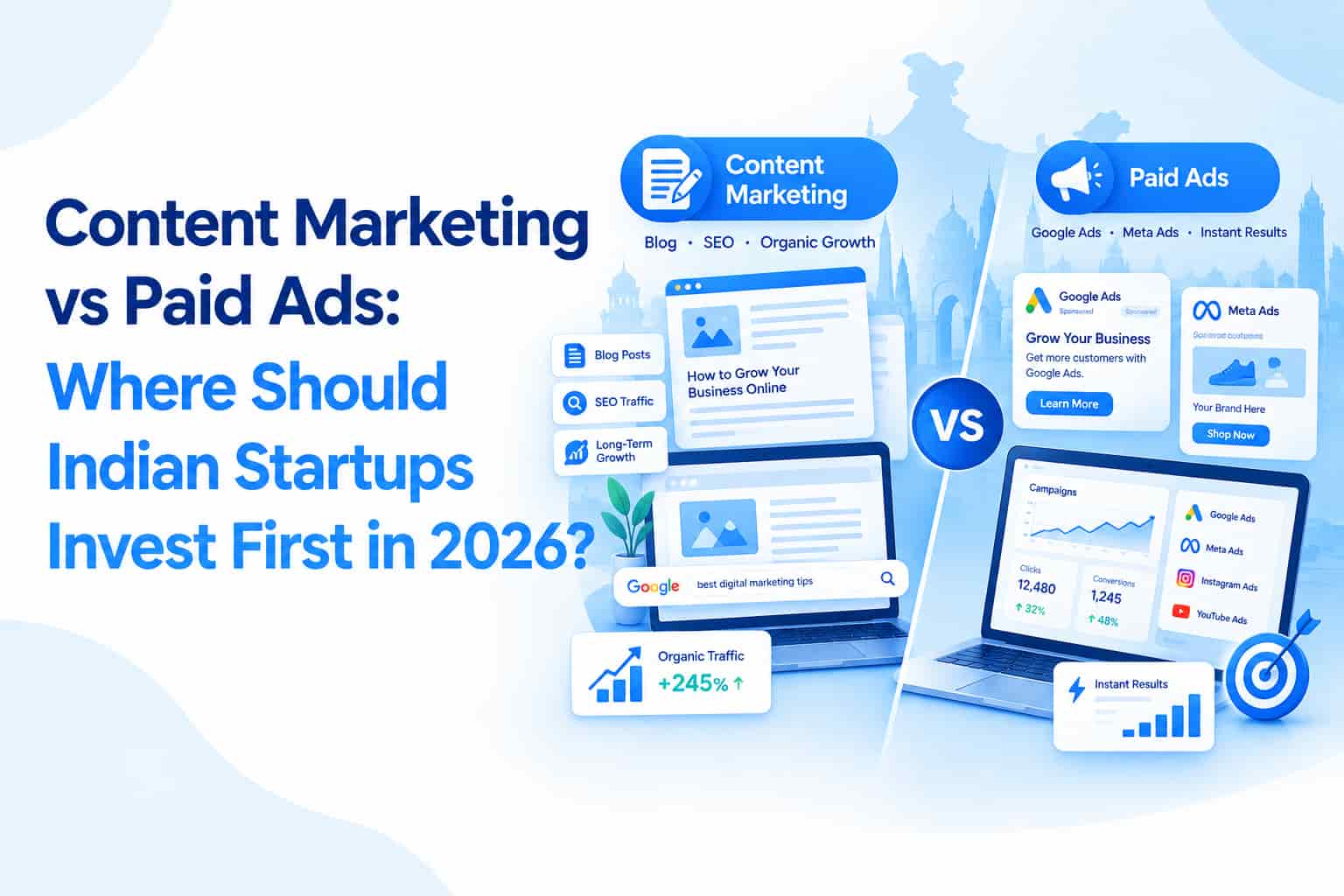
A seed-stage founder with a limited runway asks a version of the same question every quarter: put the marketing budget into ads that bring traffic starting tomorrow, or content that might not pay off for six months? Both answers are defensible — the actual mistake is treating this as a permanent either/or choice rather than a sequencing decision that changes as the startup matures.
What Paid Ads Actually Deliver Early On
Paid advertising's core advantage is speed and control — a campaign launched today can bring qualified traffic and measurable conversion data within days, which is exactly what an early-stage startup needs to validate messaging, pricing, and audience fit before committing to a longer content strategy. The tradeoff is equally direct: the traffic stops the moment the budget stops, and costs in competitive Indian categories (₹50–₹180+ CPC in finance, legal, and B2B software) can eat through a limited runway fast without disciplined tracking.
What Content Marketing Actually Delivers — And When
Content's core advantage is compounding: an article, guide, or resource published today keeps generating traffic and leads for years without ongoing spend, and organic search traffic converts at meaningfully higher intent than most paid social traffic. The tradeoff is equally real — meaningful ranking movement for competitive terms typically takes several months, which is longer than most early-stage runways can comfortably absorb without another revenue source in the meantime.
A Practical Sequencing Framework for Indian Startups
Pre-product-market-fit: Lean toward paid, but small and disciplined
Use paid ads primarily as a fast feedback loop — testing which messaging, audience, and value proposition actually converts — rather than as a scalable growth channel yet. Content at this stage should be minimal: enough to support the ads (landing pages, basic proof points) rather than a full publishing calendar.
Early traction, some repeatable revenue: Start content in parallel
Once messaging is validated by paid data, that same validated messaging becomes the foundation for content that will compound over the next 6-12 months. Running both simultaneously here — paid for immediate pipeline, content for the future pipeline — is more efficient than sequencing them fully, since content built now starts working exactly when paid costs typically rise with more competition.
Growth stage: Content should be doing real work by now
By this stage, a startup that started content early should be seeing organic traffic contributing a meaningful share of total leads, which reduces dependence on rising paid acquisition costs and gives the business a channel that doesn't scale linearly with spend.
The Real-World Numbers That Should Drive the Decision
Organic search traffic converts at roughly double the rate of typical paid social traffic in aggregate benchmarks (around 3.75% for Google Search versus 1.85% for Meta), and customers acquired through organic channels have shown 5–15x higher lifetime value than paid-acquired customers in B2B SaaS specifically. These numbers argue strongly for starting content earlier than most cash-constrained founders intuitively choose to — the compounding benefit is easy to underweight when a founder is focused on this month's numbers.
Frequently Asked Questions
Can a pre-revenue startup afford to invest in content at all?
Even a small, consistent content effort (one to two genuinely useful pieces a month, tied to validated messaging) starts building compounding value earlier than waiting until there's "enough" budget for a full content program.
Should paid ads stop once content starts working?
Rarely — most mature companies run both together, using paid for immediate pipeline and specific campaigns, and content for the compounding baseline that reduces overall acquisition cost over time.
How long before content marketing shows measurable ROI for a startup?
Most competitive B2B and consumer categories in India see initial movement in 3-6 months, with real compounding returns from month 6-12 onward — a timeline that should factor directly into runway planning.
Making the Sequencing Decision Deliberately
The startups that get this right aren't the ones who pick a side in the content-versus-ads debate — they're the ones who sequence deliberately based on stage, runway, and how quickly they need feedback versus how much they can afford to invest in something that compounds later. OM Enterprises helps Indian startups build exactly this kind of staged content and paid strategy rather than defaulting to one or the other.