

ChatGPT Prompts for Marketers: How to Get Useful Output Instead of Generic AI Content

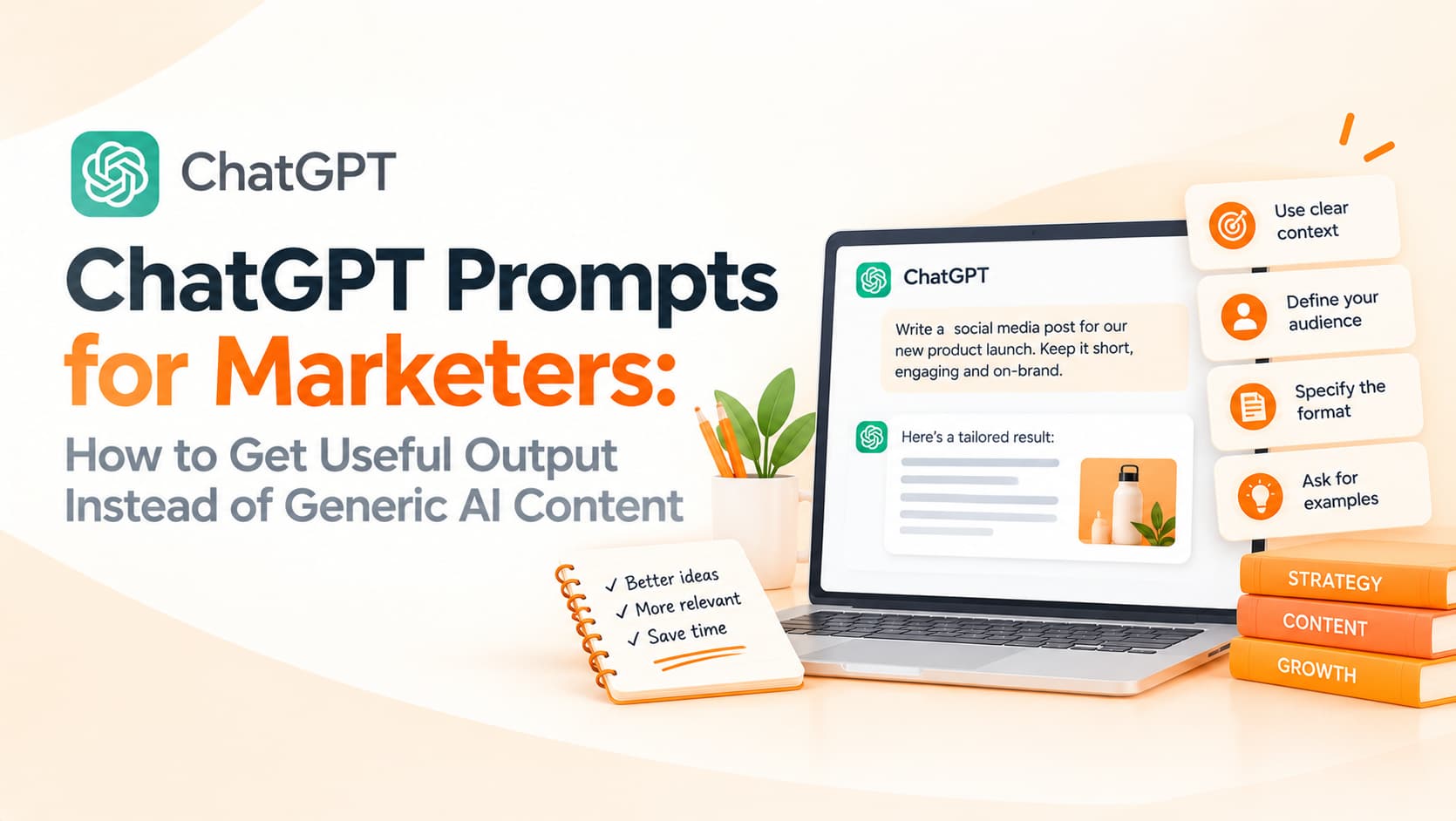
Ask an AI assistant to "write an Instagram caption for my bakery" and you will get something cheerful, full of emojis and almost identical to captions thousands of other bakeries have already posted. Ask it to "write a blog about digital marketing" and you will receive a bland overview that nobody wants to read. Many marketers try AI tools, get disappointing results and conclude that AI is only good for filler.
The problem is usually not the tool. It is the prompt. AI assistants such as ChatGPT, Claude and Gemini respond to the context and instructions they are given. Vague prompts produce vague content. Specific, well-structured prompts can produce genuinely useful drafts, ideas and analysis that save hours every week.
Why generic prompts fail
An AI model has no idea who your customers are, what makes your business different, which tone fits your brand or what has worked for you before. Without that information, it falls back on the most average version of whatever you asked for. The result reads like everything else online, because in a sense it is an average of everything else online.
The fix is to give the assistant the same briefing you would give a capable new team member on their first day: who the audience is, what the goal is, what the constraints are and what good looks like.
The elements of a strong marketing prompt
A useful prompt usually covers several things. Start with the role and context, for example "You are helping a family-run bakery in Ludhiana that has sold eggless cakes since 2015." Describe the audience: "Our customers are mostly working parents aged 28 to 45 who order birthday cakes on WhatsApp." State the goal clearly: "We want more advance orders for Diwali gift hampers." Explain the format and length: "Write five Instagram captions, each under 40 words." Describe the tone: "Warm, slightly playful, never pushy, with occasional Hinglish." Add constraints: "Do not mention discounts, do not use more than two emojis and avoid clichés like 'indulge'." Finally, provide examples of past posts that performed well, so the assistant can match your style.
The difference in output between a one-line prompt and a briefing like this is dramatic.
Practical prompt ideas for marketing tasks
For ad copy, give the assistant your product, audience, the main benefit, common objections and the platform's character limits, then ask for several distinct angles rather than small variations. For example, ask for one version focused on price, one on convenience, one on trust and one on emotion. This also suits ad platforms that reward creative diversity.
For content planning, describe your business, audience and goals, and ask for a month of content ideas grouped by theme, each with a suggested format and a one-line hook. Then pick the ideas that fit and ask for outlines.
For customer research, paste anonymised reviews, survey responses or common sales objections and ask the assistant to identify recurring themes, frustrations and the exact phrases customers use. Those phrases often become your strongest headlines.
For email and WhatsApp messages, provide the purpose, the customer segment and the action you want, and ask for short versions suited to each channel. Remember that business SMS and WhatsApp templates in India have specific approval rules, so AI drafts still need to fit those requirements.
For SEO, ask for a content brief rather than a finished article: the questions searchers are likely to have, a logical outline and the points an expert would add. Then write or heavily edit the content with your own experience.
Iterate rather than accept the first answer
Treat AI as a collaborator. If the first draft is too formal, say so. If it misses an important point, add it. Ask the assistant to critique its own draft against your goal, or to rewrite a section for a different audience. A few rounds of refinement usually produce far better results than repeatedly starting again with new prompts.
Safeguards every marketing team needs
AI tools can state incorrect facts confidently, so verify statistics, regulations, dates and product claims before publishing. Do not paste confidential customer data, financial details or sensitive business information into public tools without understanding how that data is handled, and consider India's data protection obligations. Keep a human editor responsible for every published piece, particularly anything involving health, finance, legal claims or advertising standards. And add your own experience; content that includes real examples, case studies and opinions is far more valuable than anything an AI can generate on its own.
Frequently asked questions
Can AI write all our marketing content?
It can draft and accelerate many tasks, but human judgement, brand knowledge and fact-checking remain essential.
Which AI assistant is best for marketing?
Several tools work well. The quality of your prompts and editing matters more than the specific tool.
Will AI-written content hurt SEO?
Low-value content hurts regardless of who writes it. Content that is genuinely useful and accurate is what matters.
Use AI to work smarter
OM Enterprises combines AI-assisted workflows with experienced marketers to produce content, campaigns and analysis that are faster to create and still genuinely yours. Talk to our team.