

Bulk SMS vs WhatsApp Marketing: Which Channel Wins in 2026?

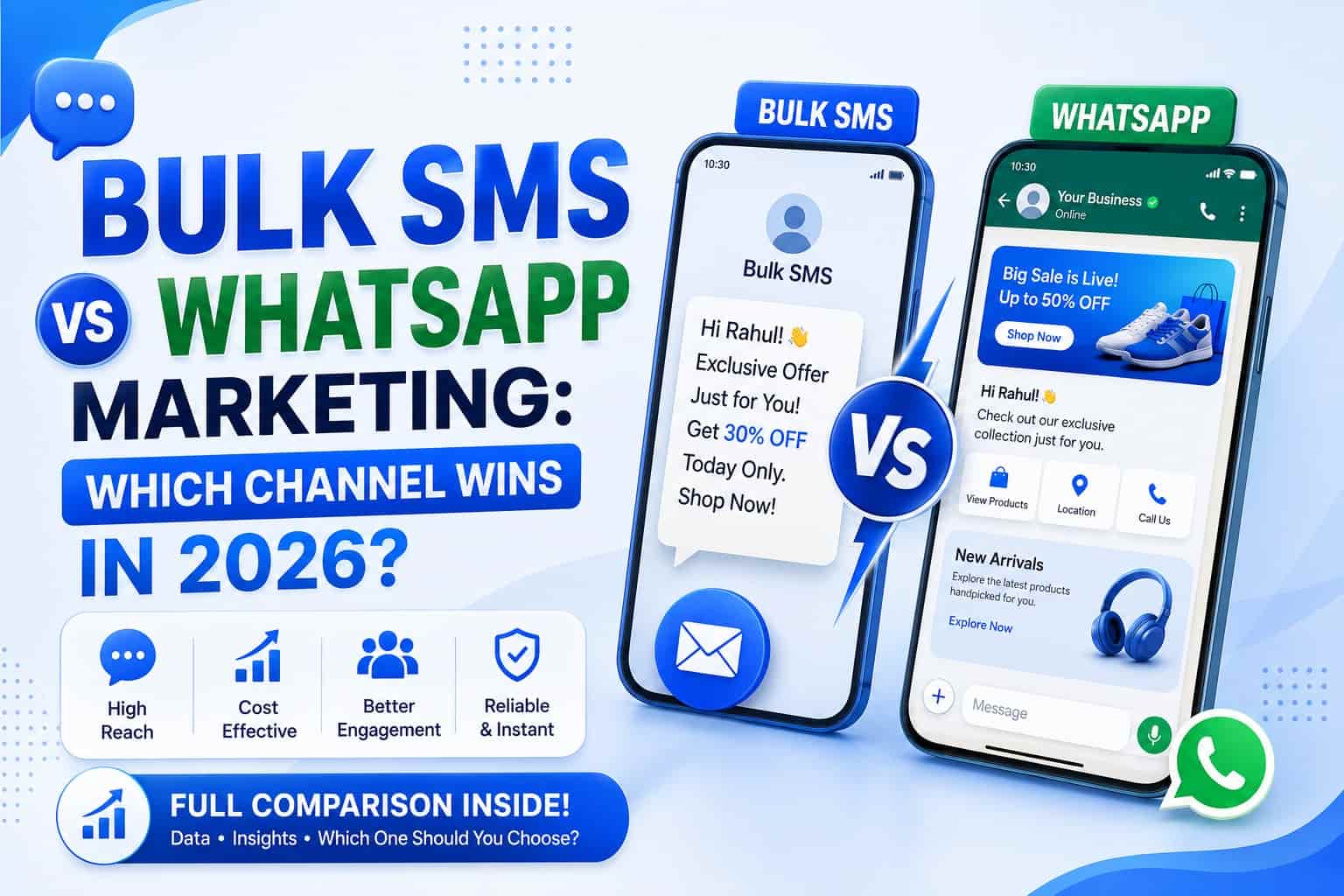
Two Giants of Mobile Marketing
Bulk SMS and WhatsApp marketing are the two most reliable ways to reach customers directly on their phones. Both have strengths, and the right choice often depends on your industry, budget, and audience.
How We Got Here: The Evolution of Mobile Messaging Marketing
SMS marketing has been around since the earliest days of mobile phones, valued for its simplicity and universal compatibility. WhatsApp, originally a personal messaging app, opened its Business API to companies as demand grew for richer, more conversational customer interactions. Today both channels coexist as mature, proven marketing tools — the question for most businesses isn't which one is "better" in the abstract, but which fits a specific use case.
Bulk SMS: Universal Reach, Zero Friction
Every mobile phone can receive SMS — no app, no internet, no opt-in through a third-party platform required. This makes bulk SMS the most dependable channel for time-sensitive alerts like OTPs, payment reminders, and delivery updates. Open rates for SMS remain among the highest of any marketing channel.
WhatsApp Marketing: Rich Media, Deeper Conversations
WhatsApp Business API allows brands to send images, catalogs, PDFs, and interactive buttons, and to hold ongoing two-way conversations. It works best for businesses with an engaged, opted-in audience who expect richer content, such as e-commerce catalogs or customer support threads.
Cost and Compliance Differences
SMS pricing is simple and predictable per message. WhatsApp Business messaging uses conversation-based pricing and requires template pre-approval for marketing messages, along with strict opt-in rules to avoid account bans.
Side-by-Side Comparison
| Factor | Bulk SMS | WhatsApp Marketing |
|---|---|---|
| Reach | Every mobile number | Only opted-in WhatsApp users |
| Setup time | Minutes | Requires template approval |
| Rich media support | No | Yes — images, PDFs, catalogs |
| Typical open rate | Very high, near-instant | High, but opt-in dependent |
| Pricing model | Flat per-message | Conversation-based |
| Best for | OTPs, alerts, reminders | Catalogs, support, nurturing |
When Bulk SMS Is the Better Choice
Choose SMS when the message is time-critical and must reach absolutely everyone regardless of app installs — OTP verification, service outage alerts, payment due reminders, and delivery notifications all fall into this category. Its simplicity is its strength: no template rejection risk, no opt-in gatekeeping.
When WhatsApp Is the Better Choice
Choose WhatsApp when you want to build a relationship, not just deliver a notification. Product catalogs, order support with images, appointment booking via buttons, and post-sale nurturing sequences all benefit from WhatsApp's richer format and two-way conversation flow.
Industry Examples: Which Channel Wins Where
E-commerce: SMS for order and shipping confirmations; WhatsApp for browsing catalogs, answering pre-purchase questions, and post-purchase support. Healthcare: SMS for appointment reminders and OTP-based patient verification; WhatsApp for sharing reports, prescriptions, and answering routine patient questions. Banking and finance: SMS for transaction alerts and OTPs, where speed and universal delivery are non-negotiable; WhatsApp for statement delivery, loan inquiries, and relationship banking conversations. Education: SMS for exam alerts and fee-due reminders; WhatsApp for sharing study materials, admission updates, and parent-teacher communication.
Building a Combined SMS + WhatsApp Strategy
Rather than choosing one channel exclusively, many businesses map each customer touchpoint to the channel best suited for it — SMS for anything urgent or universal, WhatsApp for anything relationship-driven or media-rich — and use a single platform to manage and report on both, so messaging stays consistent regardless of which channel a customer receives it through.
Common Pitfalls to Avoid
- Treating WhatsApp like SMS: Sending plain, generic text ignores the platform's rich-media strength and lowers engagement.
- Ignoring WhatsApp opt-in requirements: Marketing messages sent without proper opt-in can get your business account restricted.
- Relying on a single channel: Businesses that only use one channel miss either the guaranteed reach of SMS or the deeper engagement of WhatsApp.
Which Should You Choose?
Most businesses in 2026 don't have to pick just one. A layered strategy — SMS for critical, universal alerts and WhatsApp for rich, relationship-driven marketing — consistently outperforms either channel used alone.
Conclusion
Choosing between bulk SMS and WhatsApp marketing doesn't have to be an either-or decision. The smartest businesses in 2026 combine bulk SMS marketing for guaranteed, time-sensitive reach with WhatsApp Business marketing for rich, relationship-building conversations. If you're comparing SMS marketing services, WhatsApp Business API providers, or looking to build a bulk messaging strategy, start by mapping your use cases to the channel strengths above — then layer both channels for maximum customer engagement and ROI.