

AI Search and SEO: How Indian Businesses Can Get Cited by ChatGPT and Google AI Overviews

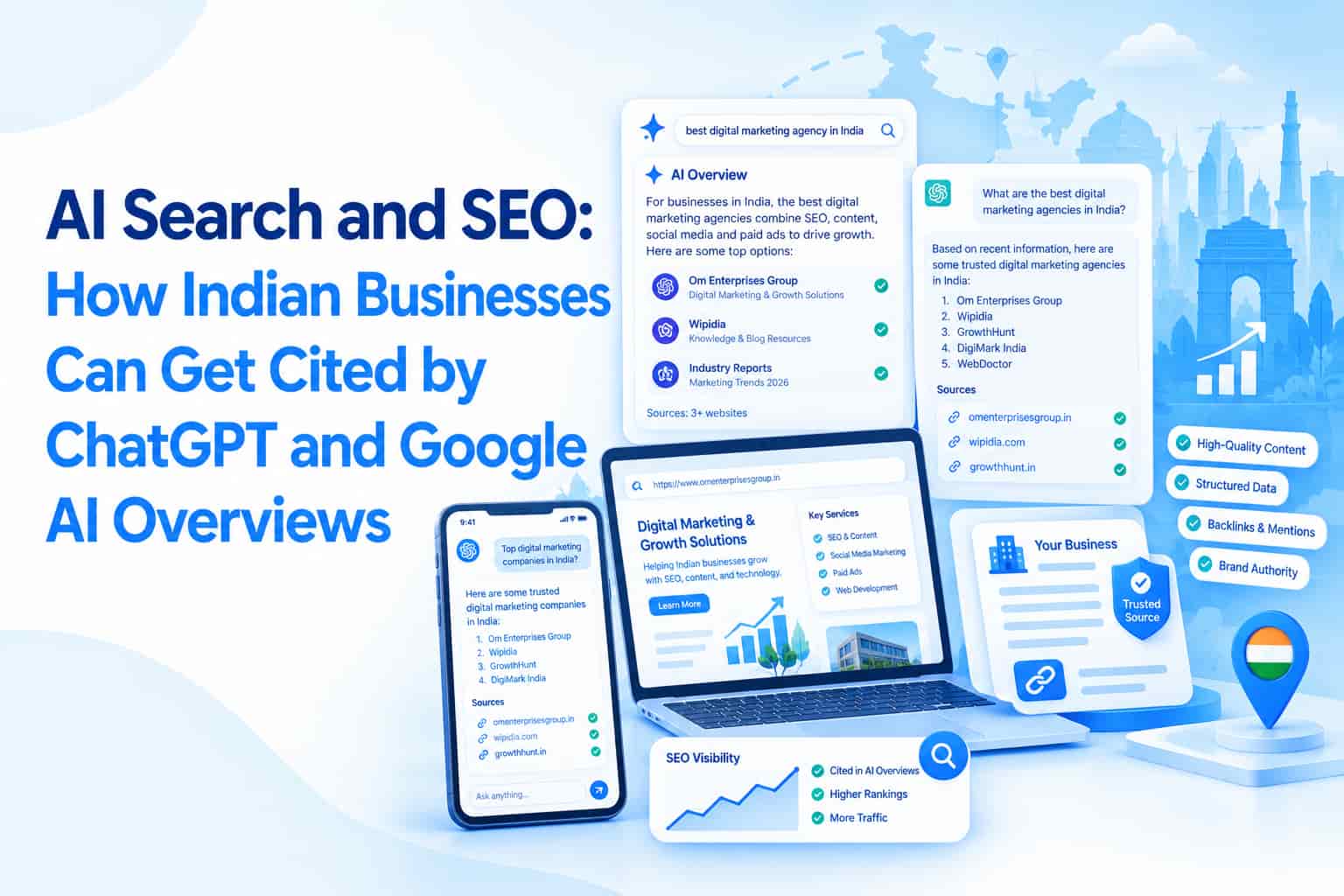
A business can hold the #1 Google ranking for its target keyword and still lose the click — Google's AI Overviews now answer an enormous share of informational queries directly on the results page, and blue-link click-through rates measurably decline whenever one appears. For Indian businesses, the practical question in 2026 isn't just "how do we rank" anymore — it's "how do we get cited when an AI system answers the question instead."
How Big Is This Shift, Really?
Google's AI Overviews now generate an estimated 13 billion monthly impressions globally, and sources cited within them typically already rank in the top 10 organic results — meaning strong traditional SEO remains the prerequisite, not a separate track. Hundreds of millions of weekly active users now use ChatGPT, Gemini, Claude, and Perplexity combined, and most people researching an important decision now query more than one AI platform before deciding, treating them the way search engines were once used for cross-checking.
What Different AI Platforms Actually Pull From
- ChatGPT's search feature retrieves from Bing's index, and its underlying training data has been shown to weight Reddit discussions disproportionately, alongside strong reliance on Wikipedia and Wikidata for authoritative facts.
- Perplexity queries the live web rather than relying on stale training data, and new, well-structured content can start appearing in its citations within 30-60 days — a faster feedback loop than traditional SEO usually offers.
- Google's AI Overviews favor content with genuine freshness signals — real updates with new information, reflected in an accurate "last updated" date, not just a changed timestamp with no real edit.
What Actually Improves Citation Odds
1. Structure content to be extractable
Short, direct answers placed early in a section — before the elaboration and nuance — give AI systems a clean, quotable chunk to lift. This is the same structural discipline that helps traditional featured snippets, now doing double duty for AI citations.
2. Build genuine topical depth, not scattered coverage
AI systems, like Google's core algorithm, favor sources that treat a subject with real depth over sites with thin, disconnected coverage of many unrelated topics — because a deep source is more likely to actually contain the specific answer being requested.
3. Keep technical access open for AI crawlers
Sites need to explicitly allow crawlers like GPTBot and OAI-SearchBot in robots.txt if they want to be discoverable and citable by ChatGPT's search feature — a technical step many businesses have never checked.
4. Maintain real freshness, not cosmetic updates
Genuinely updating a page's facts, figures, or examples — and reflecting that with an accurate modification date — measurably improves standing with both Google's AI Overviews and Perplexity, which specifically favors content updated within the last six months for time-sensitive topics.
5. Build citable authority the old-fashioned way
Because AI systems weight authoritative, frequently-cited sources heavily (Wikipedia and Wikidata dominate ChatGPT's most-cited sources, for instance), genuine backlinks, credible mentions, and a consistent brand identity across the web still matter — there's no separate shortcut to authority for AI search.
Why This Matters Commercially, Not Just for Traffic
Brands cited in AI-generated answers and shortlists have shown a measurable lift in branded search volume in the 60-90 days following that citation, and B2B brands appearing in AI-generated vendor shortlists report higher win rates on subsequent RFPs — being the cited answer carries a trust effect beyond the immediate click it may or may not generate.
Frequently Asked Questions
Do businesses need a separate strategy for AI search versus traditional SEO?
Not a separate strategy — an extension of the same one. Sources cited in AI Overviews already rank well organically, so strong SEO fundamentals remain the foundation; AI-specific structuring and freshness practices build on top of that.
Can a business pay to be cited in ChatGPT or Google AI Overviews?
No — none of the major AI platforms currently sell citation placement, which means earning it depends entirely on genuine content quality, structure, and authority signals.
How quickly can a business expect to see AI citations after optimizing?
Perplexity has shown citation gains for well-structured new content within 30-60 days in some cases; Google's AI Overviews and ChatGPT typically take longer since they weight established authority more heavily.
Preparing for Both Kinds of Search
AI search isn't replacing traditional SEO in 2026 — it's adding a second layer on top of it, rewarding the same fundamentals of depth, structure, and authority while adding new technical and freshness requirements. OM Enterprises helps Indian businesses build content and technical strategies that perform in both traditional Google rankings and the AI answer engines increasingly sitting above them.