

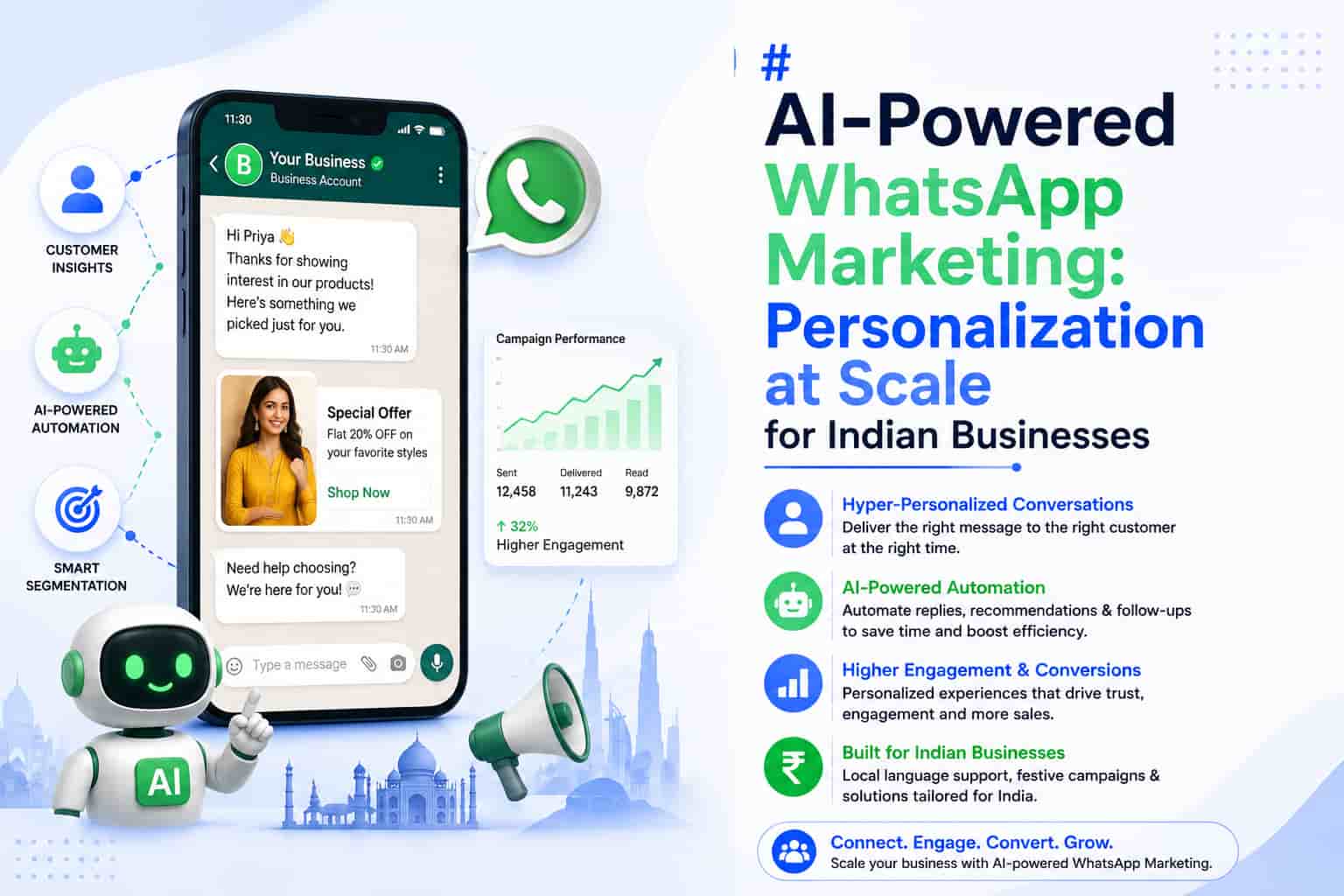
AI-Powered WhatsApp Marketing: Personalization at Scale for Indian Businesses

Why WhatsApp Is Becoming an AI-First Channel
WhatsApp is the default messaging app for hundreds of millions of people in India, which is exactly why it has become one of the most competitive marketing channels in the country. Sending the same broadcast message to an entire customer list no longer works the way it once did — open rates hold up, but engagement and conversion suffer when messages feel generic. In 2026, the businesses winning on WhatsApp are the ones using AI to personalize every message at a scale manual segmentation could never match.
What "Personalization at Scale" Actually Means
Personalization at scale isn't about greeting a customer by first name — that's table stakes. It means using AI to dynamically select the product, offer, tone, and even send-time for each individual recipient based on their browsing history, purchase behavior, location, and past engagement with your brand, and doing this automatically across thousands or millions of contacts without manual list-building for every campaign.
1. AI-Driven Audience Segmentation
Instead of static segments built manually in a spreadsheet, AI models continuously re-score customers based on recency, frequency, and value of their interactions. A customer who abandoned a cart yesterday, one who just made a repeat purchase, and one who hasn't engaged in three months should never receive the same WhatsApp message — AI segmentation makes sure they don't.
2. Dynamic Message Generation
Generative AI can produce multiple variations of the same core message — different tones, different product highlights, different calls-to-action — and automatically match the variation most likely to resonate with each segment, based on what has performed well with similar customers previously.
3. AI Chatbots for Two-Way Conversations
Personalization doesn't stop at the outbound message. When a customer replies, an AI-trained chatbot can continue the conversation — answering product questions, recommending alternatives, or collecting preferences — using the business's actual catalog and policies rather than generic scripted responses.
4. Predictive Send-Time Optimization
AI models can learn when each individual customer is most likely to open and respond to a WhatsApp message, and schedule delivery accordingly, rather than sending an entire campaign at one fixed time for everyone.
5. Behavioral Trigger Campaigns
Cart abandonment, browsing without purchase, a subscription about to expire, a delivery in transit — each of these events can trigger an AI-personalized WhatsApp message automatically, without a marketer manually building a new campaign for every scenario.
Building a Compliant, Consent-First AI WhatsApp Strategy
Personalization only works if customers have opted in and continue to find the messages useful. Indian businesses using WhatsApp Business API for marketing need explicit opt-in, clear opt-out options in every conversation, and message templates approved through Meta's business messaging policies. AI personalization should make messages more relevant, not more frequent — sending smarter messages less often typically outperforms sending generic messages more often.
A Practical Rollout Plan
- Start with one high-value use case — cart abandonment or post-purchase follow-up are usually the fastest to show ROI.
- Connect your customer data so the AI has real purchase and browsing history to personalize against, not just a name and phone number.
- Set clear guardrails on tone, frequency, and escalation to a human agent when the AI chatbot can't resolve a query.
- Measure beyond open rate — track click-through, conversion, and opt-out rate for each AI-personalized segment.
- Expand gradually to more triggers and segments once the first use case is proven.
Common Mistakes to Avoid
- Over-personalizing to the point of feeling intrusive: referencing very specific browsing behavior can feel unsettling rather than helpful — keep personalization relevant, not invasive.
- Ignoring the human handoff: an AI chatbot that can't recognize when to transfer a frustrated customer to a person will damage trust quickly.
- Treating WhatsApp like email: WhatsApp is a higher-trust, higher-intimacy channel than the inbox — the frequency and tone that work in email marketing will feel like spam here.
FAQs
Is AI-powered WhatsApp marketing only for large businesses?
No. Many WhatsApp Business API and messaging platforms now offer AI segmentation and chatbot tools built for small and mid-sized businesses, not just large enterprises with dedicated data science teams.
Does AI personalization require a large customer database?
It helps, but even a modest amount of purchase and engagement history is enough to start with meaningful segmentation — the AI's usefulness grows as more data accumulates over time.
Conclusion
AI-powered WhatsApp marketing is shifting the channel from mass broadcast messaging toward genuinely one-to-one communication at scale. Indian businesses that combine AI-driven segmentation, dynamic content, and well-guardrailed chatbots with a consent-first approach will see stronger engagement and conversion than those still sending one message to their entire list. Start with a single behavioral trigger, measure real outcomes beyond open rate, and expand your AI WhatsApp marketing strategy as the data proves its value.