

AI Content Writing vs Human Writing: What Actually Ranks for Indian Businesses in 2026

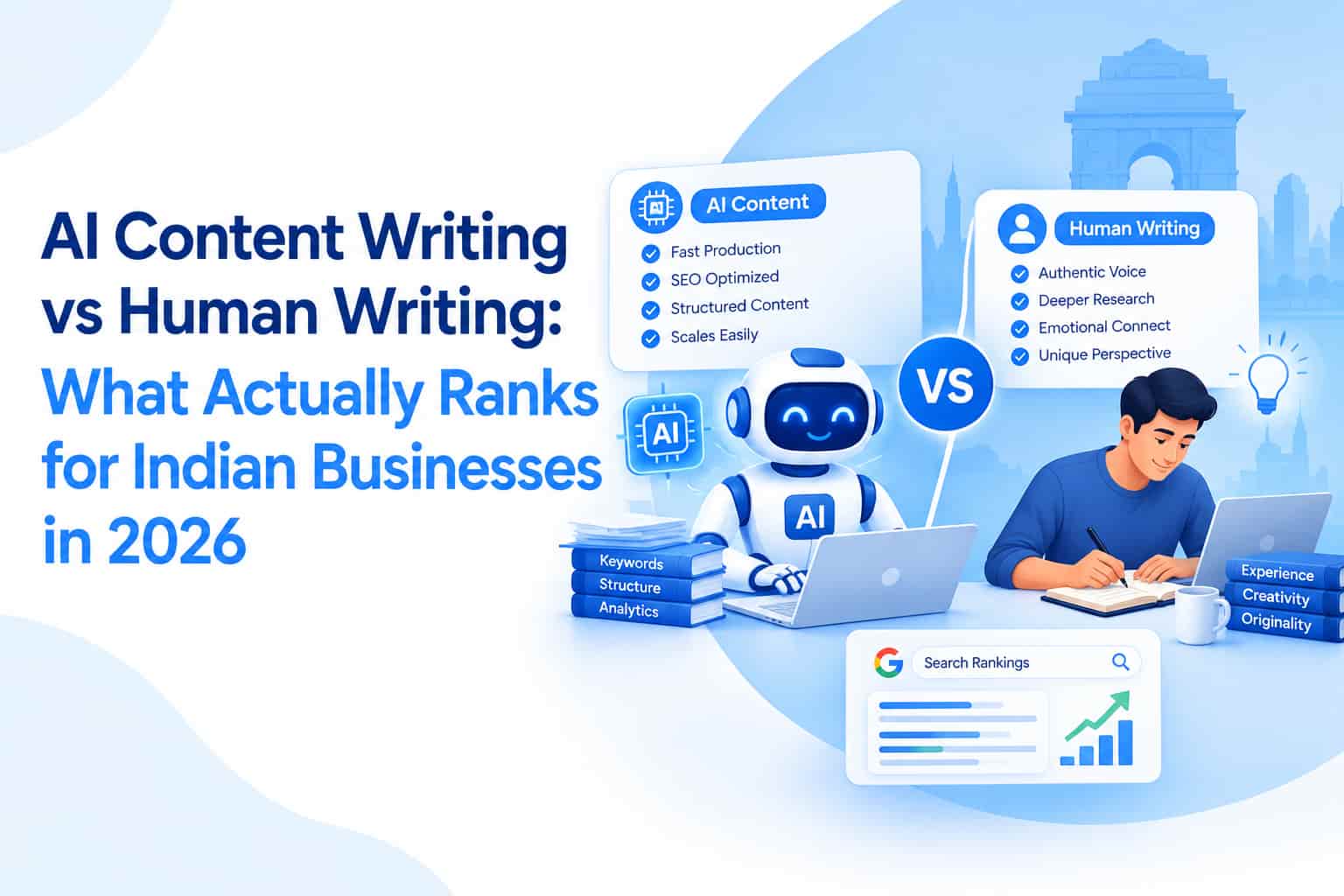
A business owner cancels their content writer's retainer, switches to an AI tool, publishes twice as much — and traffic doesn't move, or drops. Another business does the same thing and sees a genuine increase. The difference almost never comes down to "AI vs human" as a category. It comes down to whether anyone with real expertise reviewed, corrected, and improved what the AI produced before it went live.
What the Actual Data Shows
Semrush's widely cited research found AI-assisted and human-written articles landing in Google's top 10 at nearly identical rates — 57% for AI-assisted content versus 58% for human-written content. That's close enough to call it parity, not a decisive win for either side. Separately, 39% of marketers reported traffic increases after adding AI content to their workflow, and 33% said their AI-produced pieces outperformed human-written equivalents — but the critical detail is that 73% of those marketers used a hybrid process with human editorial oversight, not unedited AI output published as-is.
Where AI Genuinely Helps
- Headlines and hooks: one documented case at a Danish news outlet found AI-crafted headlines drove a 59% higher click-through rate than journalist-written ones — machines are often good at spotting curiosity-triggering phrasing patterns.
- Structure and depth at scale: using AI tools to enhance content depth and structure, one media outlet reported a 73% reduction in bounce rate alongside 61% more visits.
- First-draft speed: AI can compress the blank-page problem from hours to minutes, freeing up human time for research, fact-checking, and the parts that actually require judgment.
Where AI Content Fails Without Human Oversight
Google has been explicit that it penalizes mass-produced, low-quality, unhelpful content — regardless of whether a human or an AI wrote it. The failure pattern is consistent: unedited, bulk-published AI content trends toward generic phrasing, repetitive structure, and shallow treatment of a topic, which fails to hold reader attention and signals low quality to both readers and search algorithms. For an Indian business, this usually shows up as content that reads correctly but says nothing a competitor's page doesn't already say — no local examples, no real numbers, no actual point of view.
A Practical Hybrid Workflow for Indian Businesses
- Research first, independent of the AI tool — gather real data, local examples, and current facts before drafting anything.
- Draft with AI assistance for structure and speed, using the researched material as input rather than letting the tool invent facts.
- Have someone with actual subject knowledge edit for accuracy, local relevance, and genuine insight — the step most businesses skip when trying to scale.
- Add specifics an AI wouldn't know — a real customer scenario, a regional detail, a number from the business's own experience.
- Fact-check every statistic and claim before publishing, since AI tools can produce confident, plausible-sounding numbers that are simply wrong.
Frequently Asked Questions
Does Google penalize AI-written content specifically?
No — Google's stated policy targets low-quality, unhelpful, mass-produced content regardless of how it was created. Well-researched, edited, genuinely useful content performs comparably whether AI-assisted or fully human-written.
Is it safe to publish AI content without any editing?
Not for a business that depends on search traffic — the businesses reporting real gains from AI content overwhelmingly used human oversight, not unedited output.
Should a small business abandon AI tools entirely and hire only human writers?
Not necessarily — a hybrid approach (AI for speed and structure, human review for accuracy and depth) is what the data actually supports, not a strict either/or choice.
The Actual Lesson
The debate isn't really "AI vs human" — it's "edited vs unedited," and "researched vs generic." Indian businesses getting real results from content in 2026 are the ones treating AI as a drafting tool inside a human-supervised process, not a replacement for one. OM Enterprises builds exactly this kind of hybrid content workflow for Indian clients — researched, AI-assisted, and human-reviewed before anything goes live.