

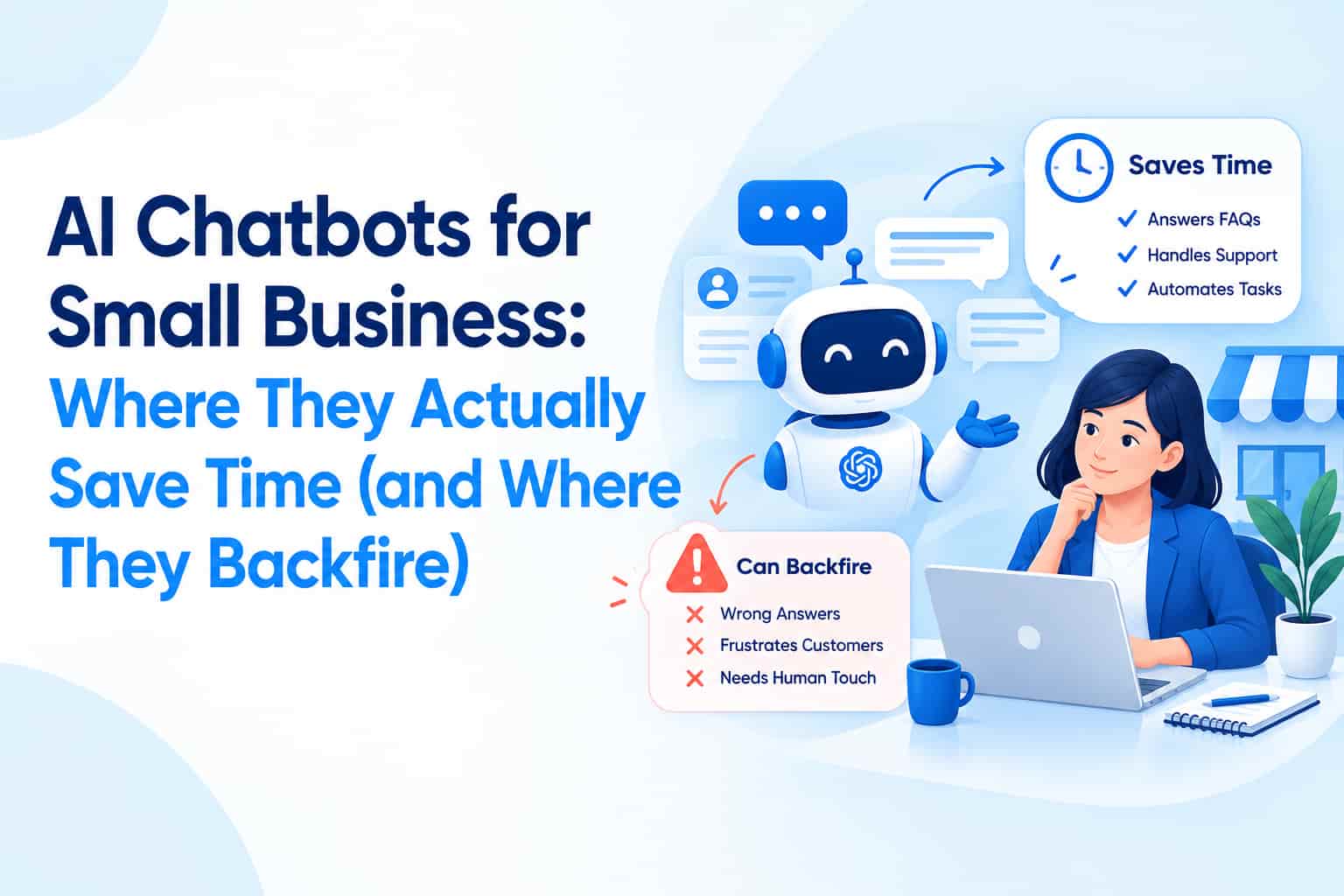
AI Chatbots for Small Business: Where They Actually Save Time (and Where They Backfire)

A customer messages a small business's Instagram page at 11pm asking about return policy. Nobody's awake to answer, so the reply comes eight hours later, by which point the customer has already bought the same product from a competitor who answered in ninety seconds. This is the actual business case for AI chatbots — not replacing staff, but closing the gap between when a customer asks and when a human is available to respond.
Where chatbots genuinely help
The first response, not the whole conversation
The strongest use case is instant acknowledgment and answering the handful of questions that come up constantly — hours, pricing ranges, return policy, availability — freeing staff to spend their time on the conversations that actually need a human: complaints, custom requests, anything emotionally charged.
Qualifying leads before a human gets involved
A well-built chatbot can ask the two or three questions a sales team always asks anyway — budget range, timeline, specific need — and hand off a warm, pre-qualified conversation instead of a cold "hi, interested in your services" message that a salesperson then has to interrogate from scratch.
After-hours coverage
Businesses that get a meaningful share of enquiries outside working hours see the clearest ROI, simply because the alternative wasn't a slower human response — it was often no response until the next morning.
Where they backfire
No visible way to reach a human
The single most common complaint about business chatbots is being trapped in a loop with no obvious escape to a real person. Every chatbot deployment needs a clear, easy trigger — "talk to a person," or automatic escalation after two failed attempts to understand the query.
Pretending to be human
Customers who realize mid-conversation that they've been talking to a bot that never disclosed it tend to feel misled, which damages trust more than the bot not existing at all would have. Simple disclosure at the start of the conversation avoids this entirely.
Being deployed on complaints or sensitive queries
A frustrated customer met with a scripted bot response, especially one that clearly hasn't understood the complaint, escalates frustration rather than resolving it. Complaint-shaped messages should route to a human immediately, not attempt automated resolution.
Getting started without overbuilding
Most small businesses don't need a custom-built AI system on day one. Starting with the handful of questions that come up most often — pulled straight from actual past customer messages — and building a simple, well-scoped bot around just those, with an easy human handoff, captures most of the available value at a fraction of the cost and risk of a broader deployment.
FAQ
Will customers mind talking to a bot?
Most don't, as long as it's disclosed and actually resolves their question quickly — the frustration comes from bots that fail to help or that hide the handoff to a human, not from automation itself.
Do I need a developer to set one up?
No — most WhatsApp, Instagram, and website chatbot platforms today offer no-code builders suitable for the common use cases (FAQs, lead qualification, appointment booking) without custom development.
How do I measure if it's actually working?
Track resolution rate without human handoff, average first-response time, and — most importantly — customer satisfaction on bot-handled conversations versus human-handled ones, so a well-intentioned bot doesn't quietly hurt satisfaction while looking efficient on paper.
Conclusion
The businesses getting real value from AI chatbots treat them as a first-response layer for predictable, common questions — not a replacement for judgment on anything that needs it. Get the scope right, keep a visible door to a human open at all times, and disclose what customers are talking to, and a chatbot becomes a genuine time-saver rather than the source of the next bad review.